
Last week saw the great gathering of French legaltech: the Rendez-vous des transformations du droit! The unmissable event for innovation in law was held on 26 and 27 November, and brought together more than 4,000 visitors and 80 exhibitors.
Prime Conseil was there, to meet friends and partners such as SmartPreuve, BirdsEye and Luminance. The perfect opportunity to (re)discover the best software and digital tools available for contract managers.
A. What realities lie behind the promises of artificial intelligence?
From the entrance, the tone was set, as the words "AI" or "Artificial Intelligence" were everywhere, on every screen, on everyone's lips. A quick glance at the programme (see screenshot below) makes it hard to miss the theme of the moment, since almost every conference and workshop was devoted to feeding you AI!
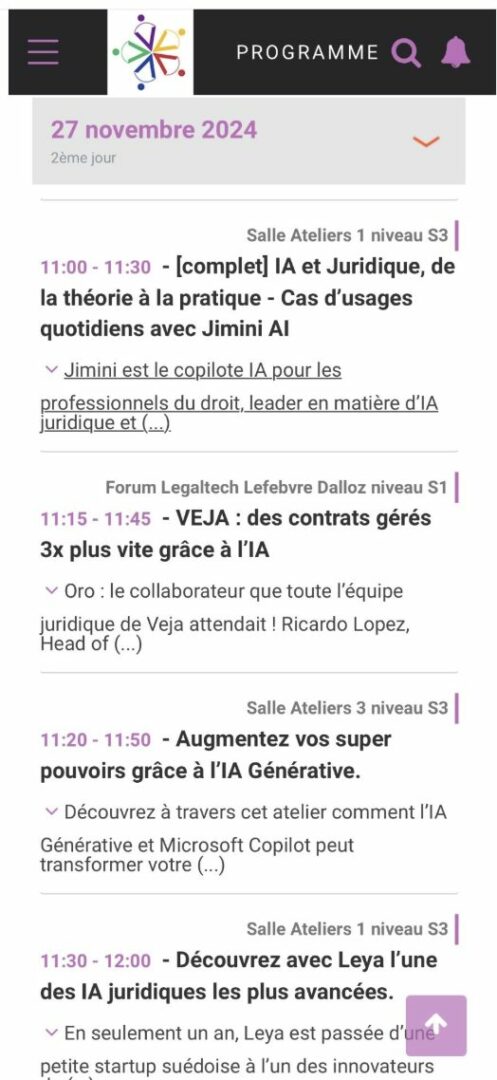
Browsing this programme, we discovered that OpenLaw wanted to present the "new normal", Autolex spoke of "machines that will soon be able to negotiate with each other", Doctrine explained "how to calmly navigate the shift to generative AI", and even the buzzword of the moment was picked up by the Ministry of Justice, which presented its "AI-integrated tool". In short, having read this programme, and then discovered on site the screens, banners and other marketing brochures full of promises of productivity gains, augmented contracts, superpowers and, more generally, the transformation of everyday life, we wanted to find out more about these tools that could affect contract management today and tomorrow. So we went to take a closer look at these vendors, to find out, concretely, what these pieces of software actually offer.
Let's get straight to the point: after walking the aisles and talking with numerous vendors, our seasoned eyes were left somewhat unsatisfied. Indeed, while we did note progress from some vendors, who now go further than a simple interface layer over OpenAI, MistralAI and the like (with a special mention for Luminance's LLM), it remains clear that this software – although labelled CLM – was not designed and developed for the practice of contract management, and mainly targets legal departments. Software vendors thus have fairly similar value propositions, covering – depending on the solution – between 10% and 25% of the contract lifecycle, namely drafting, a few fragments of negotiation, signature, and archiving. All aspects relating to risk and opportunity analysis, complex negotiations, the dissemination of key information (we're not talking about effective dates here…), the management of key deadlines (again, we're not talking about simple renewals but essential milestones), claims, contract deviations, and so on, are not addressed by vendors. Discussions with a few of them confirmed that these projects are not on the product "roadmap" of the vast majority of vendors.
Vendors' promises of AI-driven transformation therefore seem to concern only lawyers, since from a contract manager's point of view, none of these solutions offers a revolution, still less superpowers (whereas we naively hoped to leave this conference knowing how to fly and having acquired the gift of ubiquity). So we came away from this event empty-handed, but on the way back, taking a step back, we also told ourselves that, looking on the bright side, the survival of our profession seems, for now, far from threatened by an all-powerful AI!
B. Innovation in contract management: going beyond AI
It would, however, be reductive to equate this Rendez-vous des transformations du droit with an AI summit. Indeed, beyond the AI-related themes in the spotlight, other very interesting topics – notably for contract managers like us – were also covered over these two days. For example, we saw GinoLegalTech run a workshop on integrating CSR into contracts, and another on contractual data, we attended a workshop on managing complex contracts with Scale Up Legal, and we heard Deloitte address the topic of CLM through the lens of supply chain.
These are all topics relevant to the day-to-day practice of contract management, and are likely to build bridges between legal departments and contract management departments. In this respect, even if the contract manager is not the "target" of an event such as this Rendez-vous des transformations du droit, this event (in the absence of a similar event dedicated to contract management?) is well worth the visit, allowing people to exchange views and share best practices on topics that matter today and will matter tomorrow in contract management (CSR, supplier contract management, as well as plain language and communication).
So, at the end of the day, one question remains: what is innovation in contract management? At Prime Conseil, we believe that reducing innovation to AI, and more generally to digital tools, is a mistake, and that depending on an organisation's level of maturity in this area, innovation lies above all in the teams and processes put in place. Indeed, innovation goes beyond simply equipping oneself with tools from this or that vendor; it lies rather in the "people-process-technology" triptych too often neglected by organisations.

C. Not such a mixed verdict after all
As we finish writing these lines, we realised that almost a year has passed between our first article on artificial intelligence in contract management and this event. That is certainly why we left this event with mixed feelings, torn between disappointment and hope.
Indeed, we must acknowledge that there has been very little (if any) innovation in artificial intelligence for contract management in 2024. The features on offer, and more generally the issues addressed by vendors, remain the same (redlining, template creation, approval and signature processes, etc.) and are aimed at lawyers rather than contract managers. To illustrate, the post-signature phase of the contract lifecycle is almost entirely overlooked (with the exception of the contract repository/library, which is of very limited interest) by vendors. The limited ambition and lack of interest shown by CLM players in contract management is both surprising given the size of the market, and understandable given its complexity.
But on the other hand, to look on the bright side (and above all to end this article on a positive note), we were sometimes pleasantly surprised to see certain AI models improving on contractual matters, becoming more refined and more relevant, with fewer errors and hallucinations. This suggests that these tools may soon be used for more than legal secretarial work or contract administration… and perhaps one day will interest contract managers too!