
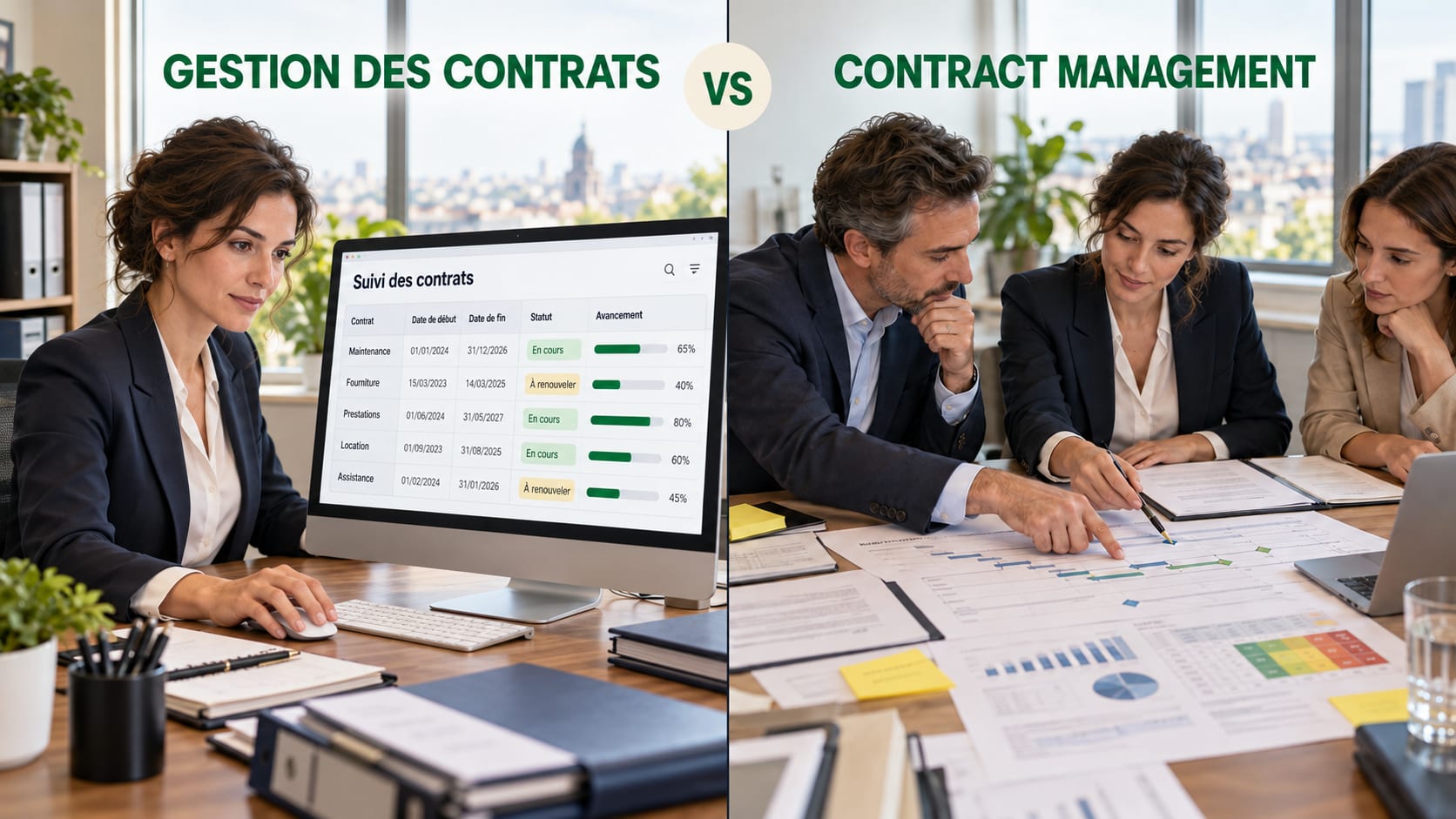
In theory, the term "gestion des contrats" should be the literal French translation of what our English-speaking friends call "contract management". In practice, any seasoned contract manager will have noticed that these two terms do not mean the same thing. The French meaning usually refers to contract administration, whereas the English version is broader. What might at first glance seem like a mere semantic shift actually weighs on the profession, and more broadly on the place a business gives to its contracts.
"Gestion des contrats": a literal translation with practical limits
As we saw above, on paper "gestion des contrats" would be the most faithful translation of contract management. In practice, when an organisation talks about "managing its contracts", it is usually referring to administrative matters such as: where are my contracts stored? who needs to sign the contracts? or when do they expire?
Software vendors bear much of the responsibility for distorting this key term, and for how organisations understand what "gestion des contrats" covers. CLM (contract lifecycle management) solutions meet a real need, and their vendors have invested heavily to dominate the phrase, even in search engine results. Over time, "gestion des contrats" has come to mean whatever a CLM can do: store, index, alert.
Faced with the cannibalisation of the term "gestion des contrats", another translation emerged: "contract management & administration", especially among public bodies keen to use the French language. This alternative, less faithful to the original, has the merit of putting action back at the centre, but also a significant limitation, since the term is often understood as covering only the period following signature. Yet contract management begins well before that, from contractual strategy and negotiation onwards, as shown by the contract lifecycle. Ultimately, no French term today covers the whole discipline, which partly explains why the English term persists.
Contract administration: a foundation that is both essential and insufficient
Let's start this section by recalling that contract administration is a useful and necessary activity. For an organisation just starting out, it is often the first step: bringing contracts together in one place, the famous repository, extracting the key characteristics (parties, amounts, start and end dates) and giving access to those who need it.
This administrative work is a foundation that will allow an organisation to move towards contract management. Without administration, it is not uncommon for an organisation to realise, during a dispute, that it cannot find the last signed version of a contract amendment. After all, you cannot manage contractual commitments that you cannot identify.
That said, there are also a number of organisations in which the contract is administered (notably via a CLM) and then handed over to a sales department before signature, or to a project department after signature, with occasional support from lawyers, buyers and other finance controllers. This is precisely where the trap of confusing "gestion des contrats" with contract management closes in on an organisation.
What the confusion costs contract managers
This trap that closes in on the organisation affects people first and foremost. Contract administrator and contract manager are two different roles, with skills, levels of responsibility and stakeholders that do not overlap. When a single word covers both, you no longer know which one you are recruiting.
This trap also affects our discipline more broadly. Equating contract management with administration blurs the boundaries of the discipline, makes it harder to set objectives, and ultimately prevents the required skills from being properly defined. Job descriptions and recruitment adverts are one of the most visible consequences, with pay levels, required qualifications, duties and even job titles that could not be more inconsistent.
The underlying risk is a gradual downward drift towards generalist mass-production. The contract manager role could lose its strategic dimension in favour of its administrative one, with organisations multiplying administrative resources when what they actually need is contract management capable of acting on the profit and loss account, rather than sending letters or filing contract amendments.
What the confusion costs organisations
The other side of this trap, which goes beyond a matter of semantics, is a flawed view of the contract that takes hold within organisations. If the matter is treated as an administrative support function, the contract is a static object: a legal document, signed and then filed away. Conversely, when contract management is handled as it should be, the contract becomes a living object that contributes directly to the company's results.
The difference is visible at every stage of the contract lifecycle, for example when an event occurs during performance. A supplier falls behind schedule, a client requests a change. Administration takes note of the delay, sends a letter, records the contract amendment once signed, and eventually notes the liquidated damages once applied. In other words, contract administration acts after the fact; it takes note of the damage. Contract management, on the other hand, is meant to anticipate and intervene earlier. The contract manager identifies and qualifies deviations as soon as they arise, gives notice within the required timeframes, quantifies the impact and prepares the discussion. The contract becomes a way of preserving deadlines, margins and the relationship between the parties.
In short, a company that confuses the two runs a specific risk: believing the matter is under control simply because a CLM exists or someone administers the contract, when genuine contract management is not limited to administration.
How to recognise an organisation that administers without managing
To sketch a quick profile, there are some telltale signs:
- Contracts are consulted only once a problem has already arisen.
- At the tender stage, only a lawyer is consulted, and only at the very end
- There is no risk and opportunity review before signing a contract
- The teams responsible for performing the contract are not familiar with the contract and its appendices
- Obligations relating to documentation, governance meetings or deliverables are not tracked rigorously
- No document tracks deviations from the contract
- The contractual indicators tracked relate to the number of contracts and deadlines, not to events, deviations, claims or margin.
In reality, there are many factors that help distinguish "gestion des contrats" from contract management. We have in particular set up a free maturity self-assessment.
Doing only contract administration rather than contract management is not, however, inevitable. Administration is often a necessary stage; the question to ask is: (i) whether the organisation is aware that it is only doing "gestion des contrats" and not contract management, and (ii) whether the organisation aims to move towards contract management, and gives itself the means to do so.
Beyond semantics
As this article draws to a close, we hope to have convinced you that the difference between "gestion des contrats" and contract management is far more than a quarrel over vocabulary. Words matter: they determine what is expected of a role, the profiles recruited and the point at which they get involved. As long as the contract remains a document to be administered and filed, its contribution to performance remains illusory, whereas the whole point of contract management lies in using the contract to contribute to a project's performance.