
In works contracts, the use of subcontracting is common practice. Whether it involves drawing on specific expertise, carrying out technical work, or installing scaffolding, companies (whether they hold public procurement contracts or private contracts) often call on subcontractors. However, this practice comes with a precise framework, particularly regarding subcontractor payment.
How can subcontractor payment be guaranteed? What obligations apply to the various parties?
The answers vary depending on the nature of the contract, the parties' wishes and the type of subcontractor. Two mechanisms can be distinguished: direct payment and payment delegation. These mechanisms should not be confused, as they rely on different rules and obligations, but they serve a common purpose: securing subcontractor payment.
This article looks at how they work, their stages and their consequences, with insight from a contract manager.
Direct payment in public procurement contracts: how it works and the procedure
Direct payment is a mechanism provided for in public works contracts that allows the client to pay a subcontractor directly, without going through the contract holder. This mechanism is set out in the law of 31 December 1975 on subcontracting and is governed by the Public Procurement Code. Direct payment secures subcontractor payment while keeping the contract holder responsible for performance of the contract.
- It is a regulated right: it applies to first-tier subcontracting agreements in standard public procurement contracts, where the regulatory threshold reaches €600 including tax, provided the subcontractor has been previously accepted by the client and their payment terms have been approved.
- And a mandatory right: under Article L. 2193-11 of the Public Procurement Code, any waiver of direct payment is deemed not to have been written. This prevents potential pressure or manipulation of the subcontractor by the contract holder.
The different stages of direct payment
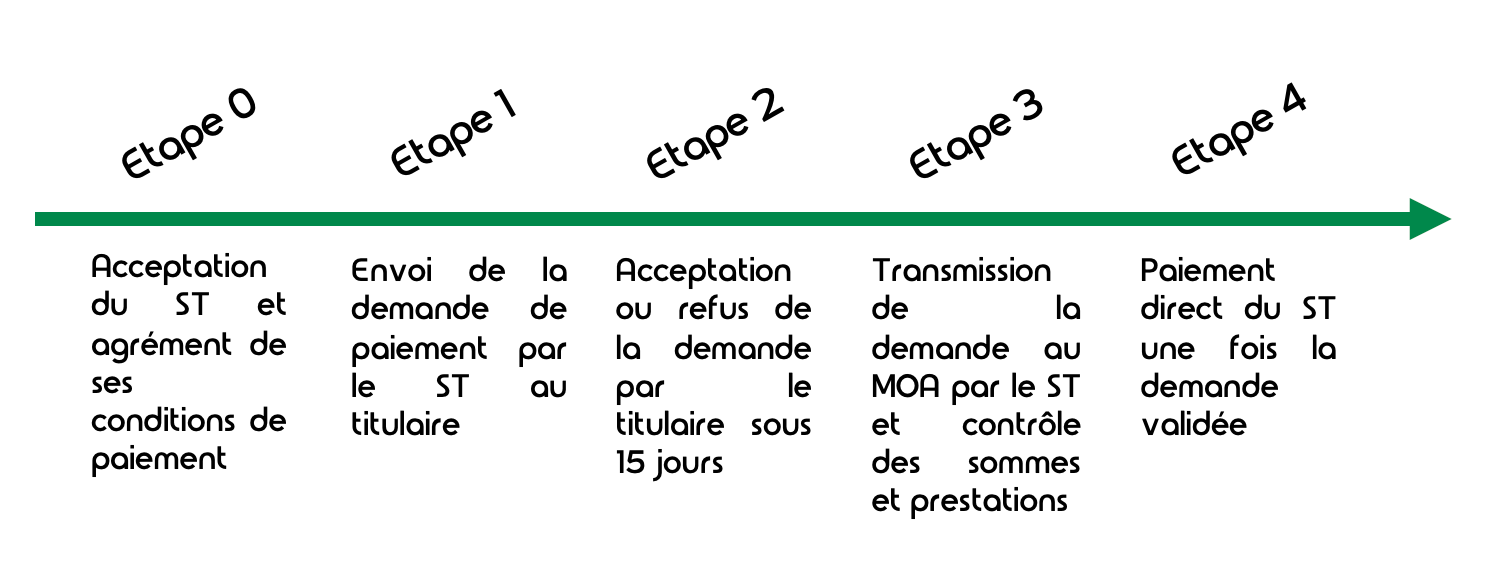
Step 0, acceptance and approval: the contract holder declares their subcontractor to the client so that the client can accept them and approve their payment terms. Without this preliminary step, there can be no subcontracting in a public procurement contract. We will return to the subcontractor approval procedure in another article.
Step 1, the payment request: the subcontractor sends its request to the contract holder, by registered letter with acknowledgement of receipt or via Chorus Pro, depending on the applicable arrangements.
Step 2, verification by the contract holder: they have 15 days to accept or refuse the payment request. Silence on their part once this period has expired is deemed acceptance of the request, and a late dispute cannot call this agreement into question. It is therefore essential to meet the deadline.
Step 3, transmission and checking: the payment request is then forwarded to the client, in particular via Chorus Pro. The client can then verify that the work has actually been carried out and check the amounts claimed.
Step 4, payment: the client pays the subcontractor directly within the applicable statutory time limit, and informs the contract holder.
These stages make it possible to distinguish the payment owed to the contract holder from that owed to the subcontractor, while securing the latter's payment.
The impact of direct payment on the parties involved
For the subcontractor, direct payment is a major financial safeguard. It means they do not depend on the contract holder's solvency, guaranteeing them a right to payment from a public body. The subcontractor will therefore be paid regardless of the contract holder's financial situation. It should be noted, however, that in practice this can lead to payment delays: blockages, disputes, administrative slowness or requests for clarification from the contracting authority can occur.
For the contract holder, direct payment involves an obligation to declare its subcontractors, as well as checking payment requests within the deadlines. The contract holder remains liable to the subcontractor and continues to be its main point of contact: direct payment does not relieve it of its obligations.
For the client, direct payment only creates an obligation to pay, after carrying out, if it wishes, a check of the legal conditions and the amounts due. The Conseil d'État has notably confirmed that the client can check that the work has actually been carried out and that it complies with the contract (CE, 9 June 2017, No. 396358).
Fictional example
Take the example of a public procurement contract for the construction of a bridge awarded by Prime-Ville (PV) to Prime Titulaire (PT). PT entrusts a design assignment to Prime Sous-Traitant (PST).
After PST has been accepted and PV has approved its payment terms, PST carries out its work and then sends its payment request to PT, in accordance with the applicable procedure.
PT has 15 days to accept or refuse it. If accepted, and after the necessary checks, PV pays PST directly, without the funds passing through PT.
Payment delegation in private contracts: how it works and the procedure
Payment delegation is a contractual mechanism that allows the main contracting company to ask the client to pay the subcontractor directly. The mechanism is provided for by the law of 31 December 1975 on subcontracting and by Articles 1336 et seq. of the Civil Code. It is the main alternative to a bank guarantee, which is the default subcontractor payment guarantee under the aforementioned 1975 law.
Unlike direct payment, which is a mechanism imposed by law, payment delegation relies on an agreement between the parties to a private contract.
Several parties are involved:
- The delegate, the client that agrees to pay if it accepts implementation of this delegation. It is free to refuse the delegator's delegation request.
- The delegator, the main contracting company asking the client to pay its subcontractor. It is not released from its payment obligation to the subcontractor.
- The delegatee, the subcontractor who benefits from the payment and gains an additional debtor.

The different stages of payment delegation
Step 0, acceptance of the mechanism: the delegator proposes the payment mechanism to the delegate, who remains free to accept it or not. Its implementation requires the agreement of all three parties.
Step 1, concluding the agreement: the three parties agree on the payment terms, mainly the work concerned and the payment conditions.
Step 2, performance of the work: the delegatee carries out the work set out in its subcontracting agreement.
Step 3, the payment request: the delegatee sends its payment request via an invoice or a works statement, in accordance with the terms of the agreement.
Step 4, verification by the delegate: the delegate checks the conditions for the sums requested to be due and that the related work has actually been carried out.
Step 5, payment: the delegate pays the amount for the work directly to the delegatee, in accordance with its contractual commitment. These sums are deducted from those owed to the delegator.
The 1975 law does not set a specific time limit for delegation. The payment terms of the Commercial Code apply instead: 30 days in the absence of agreement, or a maximum of 60 days, or 45 days end of month, if the agreement provides otherwise.
The impact of payment delegation on the parties involved
For the delegatee, the mechanism provides additional financial security: it can request payment for its work directly from the delegate. This can prove useful if the delegator defaults.
For the delegator, delegation makes it possible to meet its statutory obligation to guarantee payment without resorting to a bank guarantee. It retains its contractual obligations towards the delegatee.
For the delegate, payment delegation creates a contractual payment obligation through the agreement. This obligation is not, however, absolute: in a ruling of 27 November 2025, the Court of Cassation specified that the delegate may refuse to pay for work that has not been carried out or whose price is not yet due (Cass. 3e civ., No. 23-21.762).
The absence of a subcontractor payment guarantee can lead to significant legal consequences, including the nullity of the subcontracting agreement. These sanctions deserve particular attention: we will return to them in a dedicated article.
Fictional example
Take the example of Prime MOA (PMOA), who entrusts the construction of a warehouse under a private contract to Prime Entreprise Principale (PEP). PEP subcontracts a design assignment to Prime Sous-Traitant (PST).
To guarantee payment to PST, the three companies decide to enter into a payment delegation agreement. Once the design work has been carried out under the contractual terms, PST sends its invoice in accordance with the conditions of the agreement.
Once PMOA has verified the work and that payment is due, it pays the amounts owed to PST directly, deducting this amount from the sums owed to PEP.
In summary
Direct payment and payment delegation follow different logics, but pursue the same objective: securing subcontractor payment.
In public procurement contracts, direct payment is a mandatory legal right for first-tier subcontractors meeting the required conditions. In private contracts, by contrast, payment delegation relies on a contractual agreement between the parties and makes it possible to guarantee payment while avoiding the need for a bank guarantee. In both cases, knowing the payment terms from the outset of the subcontracting arrangement helps secure contractual relationships and limit the risk of disputes during a project.