

With all the communication channels used on a project (telephone, email, letters, face-to-face meetings, video calls and instant messaging), it is fairly safe to say that communication has gradually taken on an even more central role in the life of a project, and more broadly in our professional and personal lives.
The contract manager, who in their advisory and facilitating role sometimes has to be the bearer of bad news, must therefore be able to communicate with subtlety, avoid certain cognitive biases typical of contract management, and know how to use these different channels to get a message across or convey an idea, both internally and externally.
This article does not claim to be exhaustive on the subject (books such as Non-violent communication, a language of life by Marshall B. Rosenberg, Talking to Strangers: What we should know about the people we don’t know by Malcolm Gladwell, or 4 essential keys to effective communication by Bento C. Leal III are all worth rediscovering), but these few lines aim to set out some useful reminders, to focus on the contract manager role, and to debunk a few received ideas about communication.
I. Some useful reminders about communication
Communication is an essential skill for contract managers, because it is how information is passed on, deals are negotiated and disputes are resolved. Understanding the different modes and styles of communication is therefore crucial to getting the most out of professional interactions.
Communication is an essential skill for contract managers, because it is how information is passed on, deals are negotiated and disputes are resolved. Understanding the different modes and styles of communication is therefore crucial to getting the most out of professional interactions.
A. The different communication styles
According to many social science researchers, there are four main communication styles: passive, aggressive, passive-aggressive and assertive. Each has its own characteristics and can be adapted to the situation.
i. Passive communication
Passive communicators tend to avoid confrontation and to hold back their needs or opinions. They can come across as reserved or shy and often let others make the decisions. While this style may head off immediate conflict, it can lead to resentment and misunderstandings in the long run.
ii. Aggressive communication
Aggressive communicators express their needs and opinions directly and sometimes in a domineering way, often at the expense of others. They may use a loud tone of voice and imposing gestures. This style can be effective for getting quick results, but it can also create tension and conflict.
iii. Passive-aggressive communication
This style combines elements of passive and aggressive communication. Passive-aggressive communicators may appear passive on the surface but express their dissatisfaction indirectly, often through acts of sabotage or sarcastic remarks. This style can be a source of confusion and frustration for others.
iv. Assertive communication
Assertive communication is generally regarded as the most effective. Assertive communicators express their needs and opinions clearly and respectfully, while taking account of other people’s feelings. This style encourages honest, open interactions and tends to minimise misunderstandings and conflict.
Of course, most of us do not use a single communication style in every interaction. These styles are simply different methods we can use to communicate (see Princeton University’s article on the subject). Assertive communication is particularly suited to the practice of contract management, because it is the most likely to lead to respectful, lasting contractual relationships. It is not, however, appropriate in every situation. Passive communication, for example, can help defuse a difficult situation, and aggressive communication can sometimes (unfortunately) suit certain situations or personalities. The key is to keep the different communication styles in the back of your mind at all times, so you can better understand and respond to the styles you come up against.
B. The different modes of communication
Four broad modes of communication are traditionally distinguished, and we set them out below:
i. Verbal communication
Verbal communication covers any exchange that uses speech. It can take place face to face, by telephone or through online conference calls. Verbal communication allows direct, immediate interaction, which is ideal for detailed or complex discussions, and also for avoiding the misunderstandings that have become common now that communication channels have multiplied.
ii. Non-verbal communication
Non-verbal communication covers gestures, facial expressions, body language and eye contact. It can reinforce or contradict what is said out loud. Crossed arms, for example, can signal a defensive attitude even when the words used are positive. The COVID pandemic and the successive lockdowns helped popularise this mode of communication: the surge in phone calls and video meetings, which are not well suited to communication, reminded everyone how important non-verbal communication is in conveying emotions, ideas and messages.
iii. Written communication
Emails, letters, reports and instant messages are all forms of written communication. This mode (well known to contract managers) leaves a written record of exchanges, which is crucial for project monitoring and documentation. Yet although it is often the mode favoured by many contract managers, it frequently lacks spontaneity, loses the richness of non-verbal cues, and can be open to varying interpretations, particularly where a cross-cultural dimension enters the project.
iv. Visual communication
Visual communication uses graphic elements such as diagrams, maps, videos and presentations to convey information. Combined with written and/or verbal communication, this mode can be highly effective in illustrating complex concepts, holding an audience’s attention and even supporting the demonstration of a claim.
C. The communication process
The communication process is made up of several key stages that allow a message to be transferred from a sender to a receiver. This process, as described by Business Jargons, highlights the various elements that can affect the clarity and effectiveness of communication.
i. The stages of the communication process
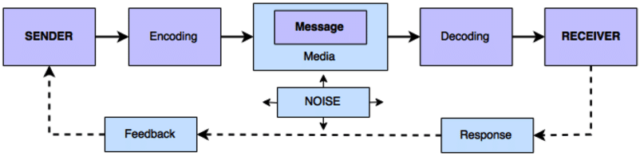
Passing on a message, conveying an idea or a feeling, means working through a communication process made up of several key stages that allow a message to be transferred from a sender to a receiver. This process, theorised by many authors (the diagram below, for example, was produced in 1967 by P. Kotler), highlights the various elements that can affect the clarity and effectiveness of communication:
Simple though it looks, communication turns out to involve many components: the sender, encoding, the message, the channel, decoding, the receiver and feedback, each playing a crucial role in transmitting an idea.
This communication process therefore brings to light the many variables that can distort an idea and create misunderstandings:
ii. The vehicle for the message
The choice of communication channel (verbal, non-verbal, written, visual) shapes how the message is perceived. A complex message, for example, may be better understood in writing with visual aids, whereas an urgent message may call for direct verbal communication.
iii. Noise
Any external or internal factor that interferes with the transmission of the message. This can include physical distractions, interruptions, technical errors or personal prejudices. Noise can distort the message and make communication ineffective.
iv. Encoding and decoding
The way individuals encode and decode messages is open to personal interpretation. Cultural differences, personal experience and emotions can all influence how a message is understood. A harmless phrase in one culture, for example, may be seen as offensive in another.
These variables show that communication is a complex, dynamic process in which every element plays an essential part. To avoid misunderstandings, it is crucial to choose the right channel, minimise noise and allow for differences in the encoding and decoding of messages.
In short, mastering the modes, styles and process of communication allows contract managers to improve their professional interactions, reduce misunderstandings and strengthen working relationships. Effective communication is the key to success in contract management and in running complex projects.
II. Communication best practice for the contract manager
Communication is one of the most critical skills for a contract manager. As well as mastering the technical and legal aspects of contracts, the contract manager must navigate the sometimes choppy waters of professional communication. Here are five essential best practices for improving communication in contract management.
A. Know how to say no
You may already have had a colleague (a project manager, an operations director or someone else) insist that you draft a sharp reply to an event or to a clumsy letter received from a counterparty. As a contract manager (and not a scribe), it is up to you to say no when that approach does not seem right for the situation, when it risks inflaming matters rather than resolving them.
Refusing to follow an inappropriate request takes courage and a certain amount of diplomacy. The advisory dimension of the role requires that no to be justified and explained constructively. It is essential to propose more suitable alternatives and to show why a more measured response could pay off in the long run. This not only defuses potential conflict but also strengthens your credibility as a professional capable of balanced, strategic judgement.
B. Use the full range of communication channels
As we touched on above, communication channels have multiplied in recent years. Letters, emails, calls and face-to-face meetings have been joined by instant messaging, video conferencing and SaaS platforms for project or document management. While it is tempting to regret this proliferation of channels, which does not always make communication between stakeholders any simpler, we can also see each of them as a lever to be used to communicate effectively.
Every channel has its advantages and drawbacks, and it is crucial to know these modes well in order to choose the most appropriate one for the situation. Emails, for example, are ideal for formal, detailed communications, whereas instant messaging is perfect for quick, informal exchanges. Video conferencing, for its part, combines the benefits of verbal and non-verbal communication. By diversifying and mastering these tools, a contract manager can make sure the message lands as intended.
C. Embody perspective
Easier said than done, especially in the face of inappropriate behaviour and colourful personalities, but the contract manager must play this facilitator role. In all circumstances they must remain objective and cool-headed so as not to over-react, to defuse conflict and, more generally, to keep the distance and emotional detachment that allow a healthy, non-partisan and constructive reading of a situation.
This moderating role is essential, especially when tensions rise and emotions take over. By keeping a certain distance, the contract manager can analyse situations objectively and propose balanced solutions. As Sun Tzu put it, “whoever excels at resolving difficulties does so before they arise”. This proactive approach not only prevents conflict but also creates a more harmonious and productive working environment.
D. Take the time
I can see you coming… Careful: taking the time does not mean idling and blowing deadlines! We mean it rather as taking the time… to do things properly. On our assignments we still too often see approximations, oversights and omissions that stem from a lack of time, or rather from haste. Yet control of time and of the schedule is essential; good organisation is therefore crucial and must leave enough time to prepare, document and proofread your communications properly.
Taking the time also means making sure every message is clear, complete and precise. That requires checking the facts, structuring information logically and making sure the tone is appropriate. By taking the time to do things properly, you reduce the risk of misunderstandings, errors and backtracking, which ultimately saves time and improves the overall effectiveness of contract management.
E. Document, document and document again
Finally, though this last point will seem obvious to many contract managers, we can never stress enough how important it is to formalise and record communications. A project is long and complex, and what was said in January can be distorted or forgotten by October. Not a single project goes by without an objective situation turning, through non-conformities and delays, into science fiction based on a true story!
There is one answer to this: formalise and file communications so that you can support a project throughout its delivery. Sometimes a verbal exchange will clear the air or unblock a situation, and it is true that writing can create tension and stiffen positions. But the experienced contract manager knows how to use the right channel at the right moment, while making sure that the absence of a written record remains the exception. Systematically documenting exchanges, decisions and actions taken keeps a clear, accessible record, making it easier to monitor the project and settle any disputes.
III. Pitfalls to avoid and false good ideas
A. Grandstanding in meetings
Forget the caricatural role-play, whether the outdated “good cop / bad cop” or the notorious door-slam that impresses no one any more. This kind of grandstanding is to be avoided if you want to keep any credibility with the people sitting across from you. Professionalism and sincerity are the keys to effective, respectful communication.
Using these theatrical techniques can damage your image and also put at risk the relationships of trust you have built. Project stakeholders expect exchanges based on transparency and authenticity. By opting for honest, direct approaches, you strengthen your position as a reliable, respected contract manager, capable of handling delicate situations with diplomacy and skill.
B. Lack of preparation
Nothing is worse for a contract manager than “winging it”. Whatever your qualities, it is extremely risky to walk into a negotiation meeting or another important encounter unprepared. A meeting has to be prepared; there is nothing more dangerous than someone who thinks they know without having taken the time to prepare.
Preparation is essential to anticipate questions, structure your arguments and plan suitable responses. It also helps you understand what is at stake for each stakeholder and set clear objectives. A well-prepared meeting runs more smoothly and improves the chances of reaching positive outcomes. Improvisation may look appealing, but it exposes you to avoidable mistakes and misunderstandings.
C. Adopting a stance
Adopting a stance in advance is perhaps one of the worst ideas you can have before entering into an exchange. Approach your communications as openly as possible and practise active listening; you will be all the more effective for it. Rigidity of stance often stops you picking up the nuances and opportunities that can arise in a discussion.
Active listening lets you genuinely understand the needs and concerns of the people you are dealing with, which is essential to a successful negotiation. By being open and receptive, you show that you value other people’s perspectives and that you are ready to find mutually beneficial solutions. This approach fosters a climate of cooperation and respect that is essential to effective contract management.
D. The language barrier
It is hard to get ideas across, to make yourself understood or even to avoid gaffes when you are not fluent in the language. Be aware of your gaps and try to get support, to have your text reviewed before you enter into or send a communication in a language you have not mastered. If that is not possible, have the tact to open with a brief reminder that it is not your mother tongue.
Admitting your linguistic limits shows humility and a willingness to communicate clearly and respectfully. It can encourage the people you are speaking with to be more understanding and patient. Using translators or bilingual colleagues can also greatly improve the clarity and accuracy of your communications, reducing the risk of misunderstanding and confusion.
E. Prejudice and preconceived ideas
Yes, there are biases, codes and conventions to take into account in cross-cultural communication. But beware of excess and prejudice! The internet is full of experts and specialists who will tell you (often through reels and short video formats) that an Asian cannot say no, that an American gets straight to the point, that a Latin is hot-blooded, or that you should be wary of Anglo-Saxons in business, and so on. Clichés die hard, but the reality is quite different.
A person’s nationality alone cannot determine a personality trait or a negotiating style. It is essential to treat each person as a unique individual, with their own experience and nuances. By avoiding stereotypes and taking a more nuanced approach, you can build more authentic and respectful relationships, based on a real understanding of what each party needs and expects.
F. Over-interpretation
This is even more common with instant messaging tools, which strip out non-verbal cues, introduce emojis that can be false friends, and encourage spontaneity. We have all tried to decode a message through several lenses, guessing what lies between the lines or what hidden messages it contains. This can be very risky because, as we saw in the communication process above, the variables are many and the margins for error wide.
Over-interpretation can lead to misunderstandings and needless conflict. It is often more effective to clarify directly with the other person than to speculate about the intentions behind a message. Communicating openly and asking questions to clear up grey areas helps avoid misunderstandings and maintain harmonious professional relationships.
By avoiding these common pitfalls and adopting thoughtful, respectful communication practices, contract managers can significantly improve project delivery and strengthen relationships with all stakeholders.
Conclusion
Communication is an essential skill and a key to success in contract management. For a contract manager, the ability to communicate effectively, to move deftly between the various styles and channels of communication, and to avoid the common pitfalls, is something to develop constantly in order to create value and contribute to the success of projects.
This skill, often seen as a soft skill and relegated to the rank of “nice to have”, is in our view one of the pillars that allows a contract manager to make the difference, and even what sets a good contract manager apart from a very good one!