

In this article, we look at contract management processes, at the continuous improvement of a contract management department, and therefore at how its performance is assessed.
To do so, we draw on a tool we use extensively at Prime Conseil, and which comes from England: the contract management good practice model published by the “National Audit Office”, the United Kingdom’s supreme audit institution for public finances (the British cousin of France’s Cour des comptes).
Although its second edition is now 8 years old, this framework, or guide, is still regarded today as “a reference for the minimum foundation required to practise contract management”. Intended to update an initial piece of work carried out in 2008, the guide has become a benchmark in the United Kingdom, and is even used as a reference standard in expert assessments and claims on major projects.
In this article, we revisit the guide and explain how it can be used to run a diagnostic or an audit of an organisation’s practices and of its maturity level in contract management.
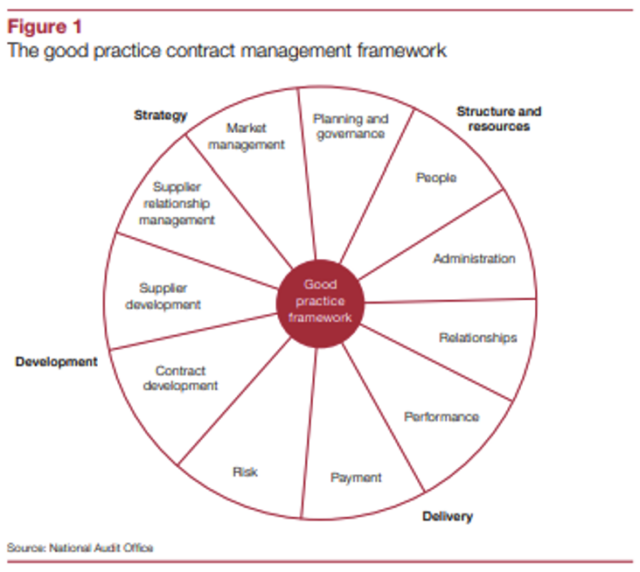
I. A model built on 4 pillars and 11 activities
By way of introduction, note that this model is mainly dedicated to the contract execution phase (see the different phases of the contract lifecycle). It remains an excellent model for that essential execution phase, and some of its pillars also apply to the pre-signature phases. The English NAO describes 11 activities as forming part of this model, spread across 4 pillars:
a. Structure and resources
This first pillar covers 3 distinct activities:
- The first activity, “Governance & planning”, aims to enable a smooth handover, with no loss of knowledge, from the pre-sales phase to the execution phase. In practice, this activity covers everything from allocating a contract management budget in the bid through to defining a contract ownership structure (who? what? how?), as well as implementing clear processes aligned with those of the project (for example, a CMP and a PMP that dovetail properly).
- The second activity in this pillar is “People” and aims to ensure that the contract manager post is properly staffed and sufficiently stable given what projects require. The skills, reporting line, objectives and authority of contract management must be clearly established and relevant to the project.
- Finally, the last activity is “Administration”. Trivial as it may seem, it comes down to making sure that the people concerned actually hold a copy of the contract, that access rights are properly defined, that the technical annexes are known to those who need them, and that points of contact are clearly identified within the organisation or the project team.
b. Performance
The performance pillar comprises 4 distinct activities:
- “Stakeholder relationship management” is one of the most important activities in the whole framework. It consists in making sure that the roles and responsibilities of the various contract counterparts, on both the client and the supplier side, are properly defined and known to internal and external stakeholders; that continuity in contract management & administration is maintained, internally as well as among key stakeholders; that communication channels and routines are established; that the counterparts concerned have received a briefing on the contract and its main requirements; and that a conflict escalation mechanism is in place.
- The second concerns “Performance management”, another essential activity, since it consists in making sure the contract is executed in accordance with its provisions. In practice, this means ensuring that specifications, SLAs and other reporting and performance measurement indicators are clear, that a bonus/penalty system (i.e. penalties or price supplements) is provided for, along with a mechanism and processes for periodic performance reviews.
- Next comes the “Payment and incentives” activity, which consists in making sure that payment mechanisms and terms are clear, well defined and understood by the parties, and that the invoice issuing and processing workflow is efficient, with the necessary checks and approvals. Price adjustment mechanisms in the event of change must be clear, as must the terms for applying contractual penalties or bonuses where relevant. This activity is also the right place to add, as a good practice, a dedicated contract management budget (whether working on a dedicated basis or across a portfolio).
- Finally, the “Risks” activity closes this performance section. Here, both the client side and the supplier side need to put in place tables and other risk analysis tools, including quantification and qualification elements. Other good practices include processes for regularly monitoring and updating these risk management tools, along with a summary of the contractual clauses dealing with risk (liability, disputes, security, termination, etc.), which must be produced and circulated.
c. Development
This development pillar covers two activities:
- The first is “Contract variations”. As the name suggests, this activity consists in making sure the contract has been properly clarified (in particular through a contract awareness session), and that its performance is monitored regularly by a designated counterpart (ideally a contract manager, but it can also be a project manager). A clear procedure applicable in the event of change (contract amendment, etc.) must also be put in place, along with strict mechanisms for major changes; FIDIC contracts offer useful inspiration on this point. A mechanism for resolving the disputes inherent in these changes to the contractual scope must be provided for.
- The second is “Supplier performance”, which aims to ensure that contracts are properly in place with suppliers, including incentives, penalties and other performance management mechanisms, and that processes exist to manage the execution of those suppliers’ subcontracts. Continuous improvement target clauses can also be cleverly built into supplier contracts. Finally, regular reviews of the risks and opportunities linked to these suppliers must be scheduled, along with a point of contact responsible for coordinating that monitoring.
d. Strategy
Like the Development pillar, this final pillar, entitled “Strategy”, also comprises two activities:
- The first, linked to the previous one on suppliers, is “Supplier relationship management”, also known as SRM. The aim here is to ensure that a supplier governance plan is in place, covering in particular the identification of critical suppliers, the processes for assessing their soundness and also the identification of alternatives in order to anticipate failures. Intellectual property and knowledge management must also be taken into account, so as to capitalise on collaboration with suppliers and avoid situations of dependency.
- the last activity is “Market intelligence”. Behind this somewhat catch-all name lie a great many actions, such as the processes for deciding whether to insource or outsource activities (make or buy), constant benchmarking of critical technological developments, and monitoring of the geopolitical conditions that may affect contract execution (strikes, civil unrest, export regulations, etc.).
To close this first part, here is a diagram summarising these 4 pillars and 11 activities:
II. How can you apply this method to your day-to-day contract management?
At first glance, this holistic model may look rather heavy to implement, particularly within mid-sized companies that do not always have dedicated resources. With some effort to adapt it, however, the method can be tailored to a company’s size and sector, delivering gains in efficiency and relevance and making it possible to assess the maturity of a contract management department on a continuous basis.
To that end, we suggest: (i) systematic preliminary diagnostics, and (ii) more occasional full audits.
a. Preliminary diagnostic
To help you get straight to the heart of the matter, we have developed at Prime Conseil a scoring matrix inspired by this English method, allowing a quick diagnostic of the level of contract management, contract by contract.
This tool, which comes as an Excel file, can be used at any point in the life of a project: as an aide-memoire when responding to a tender, as a real-time diagnostic while a project is being executed, or even as a working basis for developing or transforming a contract management department. To download this diagnostic tool free of charge, submit a request by clicking on the banner below:

b. Full audit
Just as the English authorities have on occasion used this framework in expert assessments and court proceedings, you can use the method (available here) to run a full audit and translate it into an action plan.
You can either run this audit in-house (through an internal audit unit, a quality department, or even the contract management department itself, although self-assessment is always delicate), or entrust it to a Prime Conseil contract management consultant.
The aim of the audit is to gain a clear understanding of how contract management currently works within your organisation, of its relationships and (inter)dependencies with other departments (procurement, legal, project, operations, etc.), and to formalise a continuous improvement plan with concrete actions to advance contract management maturity across your organisation.