
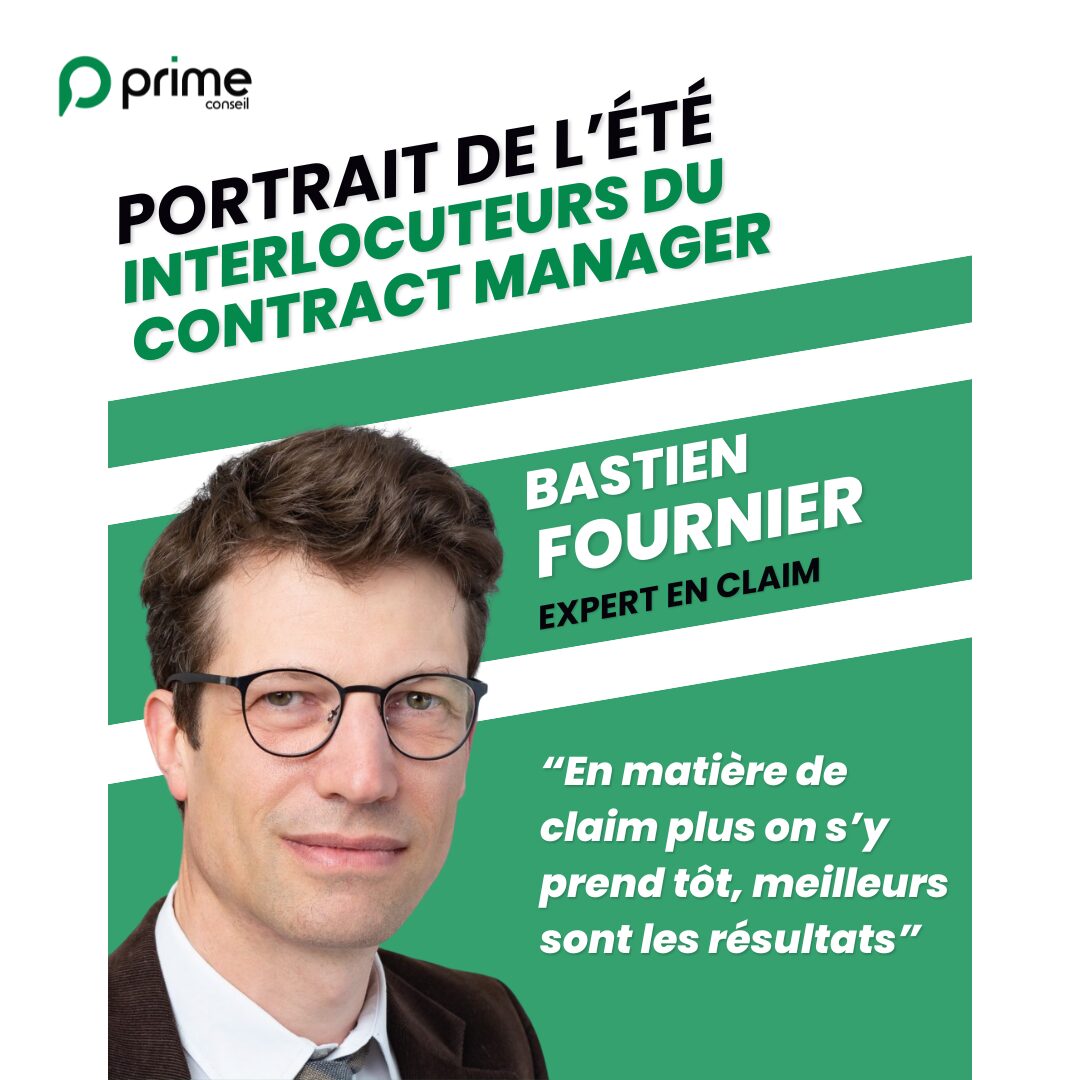
Following a fascinating conversation with Jean-François, Project Director, and a rich interview with Anne-Marie, Head of Procurement, we continue our summer series of portraits with Bastien Fournier, a claims expert. A specialist in the analysis of delays and cost overruns, he explains how he works, sometimes alongside contract managers, to bring objectivity to complex and occasionally conflictual situations.
1. Hello Bastien. To get straight to the point: how would you explain your job as an expert to a five-year-old?
It is not that simple! But to illustrate with an example: take a bricklayer who has to build a wall in 5 days for €1,000. In the end he takes 10 days and asks for €3,000 for his wall, because the client did not supply water and he had to bring in tanker lorries.
That is where I come in. I look at whether the client's failure to supply water is a valid excuse, and then at whether it really justifies that much extra time and cost. My role is to examine these aspects objectively, so that the bricklayer and his client can reach an agreement.
2. Your profession is fairly little known. How does one become a claims expert?
It is rarely a mapped-out path. Every expert I have met came into this field after a few years of career and project experience. There is no dedicated academic training for the job. You come to it out of taste: a taste for getting to the bottom of things, for analysing, for resolving conflicts. Because in the end, facing us are people and organisations with their own constraints.
In terms of training, many claims experts have a dual technical and legal background. You come across engineers who train in law more often than the reverse, but both routes are possible. In any event, initial training gives you an overall view and a set of tools, but a large part of the job is learned on the job.
3. In a claim there are often several stakeholders (in-house lawyers, contract managers, project managers, insurers, external counsel, and so on). How do you fit into that dynamic?
It depends a great deal on the context!
On claims, when I work for a small organisation with no legal department and no contract manager, I deal directly with the project manager: it is simple and direct, with few points of contact. In larger organisations, I rely on the project manager for the field and financial picture, and on a range of support functions where they are involved. That saves me time and lets me concentrate on the technical side.
In arbitration, instructions tend to come from law firms. In that setting I have a duty of independence, which is why I limit myself to quantum (the financial aspects).
4. How do you work with the contract manager?
Again, it can vary from project to project and organisation to organisation. Sometimes there is no contract manager on the project, which can complicate matters and even prove problematic, especially if the project management team has no feel for contractual issues.
On projects that do have a contract manager, that person is my main point of contact: they have a cross-cutting view of the project and have already gathered a great deal of information, which makes my work far easier. If a first claim has come to nothing, the contract manager passes me the material so we can dig deeper and iterate together.
In every case, what we share with the contract manager is a conviction: in a claim, the earlier you start, the better the results.
5. There is a lot of talk about data, digital, even AI in the analysis of delays and financial impacts. For you, is that already a reality or are we still a long way off?
I follow it closely, but honestly I do not use it yet. I have tested a few solutions, but for now they remain fairly expensive relative to the value they deliver. This technological advance is promising nonetheless, particularly in delay analysis tools.
For my part, I work more on quantum, which lends itself less to automation or AI in the short term. But even before the tools, the central issue is data which, on a project, is abundant and sometimes inconsistent. Having a lot of data is fine, but it still has to be reliable and properly collected. So I see a big effort to be made on the data side (but also a playing field) before genuinely effective and useful tools can emerge.
6. Is there a method or a reflex you would like to see more often from contract managers to make claims more effective?
Yes, clearly: notices and badly drafted contract amendments. Too often, as experts, we end up with a file containing out-of-time notices, or no notice at all, contract amendments containing waivers of all recourse, and other loose ends that undermine the claim going forward.
While badly drafted or imprecise notices can sometimes be salvaged, some mistakes cannot be undone and can prove costly.
7. Do you have an anecdote or the memory of a particular claim you can share with us?
I have several! The first, a rookie mistake: on a basic claim, I mixed up two items in my costing… and ended up multiplying the price by 10. And I realised it… after the costing had been approved by the other party. So no one is ever safe from an error, and a review (including by a third party) can sometimes be a lifesaver, even if in this case the mistake worked in our favour.
Still on unusual anecdotes: on a large project, a digital tool for notifying changes was mandatory. The tool crashed regularly, which meant I had to redo my notices fairly often. After a while, I realised that writing the word “delay” in the tool was what made it crash every time. I first had it recorded by a bailiff, then notified the client, who eventually realised what was happening and told us the term was blocked because hackers were using it. In the end, we filed a claim for the time and money lost!
8. Finally, if you had to compare your job to a mission or an extreme sport, what would it be?
I would say a tightrope walker. Because you always have to take a step back, but also keep your balance: between the contract, the costs, the schedule and the parties' expectations. When you come onto a claim that already has a history, a past, you often find gaps between what is written and what is done, between what is perceived and what is real. And you have to find the right balance, without falling.