
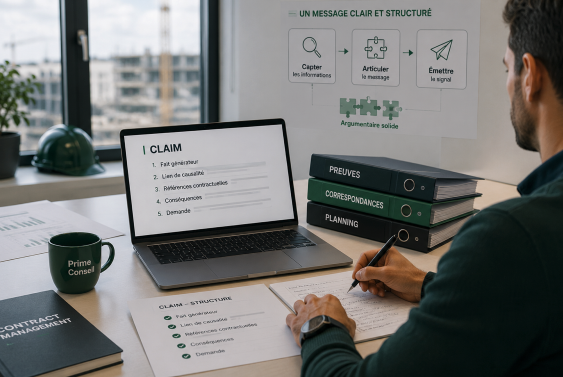
Dans un précédent article consacré aux claims sous contrat FIDIC, nous avions vu que la forme conditionne l'existence même d'une réclamation : un droit parfaitement fondé mais notifié hors délai entre dans la zone de turbulence de la forclusion. Admettons donc que ce premier contrôle est fait, que les délais ont été vérifiés et que rien n'est forclos. Ne reste plus qu'à… rédiger, et c'est précisément là, face à la page blanche, que se joue le second volet du claim.
Face à cette page blanche, on observe généralement quatre écoles : celle des inspirés, qui partent sur des envolées lyriques ; celle des profils dits « juridiques », qui reproduisent les codes de la mise en demeure ; celle des profils dits « techniques », qui consacrent l'essentiel du courrier à prouver qu'ils ont raison ; et celle du règlement de comptes, pour qui le courrier devient un exutoire. Quatre styles très différents, mais une même croyance sous-jacente : le claim serait avant tout un exercice d'écriture, et sa qualité se mesurerait à la plume.
Notre pratique nous amène à une conclusion inverse, avec un constat contre-intuitif : les mauvais courriers de claim manquent rarement de style, ils manquent de clarté. Ce qui reste à faire est ce qu'aucun outil ne fait à la place du contract manager : la réflexion et l'interface.
Un écrit est d'abord un acte de communication
Avant d'être un document contractuel, un courrier de claim est un signal. Il y a un émetteur, un message et un récepteur, et une certitude mérite d'être posée d'emblée : le signal sera toujours décodé. Un courrier envoyé est un courrier lu, interprété, classé. La vraie question n'est donc pas de savoir si le message sera reçu, mais comment il le sera : tel qu'on l'a voulu, ou tout autrement.
Cette grille de lecture n'a rien d'une simple image : c'est, presque trait pour trait, le modèle formalisé par Claude Shannon et Warren Weaver en 1948 pour les télécommunications. Une source d'information produit un message, un émetteur l'encode en signal, ce signal traverse un canal exposé à une source de bruit, puis un récepteur le décode. Transposé au contract management : une équipe projet comme source, un contract manager comme émetteur, un courrier comme canal, un destinataire comme récepteur. On n'écrit pas un courrier pour soi, on écrit pour être bien décodé.
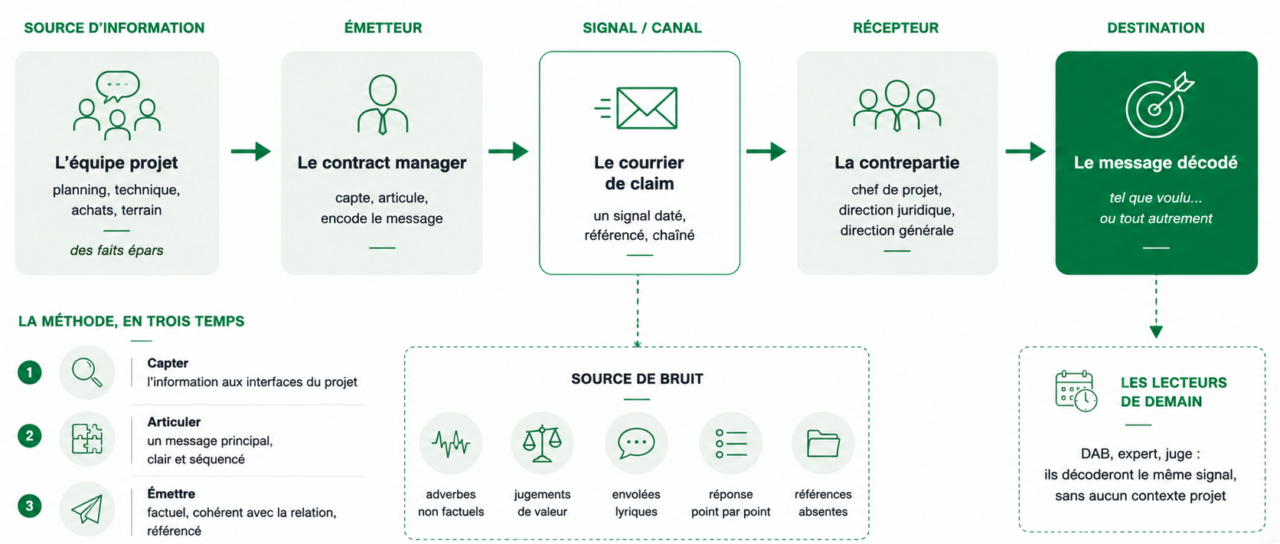
Encore convient-il de savoir par qui, puisque le récepteur d'un claim est en réalité une pluralité de récepteurs. Dans l'organisation qui reçoit le courrier d'abord : le destinataire principal est peut-être le chef de projet, mais le courrier circulera, remontera à une direction juridique, parfois à une direction générale, et chacun le lira avec son propre référentiel. Dans le temps ensuite : un courrier de claim peut se retrouver des mois ou des années plus tard entre les mains d'un DAB, d'un expert ou d'un juge, qui le découvrira sans aucun contexte projet.
Reste alors la dernière pièce du modèle, et sans doute la plus utile en pratique : le bruit. Tout ce qui, dans un courrier, ne contribue pas à l'objectif principal le parasite : adverbes non factuels, jugements de valeur, effets de style, réponses point par point qui diluent l'argument principal dans dix arguments secondaires. Réduire le bruit, c'est augmenter les chances que le signal passe comme on l'a voulu.
Capter l'information : le claim se construit loin du clavier
Nous ne ferons jamais assez ce rappel : la première compétence pour rédiger un claim n'est pas rédactionnelle. Un bon claim commence par des échanges : avec le planning, avec les équipes techniques, avec les achats, avec le terrain. C'est en multipliant les échanges avec les bonnes personnes que le contract manager collecte les bonnes informations, et surtout qu'il est en mesure de faire le pont entre des éléments qui semblaient déconnectés. Le retard d'une étude, une décision tardive du client, une modification de périmètre passée presque inaperçue : pris isolément, ces faits ne racontent rien ; reliés entre eux, ils constituent parfois l'argument central du dossier.
Il nous arrive de croiser des contract managers qui se contentent de demander au chef de projet des arguments pour répondre, et de les réutiliser en l'état. Rapide et efficace pour de petits courriers sans enjeux, cette pratique est largement insuffisante en matière de claim : le chef de projet, aussi central soit-il, ne constitue qu'un prisme de lecture. C'est en croisant les prismes que l'argument solide émerge, parce que chaque fonction détient une pièce du puzzle que les autres ne voient pas.
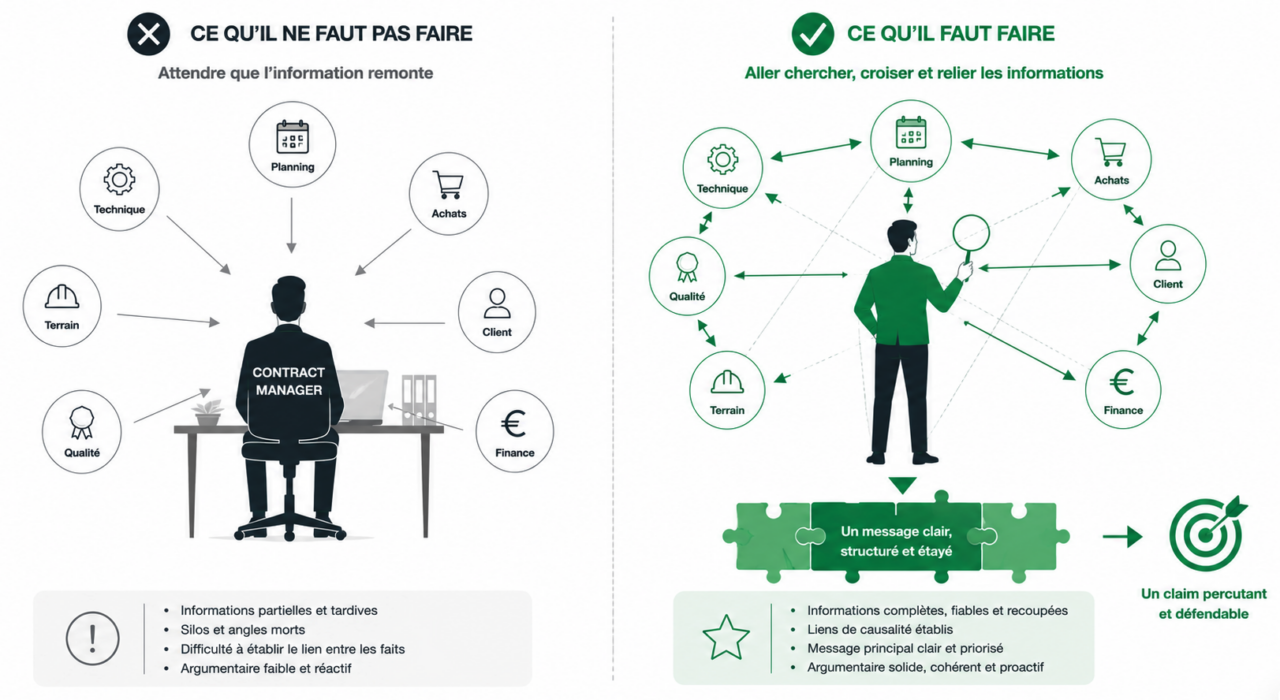
Ce travail d'interface est précisément le cœur du métier. Celui qui s'assoit directement devant son clavier se prive de la matière première du claim, et on en retrouve les stigmates au premier coup d'œil : le courrier affirme, mais ne démontre pas, parce que les faits qui auraient permis de démontrer n'ont jamais été collectés. À l'inverse, un contract manager qui a passé du temps en interface arrive à la rédaction avec un matériau daté, sourcé, recoupé, celui-là même qui alimentera ensuite des méthodes structurées comme la Time Impact Analysis. La rédaction n'est plus alors qu'une mise en forme.
Articuler : l'art de transformer des inputs en messages
Vient ensuite le travail de réflexion, une étape souvent négligée par manque de temps ou de méthode. Le fastidieux travail de collecte produit des inputs divers : des faits, des avis, des chiffrages, des convictions parfois contradictoires. L'erreur fréquente consiste à les empiler dans le courrier, dans l'ordre où ils sont arrivés. Le résultat se reconnaît immédiatement : un courrier que l'on lit en se demandant ce que son auteur voulait obtenir.
« Quel est le message principal que nous voulons faire passer ? La question doit être posée collectivement, avant que quiconque ne pose la plume. »
S'accorder sur le message principal, identifier les messages secondaires, décider de ce qu'on ne dira pas : ce travail d'alignement évite les courriers qui partent dans toutes les directions parce que chacun y a glissé son sujet.
Une fois l'alignement acquis, reste un travail individuel : le séquençage. Comment articuler ces idées pour que le courrier se lise comme une histoire, avec un fil, une progression, une conclusion qui découle de ce qui précède, et enfin une demande, souvent oubliée ? Ce point vaut tout particulièrement en réponse à un courrier reçu : rien n'oblige à répondre point par point à un courrier construit en quatre points. Répondre dans le plan de l'adversaire, c'est déjà lui concéder le cadrage du débat.
Émettre : quelques rappels élémentaires
Reste alors, et alors seulement, l'émission proprement dite, c'est-à-dire la rédaction. Cette étape, bien assimilée par les contract managers, mérite néanmoins trois rappels.
Le courrier au service de la relation contractuelle
Un courrier n'est pas un objet isolé : c'est un vecteur de la relation contractuelle, au même titre qu'une réunion de chantier. Il permet de l'entretenir, de l'améliorer ou de la dégrader. On observe pourtant régulièrement des situations difficilement lisibles pour la partie adverse : une relation projet cordiale et constructive au quotidien, et des courriers menaçants qui semblent écrits par quelqu'un d'autre.
Ce grand écart s'explique souvent par une rédaction déléguée à une fonction support extérieure au projet, qui n'est pas dans la relation et ne peut donc pas en tenir compte. Ces fonctions ont pourtant un rôle précieux à jouer, mais ailleurs : leur distance leur donne l'objectivité qui manque à ceux qui vivent le projet, ce qui en fait d'excellents relecteurs. La rédaction revient donc à celui qui est dans la relation ; la relecture est le travail de celui qui en est sorti. Le ton d'un courrier est une décision, pas une humeur.
Les faits, rien que les faits
Sur le fond, l'exercice partage beaucoup avec la démarche juridique : on documente l'existence d'un fait générateur, on établit un lien de causalité, on le rapporte au contrat et on en présente les conséquences. Une grande différence existe quant à la forme : là où une plume juridique peut choisir d'ajouter une charge émotionnelle, le courrier de contract management gagne à rester exclusivement factuel. Les adverbes d'intensité et les formules émotionnelles n'apportent aucune information et fragilisent le propos.
Tracer, documenter et suivre
Terminons avec un point aussi trivial qu'essentiel, celui que j'appelle « l'hygiène documentaire ». Tout courrier doit comporter une date, une référence propre, un rappel des correspondances précédentes traitant du même sujet : ce chaînage paraît fastidieux, il est en réalité stratégique.
C'est lui qui permet, des mois ou des années après, de reconstituer l'histoire sans effort. On retrouve ici le lecteur futur évoqué plus haut : un dossier de correspondances bien chaînées se lit comme un récit cohérent, là où des courriers orphelins obligent chacun à reconstruire le contexte, avec tous les risques d'interprétation que cela comporte.
Le contract manager, l'interface stratégique et non la plume
Au terme de cet article, une évidence se dessine : pour faire un bon courrier de claim, l'écriture est la dernière étape, et probablement la moins discriminante. Ce qui distingue un courrier qui obtient un résultat d'un courrier qui alimente le conflit se joue en amont : dans la qualité de la collecte, dans la clarté du message, dans la cohérence avec la relation.
L'IA, en rendant la correction et la mise en forme accessibles à tous, n'a pas dévalué le travail du contract manager sur ses claims. Bien au contraire, elle nous ramène à notre véritable métier : celui d'une interface stratégique qui relie des informations que personne d'autre ne relie, et transforme cette matière en un signal que ses différents récepteurs, ceux d'aujourd'hui comme ceux de demain, sauront décoder.