

Depending on who you ask, claim management belongs to project management, the procurement function, or contract management. The reference frameworks themselves don't speak with one voice: the IAPM describes it as a component of project management responsible for pursuing claims for additional payment, some procurement professionals link it to purchasing and supplier relations, while others place it within contract management as a mere sub-function. Definitions vary as much as reporting lines, and everyone draws the boundaries of the discipline to match what they sell or what they practise.
This confusion is not just a turf war. It has very concrete consequences for projects: cases handed to the wrong person at the wrong time rarely help performance, and since claim management directly affects a project's margin, the vagueness of its boundaries costs points of profit.
At Prime Conseil, our position on the question of reporting lines is simple: whether claim management belongs to the project, to procurement, or to contract management matters less than the quality of the work done. This organisational question can be settled differently depending on the organisation, without affecting the discipline itself. What cannot remain vague, however, is what claim management covers, what it is not, and who intervenes at what point.
Starting with a definition of claim management
In our view, claim management is defined as the management, throughout the contract lifecycle, of the process by which a party builds, examines, pursues or defends claims based on contractual provisions. Claim management is therefore a process serving an overall contract strategy, the outcome of which can take several forms, from a contract amendment to a settlement agreement, with litigation (to be distinguished from the claim itself) only coming into play if these earlier avenues fail.
Each term in this definition deserves careful consideration. The term "conduct" first: claim management is a discipline of steering, not a one-off act. A claim is not simply the letter that formalises it: it is prepared, documented, sequenced and negotiated over months, sometimes years. Next, the phrase "throughout the contract lifecycle": the substance of a claim is built up well before the event that triggers it, through the quality of records and events kept day to day, and continues well after, in the formalisation of the agreement reached and the lessons learned from it. Finally, "examines, pursues or defends": claim management works both ways. A mature organisation examines its own claims with the same rigour it applies to analysing and challenging those it receives.
That leaves the word "claim" itself, whose definition and scope we have already covered in detail in a previous article. One point is worth stressing here, as it sheds light on everything that follows: what distinguishes a claim from a simple contractual change is disagreement. If, during a change process governed by a contract, the parties agree on what is owed, the matter stays within the territory of change: it is settled as the contract provides, and no one speaks of a claim. A claim is born when this consensus is missing, and it exists precisely for as long as the disagreement lasts. A well-managed claim is a claim that turns back into something else: a change order, a settlement agreement, a negotiated adjustment. Seeing it as a battle to be won is already a mistake of purpose. It is a means in the service of a strategy, never an end in itself.
What claim management is not
Defining a discipline also means drawing its boundaries. Two confusions dominate the market: one is fading, the other is surprisingly persistent.
A claim is not litigation
The first confusion equates a claim with court litigation. This confusion is seen less and less on projects, but it still shapes perceptions in many organisations, for whom receiving a claim is equivalent to receiving a writ, and issuing one amounts to declaring war.
The definition set out above is enough to dispel the misunderstanding: litigation is not the claim, it is one of its possible outcomes, the least desirable and statistically the least frequent. A claim lives within the contractual sphere, relies on the mechanisms the contract provides for, and is resolved in the vast majority of cases through negotiation and the relationship. The judge or arbitrator only enters the picture once this process has failed, and that failure comes at a high price: in fees, in years of proceedings, in a damaged relationship and in loss of control over the outcome, since the decision then falls to a third party. We have devoted an article to the reasons why no party has an interest in letting a claim drag on: the same logic applies here. Confusing the path with its worst destination is to condemn yourself to travelling that path badly.
Claim management is not quantum analysis, nor delay analysis
The second confusion is more insidious, as it circulates even among seasoned professionals: the one that equates claim management with expert analysis, and specifically with quantum and delay analysis.
Delay analysis consists of establishing each party's responsibility for an overall delay, by comparing the project's planned progress with its actual progress, using proven methodologies (critical path analysis, time impact analysis, windows analysis), sometimes governed by international frameworks such as the SCL Delay and Disruption Protocol, and other AACE recommended practices.
Quantum analysis, meanwhile, consists of quantifying losses, cost overruns, productivity losses and prolongation costs, systematically linking them to their causes.
Quantum and delay analysis are thus sciences of demonstration, practised by experts whose job is to produce an analysis that will hold up before a third party, whether a dispute board, an arbitral tribunal or a state court, and that is expected to withstand the counter-analysis of the opposing expert.
Yet while claim management draws on these sciences, it should not be confused with them. The quantum or delay expert is to the claim what the expert witness is to the trial: a specialist brought in at a given point in the process to establish a specific fact objectively, never the process itself. No one would confuse a lawyer with the expert witness they call. The same distinction applies here, and it is all the more necessary in French because the word expertise carries an ambiguity, referring at times to the technical know-how of a party's expert, and at other times to the procedural expert assessment, whether judicial or out-of-court. Under either meaning, the conclusion remains the same: the expert demonstrates, the claim manager conducts.
This confusion is not always innocent. Calling what is really expert analysis "claim management", or vice versa, allows one to be sold under the name of the other. A client who pays for a conductor and gets a soloist, however talented, discovers the gap at the worst possible moment.
Who does what, and when: the claim ecosystem
Let's start by making clear that setting boundaries is not the same as building silos. If we are keen to distinguish claim management from litigation and expert analysis, it is precisely because the players in these three worlds work together, and their complementarity works all the better when each one plays their role. Experts, lawyers and legal departments are not competitors of the claim manager: they are natural allies, and the good work of one conditions the work of the others. I like to illustrate this with a simple example found on a finishing-trades building site: when the plasterboard fitter installs their boards true and plumb, the taper pulls thin, clean joint tape, and the painter, freed from lengthy preparation work, can focus on what gives value to their craft: a fine finish. Each trade prepares the ground for the next, and the quality of the finished wall is built at every link in the chain. On a claim, the same logic applies: a case handled with rigour gives the expert solid material to build their demonstration on, and a robust demonstration gives the lawyer a position of strength from which to negotiate or plead. A sequenced team effort, where each person's excellence multiplies that of the others.
In our view, the division of roles therefore comes down to the nature of each person's knowledge. The legal department and the lawyer hold knowledge of the law: what the law permits, legal qualifications, procedural risks, pre-litigation and litigation strategy. The expert holds the science of demonstration: the ability to establish, as a matter of fact, a delay impact or a cost impact using methods that will withstand scrutiny. The claim manager, for their part, holds knowledge that neither of the other two possesses: situated knowledge of the project. They know how events actually unfolded, what each piece of evidence in the file is worth as proof, what the other party probably has up their sleeve, and above all how the claim fits into an objective that goes beyond it. In some cases, taking a combative approach to a claim can be the wrong decision if winning destroys a business relationship worth ten times the amount at stake. This reading is neither legal nor technical: it is a business reading, and the claim manager is the one who carries it day to day.
This division of roles does not mean everyone needs to be mobilised on every case. For the everyday claims on a project, the claim manager operates largely independently: their grounding in contract law lets them qualify a claim and assess its admissibility, and their ability to read a schedule and carry out an initial cost and delay analysis is enough to handle most of it. For major cases, however, the best set-up is a team in which each area of expertise is held by the person who has mastered it, with the claim manager providing the orchestration. And the criterion for switching between these two set-ups is not the amount of the claim: it is its complexity and its stakes. A claim that is modest in financial terms but sets a contractual precedent or affects a strategic relationship can justify the full team, whereas a heavy but well-documented and factual case can stay in a lighter configuration.
A phase-by-phase view makes this mechanism concrete. From detecting events and building the case file through to negotiation, via analysis and costing, then, if necessary, pre-litigation and litigation, each player's level of involvement varies: the expert's role peaks at the costing and demonstration stage, while the legal department and the lawyer become more prominent as a negotiated outcome grows less likely. Only one player remains present from start to finish: the claim manager. It is this constant presence that grounds their role as conductor. Not because they can do everything, but because they are the only one who sees the whole score, from the first faint signal on the ground through to the signing of the settlement agreement, and who ensures that every intervention serves the overall strategy rather than its own logic. To illustrate this, here is a diagram showing each player's involvement at each stage of the claim management process:
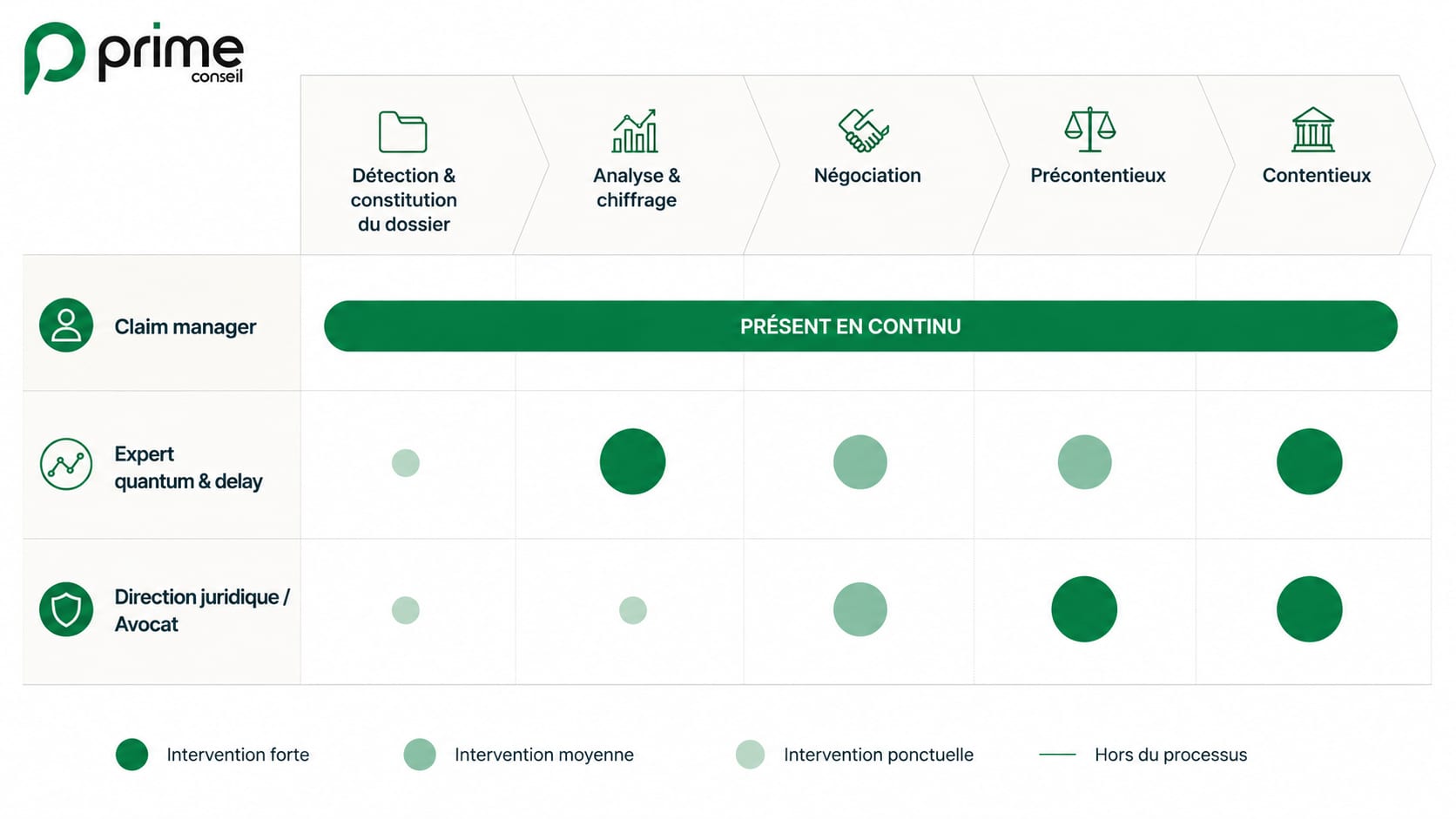
Reversing this order always comes at a cost. An expert brought in too late inherits a file that may already contain admissions or flawed early analyses that will act as an anchor, a lawyer instructed too early takes a dispute into litigation that could have been negotiated, and a claim manager sidelined from their own case watches the contract strategy dissolve into a string of disconnected technical and legal interventions. The performance of a claim lies not only in the quality of each contribution, it lies in how they are sequenced.
A discipline of orchestration
Claim management is ultimately better defined by a function than by an organisational reporting line: orchestrating, over time, a process that draws on law, technical expertise and business judgement in the service of a contract strategy. Neither litigation, of which it is in fact the best prevention, nor expert analysis, of which it is the primary client, it occupies a position that no one else holds on a project: that of the connecting thread between the event on the ground and its negotiated resolution.
That leaves the question that naturally follows on from the discipline's scope: how is this orchestration practised day to day, with what habits, what tools and what discipline in keeping the case file? That is a subject in itself, which we will cover soon. Organisations that treat claim management as a routine practised in calm times, rather than a skill reserved for a crisis, already know this: a claim is rarely won at the moment it is written!