
The publication a few weeks ago of a study conducted by the WCC (World Commerce & Contracting) among nearly 200 organisations highlighted the specifics of contracts in the energy sector (more particularly oil & gas and energy, or OGE).
Beyond the figures, this study also helps identify key points and areas for reflection to pinpoint the particularities of contracts in the energy sector, as well as how contract management can act as a performance lever.
So, as we did in early summer for contract management in the defence sector, we propose, based on this study, to identify the specifics of contract management in the energy sector! First of all, it should be noted that this sector has, for many years, followed relatively established practices: the creation of SPVs and other dedicated companies, the use of standard-form contracts (FIDIC, NEC, etc.) and negotiations that, from one project to another, cover similar topics.
However, the economic, political and fiscal instability that the business world has experienced since the post-COVID period has upended these practices, and has at times reshuffled the deck and the balance of power between end clients, major contracting authorities and Tier 1 subcontractors.
Looking on the bright side, these changes bring good news for contract management, since according to this study, 55% of organisations surveyed say they are paying more attention to contract management and recognise its key role in projects that are becoming increasingly complex.
Also on the good news front, we note that among the sector's contract management priorities are improving internal processes (60%) and staff training (49%), two areas where Prime Conseil is well placed to lend a hand!
It is now time to get to the heart of the matter, by looking at three essential points from the WCC study.
A. The most negotiated clauses in the energy sector
The energy sector is distinctive in requiring significant resources, both financial and human. The direct consequence of this heavy mobilisation of cash and experts, all within tight schedules, is that liability caps, prices and liquidated damages make up the top 3 most negotiated clauses (see image below).
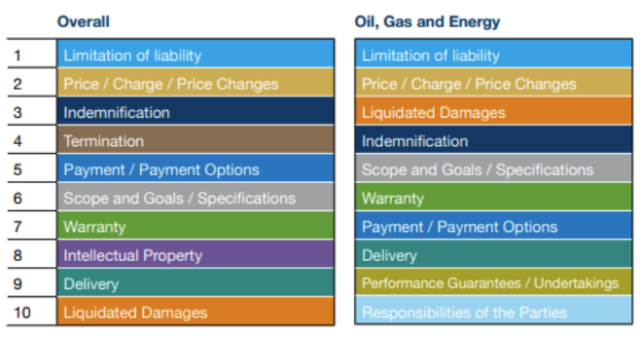
To play spot-the-difference with other sectors, we also see that warranty topics make an appearance in the top 10, while intellectual property and termination matters are less prominent than in other fields.
B. The most important clauses in the energy sector
Second section, second question. When asked which clauses are the most important, the 200 organisations surveyed gave different answers (reflecting the asymmetry between what is negotiated and what is important). Here, we immediately see topics related to the SOW and specifications (the famous "specs") come to the fore.
This is not new, since this clause is cited as the most important across many sectors. However, if we look at the specifics of energy sector contracts, we quickly identify change orders or contract amendments, whose importance in such large-scale projects is easy to understand, as well as warranty and performance matters, which are also closely tied to the economics of such large-scale contracts.
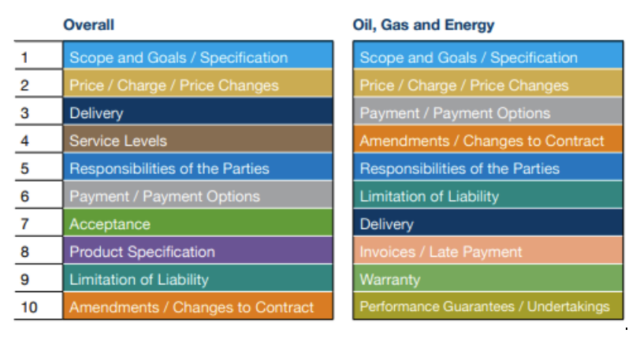
We can therefore see that negotiation and contract execution monitoring stages are crucial for projects in the energy sector, whether to properly frame exposure upstream, or to ensure the proper management of risks, cost overruns and other performance issues that may arise during execution.
C. Sources of difficulties and disputes
We now reach the essential chapter of this article, since by comparing the clauses most exposed to (pre-)disputes with those that are most negotiated (whether generally in this study, or more specifically within your organisation), one can quite quickly identify areas of risk or, at the very least, levers for improving performance.
Here, we note a rather telling top 5 (since this top 5 alone helps identify the role and importance of the contract manager):
i. Lack of clarity in the SOW and objectives
Across all sectors, 40% of respondents cite this as the main source of claims and, more generally, of deteriorating relationships between contracting parties. While this statistic is not surprising to practitioners, given how obvious this lack of clarity is on almost every project, it is nonetheless surprising that this issue remains, year after year, at the top of surveys, even though tools and methods for improvement exist.
The Prime Conseil tip: from the tender stage and at project kick-off, favour diagrams and other visual elements that summarise the parties' essential obligations, but also clearly identify elements/services/products that are "out of scope", and limit "without limitation" and other such wording that risks causing problems later on.
ii. Misunderstanding of the contract terms
It is not uncommon in the energy sector for each party to develop, as the project progresses, different interpretations and understandings. In some cases, these differences can ultimately prove significant enough to bring a project to a standstill. For example: does this type of event entitle me to an extension of time and/or cover for cost overruns?
The Prime Conseil tip: organise clarification workshops during execution when discrepancies arise, and formalise the outcomes of these discussions.
iii. Poor management of changes in circumstances
In the energy sector, projects run over the long term, energy prices fluctuate, as do applicable standards and laws (relating to the environment, construction, permitting, etc.). Once again, it is not uncommon to see disputes arise from changes that, according to some, upset the balance and economics of the contract, while others see them merely as a risk that could have been foreseen upstream.
The Prime Conseil tip: there is no magic wand applicable to all sectors and organisations, but rather a good practice: make sure to build on your experience from one project to the next so as not to repeat the same mistakes several times (permit acquisition timelines, grid connection duration, revision in the event of a substantial change in resale prices, etc.).
iv. A lack of maturity in the handover process to the project team
Now we get to the juicy part, since according to 58% of respondents (no less!), the lack of maturity (or even the complete absence) of their handover process between the team that won the tender and the team in charge of delivery is one of the main reasons disputes arise during execution.
Indeed, the reasons why certain clauses were accepted, the commitments made during negotiation sessions, or unwritten needs or constraints expressed by a client during the tender phase, are all elements that are rarely passed on to the project team responsible for delivery.
The Prime Conseil tip: have a contract manager who can take part in the pre-sales phase, but also in execution!
v. Poor contract management & administration during the execution phase
Last but not least, also cited by nearly two thirds of respondents among the main causes of disputes: the absence or failure of contract management & administration. We have already had the opportunity to write on this subject (link to the article), but the attention of legal and finance teams tends to fade once the contract is signed.
Where there is no contract management, the contract is often managed reactively (once the event has occurred) rather than proactively.
The Prime Conseil tip: you can see where this is going, can't you? Get yourself a contract manager!
Conclusion
This study illustrates the specifics of contract management in the energy sector, and, as a mirror effect, the significant challenges that sector players must address in terms of contract management.
These large contracts require substantial capital, involve an extensive subcontracting chain, and generally span a number of years, making them particularly exposed to risks of all kinds.
The answer to managing these risks, whether you are a buyer or supplier in the energy sector, is to negotiate better and manage your contracts better. Easy to say, isn't it? In practice, it's a little more complex.
Nothing, however, prevents proceeding step by step: better negotiation can start with a better understanding of key clauses and provisions likely to give rise to conflicts and disputes, and better contract management & administration can be organised by devoting a bit of time and energy to training, and by ensuring that the counterparty(ies) and the contract always remain at the heart of priorities.