
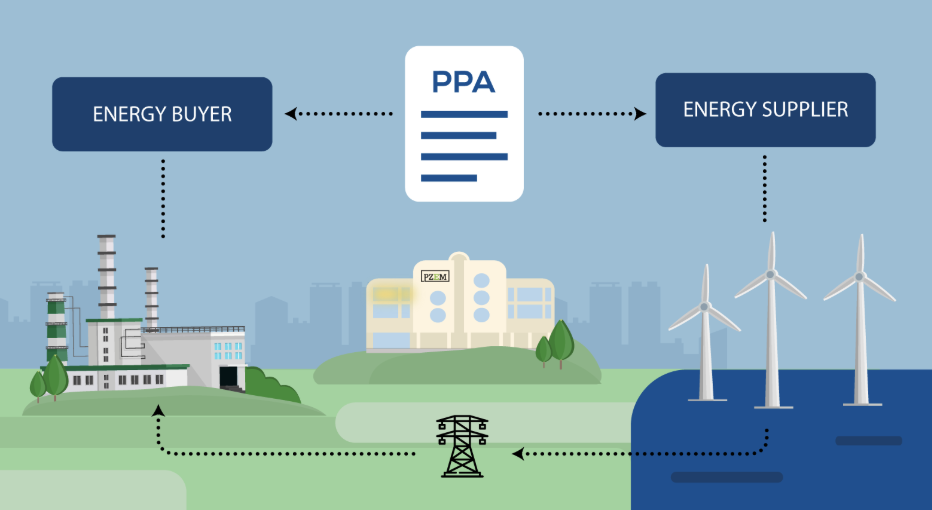
I. What is a multi-buyer contract?
Let us start with a definition, or at the very least an explanation! What do we mean by a multi-buyer contract? In simple terms, it is a contract concluded between a supplier on one side and a number of companies on the other. Those multiple companies generally belong to the same ecosystem: economic, geographic or social. For the duration of a contract, they become bound by a shared commitment (without there necessarily being any volume obligation).
In the most classic arrangements, this role is played by a parent company that centralises purchasing for its subsidiaries (think of the central procurement departments of large groups putting framework contracts in place from which each subsidiary can benefit).
But to illustrate this article, I have chosen another example, less common but more telling as to the potential of these contracts to strengthen cooperation while delivering savings. It is the first multi-buyer green electricity contract signed in France in 2025. This contract was not concluded by companies belonging to the same group, but by companies with no shareholding links between them.
II. A French first in 2025
Under this CPPA (since also referred to as a “Green Corporate PPA”), nine mid-sized companies from Nouvelle-Aquitaine signed, alongside Valeco, a Private Power Purchase Agreement (or CPPA) that is unprecedented in the energy sector. More than a simple commercial agreement, the initiative shows how important it is to think upstream about the right contractual framework, and to put in place collective contractual governance that supports the achievement of shared objectives: securing the energy supply and making it sustainable over the long term.
III. When contractual complexity becomes a lever for collective performance.
Until now, PPAs (Power Purchase Agreements), which allow electricity to be bought directly, were reserved for large groups able to reassure producers with their financial strength and high consumption. Mid-sized companies and SMEs were left on the sidelines, for want of sufficient guarantees.
The project run in Nouvelle-Aquitaine proves that risks and commitments can be pooled. Nine mid-sized companies, supported by the Region and the Club des ETI, joined forces to negotiate a common contract. Framed by technical and financial specialists but also by contract experts, this arrangement redefines the traditional patterns of contracting for energy purchases: a contract no longer links a single supplier to a single customer, but brings together a collective of players around a shared objective. A genuine revolution, and an ambitious project that I had the chance to follow, with an implementation that was not always plain sailing, reflecting the differing strategies of the various companies involved.
IV. The keys to concluding such agreements
The implementation of this agreement, a first in France, taught me several key success factors in setting up arrangements of this kind:
- A shared willingness to pool risk: each company commits to a share of the contract, which reduces individual pressure and strengthens the whole. This shared rationale must be the starting point for setting up contracts of this kind
- Coordination between companies: succeeding in such a project means creating a working environment, allocating resources and defining a framework that aligns interests, encourages the exchange of good practice and makes decision-making easier.
- The involvement of an ecosystem: in this case, a regional dynamic initiated by public bodies. The initiative helped quickly identify interested companies and encourage them to come together. Of around fifteen mid-sized companies that initially applied, 10 put themselves forward and 9 signed, proof that only the most committed see it through. The mechanism also created new links between them, weaving an unprecedented regional network.
- Fairness in governance: beyond the splits that are decided contractually (there is no requirement for each stakeholder to contribute equally), it remains essential to maintain fair treatment, so that every party to the contract has a say and sees its expectations and needs heard, whatever its weight in the contract.
V. Sharing skills: a decisive advantage
Beyond economies of scale, multi-buyer contracts open up a new field: the sharing of skills. The signatory companies were able to appoint an expert contract manager whose cost and know-how were pooled. This model gives mid-sized companies and SMEs, which often lack specialised in-house resources, access to high-level expertise.
The benefit is twofold:
- professionalising contractual management with a dedicated expert,
- creating a collective dynamic in which skills and costs become shared.
Conclusion: Collective contractual intelligence, the future of contract management for SMEs & mid-sized companies?
This multi-contract is not only a first in France: it shows that SMEs and mid-sized companies can be agile enough to give themselves means and resources usually reserved for large groups. In this instance, it allowed mid-sized companies to buy electricity directly, but also, in contract management terms, to secure the expertise of a contract manager by pooling resources. This collaboration and pooling allows mid-sized companies to strengthen their contractual management capability without increasing their payroll. Finally, the agreement illustrates more broadly the emergence of a genuine collective contractual intelligence, capable of giving mid-sized companies and SMEs the same firepower as large groups.