
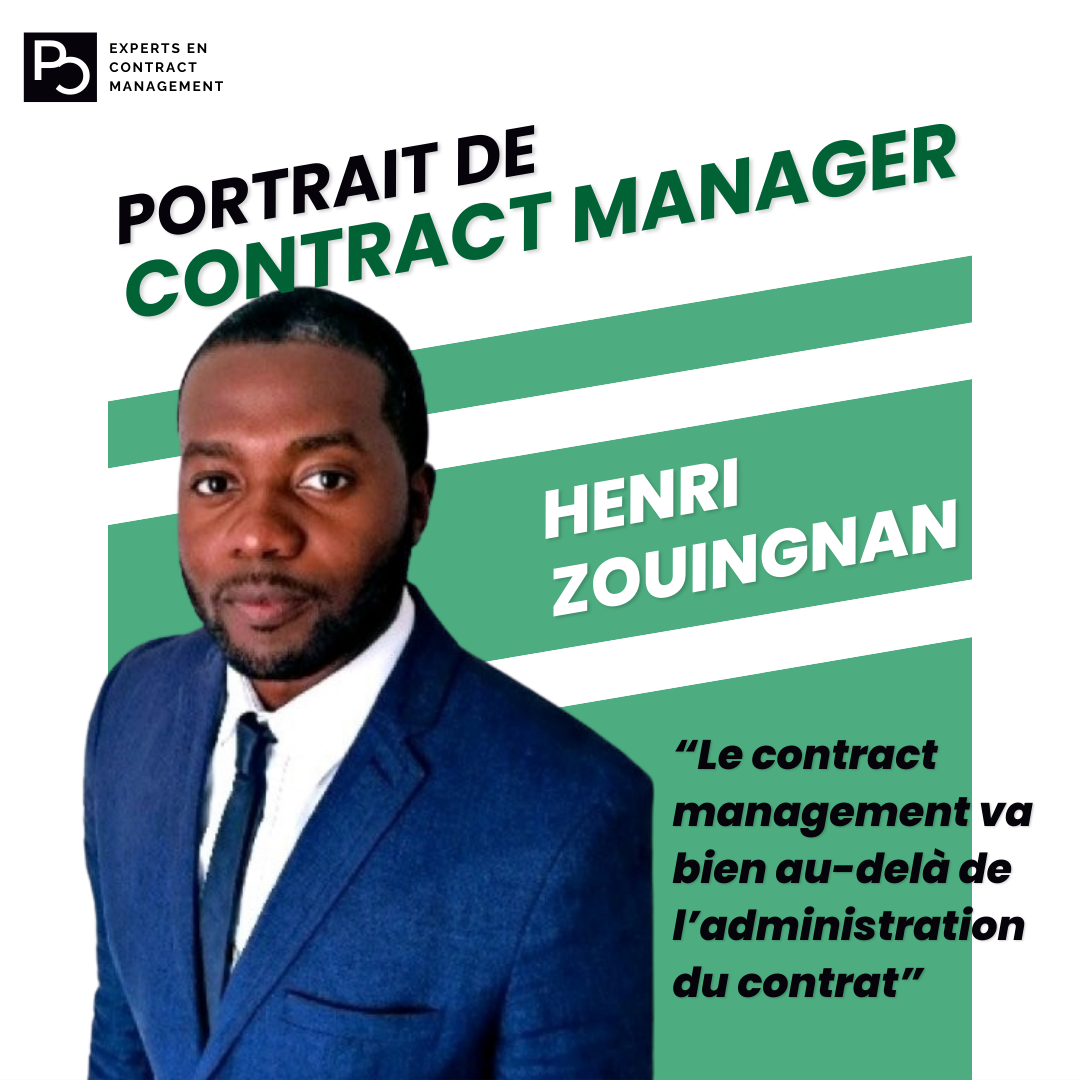
Let's continue our summer series with a second contract manager profile, and not just any one! I had the pleasure of interviewing Henri Zouingnan, partner and contract management consultant at Prime Conseil. For this slightly special interview (Henri is a member of the team), we decided to give him no favours, so as to deliver a profile guaranteed free of spin!
Through five questions, we invite you to get to know Henri, his background and his view of contract management:
Let's get straight to it: you moved from legal counsel to contract manager: punishment or vocation?
Although the answer is, to my mind, entirely obvious, the question is still a fair one. In recent years I have met many legal counsel who have become contract managers and, to put it simply, I identify two main types of profile:
- On the one hand, legal counsel who no longer found meaning in, or appetite for, what they were doing and who found in contract management a logical career change, compatible with their skills and far from wholly unfamiliar territory,
- On the other, legal counsel with a very operational approach, close to the business teams, for whom contract management was an opportunity to create more value and broaden their scope of action.
For my part, I belong to that second category. From the very start of my career I took a strongly "business"-oriented stance, and the contract has always been, for me, a tool serving performance. I was fortunate enough to spread that culture across a number of companies. When I discovered contract management, with its even more operational, multidisciplinary and strategic scope, I understood that it would be the logical next step in my career. So it is a vocation, and a profession I practise with a great deal of enthusiasm every day.
Isn't a legal background a handicap when working on engineering matters?
Quite the opposite! It does depend, though, on the lawyer's personality, their sensitivity and their curiosity about other fields, however complex those fields may be. If, in their previous career (and as I mentioned above), the lawyer had a strong appetite for operational matters and was inclined to immerse themselves in the specifics of the business, to sit at the heart of operations and requirements, it can even turn into an advantage.
Of course, you always have to get to grips with the technical aspects and learn a few methods and processes, but in reality legal counsel share far more with engineers (see our article on legal and engineering profiles) than one might imagine: rigour, analytical thinking, creativity and the methodical way of working we inherit from our legal training are all extremely valuable in contract management.
"Contract management is an administrative function": what do you make of that?
It is a reductive perception, and one we come across less and less in the field, a sign that the function's visibility in business is improving. That perception is still closely tied to the fact that contract management is not yet a fully mainstream discipline and that its scope remains too little known to the wider public.
In practice, it is a profession that goes well beyond simply negotiating, drafting and administering the contract. It is a central function within the company which, through its cross-cutting role, works with every contract stakeholder to find the major operational levers that contribute to business performance and profitability.
So it is first and foremost an operational function, on the ground and at the heart of strategy. As a contract manager, you have to go beyond know-how and practise "letting others know", so that the boundaries of this discipline are better understood and everyone is aware of its added value.
If I asked you to explain contract management in 30 seconds to a five-year-old, what would you say?
That is probably the hardest exercise there is for a contract manager, given how broad and constantly changing the scope of the role is! On reflection, I would tell that child that "contract management is a bit like Father Christmas, whose job is to get the presents ready. He makes sure he knows us and knows what we need. He makes sure he sticks to the letter he was sent and sees to it that the elves make exactly what was planned and that everything is ready on time". His aim is for everyone to be happy for as long as possible and to avoid any upset.
Let's talk about the future: contract management is a young discipline in France: what future do you see for it?
The contract management market is very dynamic and keeps on growing. You only have to look at the number of job adverts posted every day to see it.
That said, it seems to me that contract management is far from having reached its potential and that it remains a much underestimated lever for value creation within organisations. As with any activity, that progress needs to be supported by strong representative bodies at national level. Some excellent initiatives are already in place with the AFCM, but here too there is perhaps room for improvement, to give our discipline more visibility and take it mainstream.
To finish, a small challenge: there are plenty of consultancies on the market: tell me concretely why Prime Conseil, without using buzzwords like "paradigm", "innovative" and so on?
The contract management consulting landscape is fairly fragmented today, with some very good consultancies, some of them generalists around the project function, but in the end very few specialists. So I would simply say that Prime Conseil is one of the rare niche consultancies in France doing nothing but contract management. We made that choice of hyper-specialisation, with a passionate team holding real expertise in certain sectors. That allows us to give our clients a very high-quality approach to contract management and to meet their needs.