
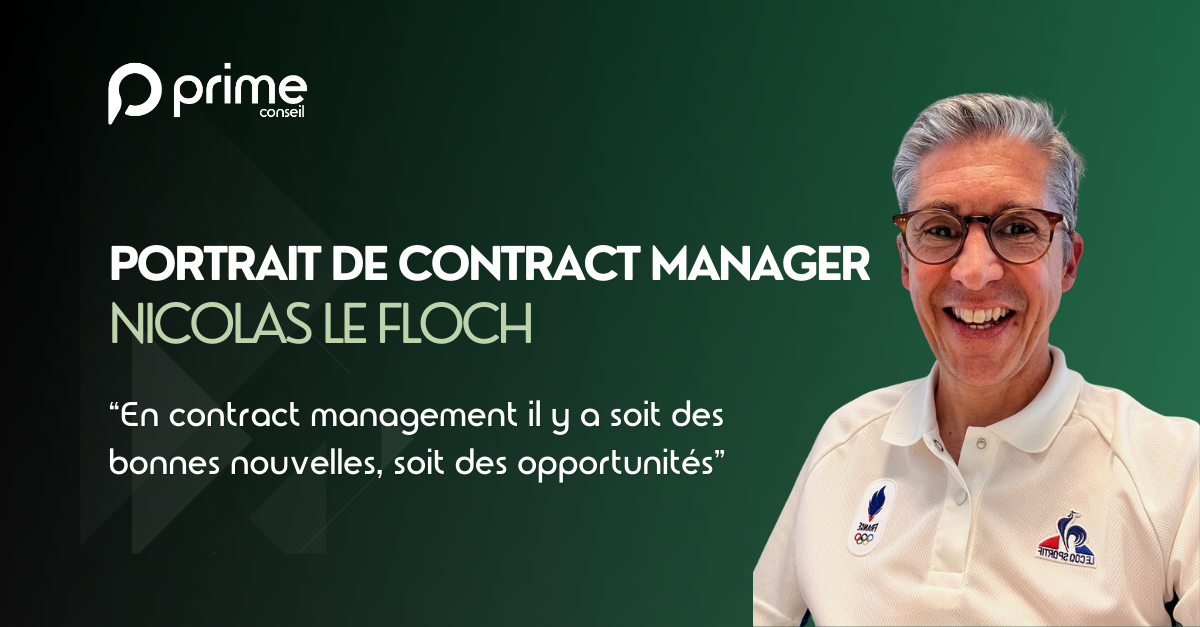
For this new contract manager profile, after Laure, Nadia and Henri, we fought (figuratively) over who at Prime Conseil would get the chance to interview Nicolas! For those who do not know him, Nicolas Le Floch brings more than 20 years’ experience within industrial groups, hundreds of compelling LinkedIn posts, a large share of them about contract management, and above all a positive view of the discipline and, more broadly, of human relationships, which we deeply share.
In this article, we look back on a superb conversation in which two shared passions came together: sport and contract management.
Prime Conseil (PC): To start with, if you had to draw an analogy between a sport and contract management, what would it be?
Nicolas Le Floch (NLF): The first thing that comes to mind is the sport I practise most, ultra-trail running (UTMB-style endurance races). Why that parallel? I once heard ultra-trail running described as “the kingdom of discomfort”, where you have to handle the unexpected constantly (setbacks, weather conditions, technical problems, and so on). Those setbacks test not only the body but also the mind.
In the same way, contract management, in its holistic dimension, demands constant adaptation to situations that arise throughout a project that may run for several years. You need resilience and adaptability, but also the sense to keep some room for manoeuvre, because no contract drafter can foresee everything up front, still less on long-term contracts. You have to let the project live and adapt as you go.
Finally, while trail running is often seen as an individual discipline, there are also team events which, like contract management, require you to coordinate and to accept depending on others.
PC: Staying with the team dimension, how would you define the contract manager’s role within a project team?
NLF: I see myself as the project director’s right hand, with an overall view. I am a kind of conductor, handling the interfaces with everyone else who holds input data. To stay with sport, I would say the contract manager is the midfielder whose job is to join the defensive effort and support the strikers.
PC: How do you see the contract manager role evolving? Over the years, is it meant to play a slightly more advanced role on the pitch?
NLF: What I see inside my own company, and outside it, is that where contract management stands on an organisation’s pitch is above all a matter of corporate culture. When an organisation has a dedicated function, tools, people and processes in this area, that does a great deal for the visibility and standing of contract management.
That said, I do not think you should hide behind an organisation’s lack of contract management maturity to justify the function playing second fiddle. In my view you must always promote your function, both to be accepted within the team and, more broadly, to give the role meaning, explain where you add value and get your messages across.
In a previous life as a lawyer, I used to say it was for the law to go out to the operational teams. In contract management, the point is to bring the contract into the daily life of operations.
PC: Day to day, how do you spread this contract management culture within the teams?
NLF: For me, contract management is a collective discipline that cannot be reduced to the contract manager alone. Whether it is a claim, a change to the contract or any other event in the contract lifecycle, I always position myself as a contributor rather than a gatekeeper, seeking to mobilise the teams with humility rather than working alone and imposing contract management.
In the end, as in sport, repeated effort pays off and the reflexes take hold, with small wins: a project colleague comes to me spontaneously and takes the initiative of drafting a letter, a planner tells me about a change to an input milestone, or someone simply thanks me for a fast answer. All of these make me feel useful to the Project.
The contract manager may one day be replaced by an AI, but so far hard work and humility allow me to contribute, to create value on projects and to be recognised as a first-team player at the centre of the game.
PC: As an accomplished athlete, can you name 3 sporting qualities that serve you in your CM practice?
NLF: Without hesitation, I would name:
1. Preparation
It is essential before a race, above all in order to know your own strengths and your limits, just as it is before walking into a negotiation room, chairing a steering committee or handing over deliverables.
2. Resilience
It is obvious in ultra-trail running, since a race can sometimes go well and sometimes very badly; resilience lets you step back from your situation (cut-off times and so on) and find solutions. It is much the same on a project, which brings its highs and lows and its share of surprises. In those situations I always tell myself that in contract management there is either good news or opportunities.
3. Passion
It is quite simply the engine. Passion is the reason you do all this, and the reason you succeed! There is no need to be a champion, in ultra-trail running or in contract management; you simply have to tell yourself how lucky you are to be doing it. It is not said often enough, but contract management, if you are a little creative, lets you “have a blast” and take real pleasure in the work ! For that, you need curiosity and a genuine interest in other people.
PC: Staying with sport, let’s talk about the trophy cabinet. How do you measure contract management performance?
NLF: On top of my own duties, I am also the “process owner” of the contract management process during the execution phase. That meant putting in place two main contract management key performance indicators (KPIs), and I chose two indicators of very different natures:
A. A short-term, quantitative indicator
This is a short-term, financial and quantitative indicator: the difference between the amount of the initial claim and the amount actually recovered.
B. A medium/long-term, qualitative indicator
The second indicator is more qualitative, with medium- to long-term results: the number of awareness sessions and training courses delivered over a given period.
Many other indicators can be used (see the excellent work done by the AFCM) to measure contract management performance, depending on the organisation and the field of activity, but in my view you must always keep a good balance between quantitative and qualitative objectives, short term and medium term, individual and collective. That is what allows the function to be grasped as a whole, rather than reduced to technical and administrative support for the project.
The Prime Conseil team thanks Nicolas for this time of sharing, and for his kindness and warmth throughout the conversation!