

Contract management is a strategic discipline that came to us from across the Atlantic. It is therefore often worth looking closely at how they practise the discipline, in particular to draw on their best practices given their greater maturity, especially in terms of the profession’s processes and documentation. With that in mind, we have chosen to focus on the Defense Contract Management Agency (DCMA), which embodies the quintessence of American-style contract management rigour and excellence.
Created almost 25 years ago, this agency is at the heart of the strategic and operational management of US defence contracts. In this article, we will explore not only the definition and the missions of the DCMA, but also the considerable impact of its work and its best practices, offering valuable lessons for organisations across the globe.
A. What is the DCMA?
1. DCMA: definition
The DCMA is an acronym that stands for “Defense Contract Management Agency”. As its name suggests, it is an agency under the United States Department of Defense (DoD) responsible for managing defence contracts. While the agency was created almost 25 years ago, taking over from the DCMC created in 1990, contract management has been professionalised within the DoD since the 1960s!
The DCMA today plays a crucial role in managing the lifecycle of defence contracts, ensuring that suppliers deliver what was promised, on cost, on time and to the required quality standards.
To find out more about the DCMA, click here.
2. The DCMA’s missions
The DCMA’s missions are varied and essential to national security and to the effectiveness of military spending. They revolve around three values: “integrity, service and excellence”, values that many contract management departments could draw on. Returning to the Agency’s missions, here are the main ones:
- Contract management: the DCMA monitors supplier compliance with contractual requirements, from production through to delivery.
- Quality assurance: it makes sure that the equipment and materials supplied meet the strict quality standards required for defence operations.
- Production surveillance: the DCMA oversees the production chain to prevent any potential delay or quality issue that could affect the armed forces.
- Audits: it carries out regular audits to ensure that funds are used effectively and that contracts are performed fairly.
- Technical support: the agency also provides technical support and expertise to help resolve the specific problems that can arise during contract implementation.
One aspect is very interesting to note here in contract management terms: the breadth of the discipline’s remit, which brings together audits, surveillance and even quality assurance, a testament to the importance of contract management across the Atlantic!
3. A few figures
The DCMA’s impact is significant, because it contributes not only to national security but also to optimising resources. By ensuring that every dollar spent contributes to defence effectively and efficiently, the DCMA plays a pivotal role in maintaining the operational capability of the US armed forces.
The measured impact of the DCMA’s activities shows the importance and the reach of the Agency, with figures and indicators that make your head spin.
- 230,000 active contracts under management
- $3.8 trillion of contracts
- 10,000 employees
- 1,000 new contracts a day
* According to the DCMA website.
B. DCMA best practices
You can imagine that with more than 10,000 employees and 25 years of existence (not counting the legacy of the DCMC, nor the DoD’s preparatory work since the 1960s), the DCMA is a goldmine of best practices!
1. Procedures in abundance
Do not get us wrong: we are not fervent advocates of process for its own sake! That said, it has to be acknowledged that a well-processed activity brings many benefits in terms of clarity, continuous improvement and service continuity and quality.
Among the DCMA’s “instructions” and “policies” you will find clear documents and easy-to-read guidelines on contract financial analysis, negotiation procedures and contract amendments and price changes. In short, more than fifty procedures (American-style, then) that you can draw inspiration from.
2. A clear roadmap
The DCMA applies to the letter the words of Nicolas Boileau: “what is well conceived is clearly expressed, and the words to say it come easily”. The agency indeed publishes clear “strategic plans”, setting out an action plan, priorities and an explicit contract management strategy.
For the current period (2022-2026), the four priorities are as follows:
- Focus on compliant deliveries, on time and to quality
- Improved flexibility and decision-making processes in acquisition arrangements
- Adoption of tools and working methods to deliver maximum value and prepare for the challenges ahead
- Innovation and modernisation of working conditions
3. Relevant positioning and organisation
Finally, two further points stand out as best practices applicable to our French and European organisations.
The first is positioning. The DCMA reports directly, within the DoD, to the US Secretary of Defense (see the organisation chart below), which allows it both to stay very close to the operational need and to have the independence, the legitimacy (and the hearing) at senior level to evolve and adapt quickly to changes in contract management.
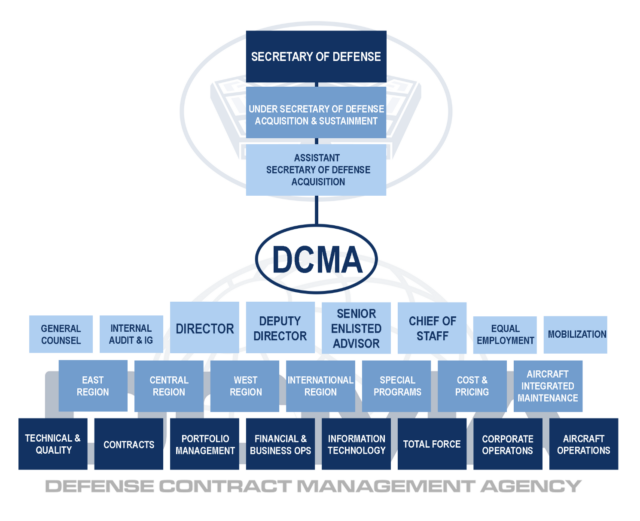
The second concerns its organisation because, again in the chart above, we note a matrix organisation crossing geographic sectors with functional approaches, which delivers 360° contract management expertise. While it is hard to apply such an organisation (more than 10,000 people within the agency) to a team of contract managers working within a company, one can still note a sector and geography crossover that may be worth putting in place, especially as contract managers often have rich and varied backgrounds.
Conclusion
This focus on the Defense Contract Management Agency (DCMA) reveals not only the strategic importance of contract management within US national defence, but also its maturity in contract management terms. Its well-defined processes, its effective organisation and its proactive contract management and audit strategies are elements that any organisation, public or private, can seek to emulate.
By drawing on (and re-adapting) the DCMA’s operating principles, values and methods, French contract management departments can not only improve their operational efficiency, but also increase their added value within their organisation, in a complex and demanding environment. So the DCMA does not merely play a crucial role in the security of the United States, it also serves as a compass for contract management internationally.