

For the past eighteen months, the discourse on AI and contract management has often been reduced to a single sentence, always the same one. In this opinion piece, I propose to go a little further, even if it means admitting that, to date, we do not yet have all the answers.
"AI will not replace contract managers, but contract managers who master AI will replace those who do not." How many times have you heard this sentence over the past eighteen months?
How many conferences, webinars or podcasts have you attended just to hear it repeated, with varying degrees of conviction (and I would not swear that I have never said it myself)?
Stepping back a little, could we not take the same sentence, replace the term "contract manager" with lawyer, auditor, buyer, accountant or developer, and find that it works just as well? It certainly seems so, which shows that this sentence has become a cliché that suits everyone without saying anything concrete.
In last month's opinion piece, I answered the question of AI with optimism and confidence, explaining that the real danger for our discipline was not AI itself, but training contract managers to do what it can already do. I still believe this, but on re-reading it, I thought we could dig deeper into the subject.
Let us start with a paradox: the market has never sought contract managers so much (I posted on LinkedIn last week that contract manager recruitment has increased by 14% compared to last year), and the contours of the contract manager role are not yet fully fixed (see, for example, the contract management standard and the ongoing work to standardise the role, up to a future ISO standard). Yet it is quite possible that AI will reshuffle the cards before this work is even completed.
In short, the discipline is more necessary than ever, but the contract manager who practises it is probably more exposed than they would like to believe.
As the head of a consultancy, I naturally ask myself about our business model, and how we will need to adapt our offering in the face of AI. But it is above all as someone passionate about this field that I ask the question that really matters, the one about what comes next: in a few months, when AI is everywhere in our contracts, how will a contract manager remain genuinely useful? To date, and some of you may stop reading this opinion piece at the end of this sentence: I do not have a definitive answer, only observations, reflections, doubts and a few convictions.
What AI can already do (often better than us) in contract management
I wrote this opinion piece at the end of a week during which Prime Conseil supported a client in setting up AI agents dedicated to contract management. This leaves no room for denial: AI is transforming the day-to-day work of a contract manager on a project.
This shift is linked to the fact that, in practice, a significant share of a contract manager's working time is spent answering questions and drafting documents about the content of the contract and its interpretation: what is the notification period, who bears a given risk, what does a particular appendix state, and so on. The (harsh) reality is that AI answers these questions very well. For example, finding the notification period for an extension-of-time request in a 300-page contract is exactly the kind of task it excels at, and it is far quicker than us at it.
Similarly, producing meeting minutes, updating a correspondence register or drafting simple notification letters are now activities well within AI's reach. In other words, the activities that, in volume, accounted for most of a contract manager's work are now AI's playground.
This observation is not unique to our profession. Anthropic, the maker of Claude, regularly publishes analyses of how its tool is actually used. One of these, published at the end of 2025, already ranked legal tasks among the longest and most costly of all those studied, with nearly two hours of work on average per task and potential productivity gains of 80% thanks to AI.
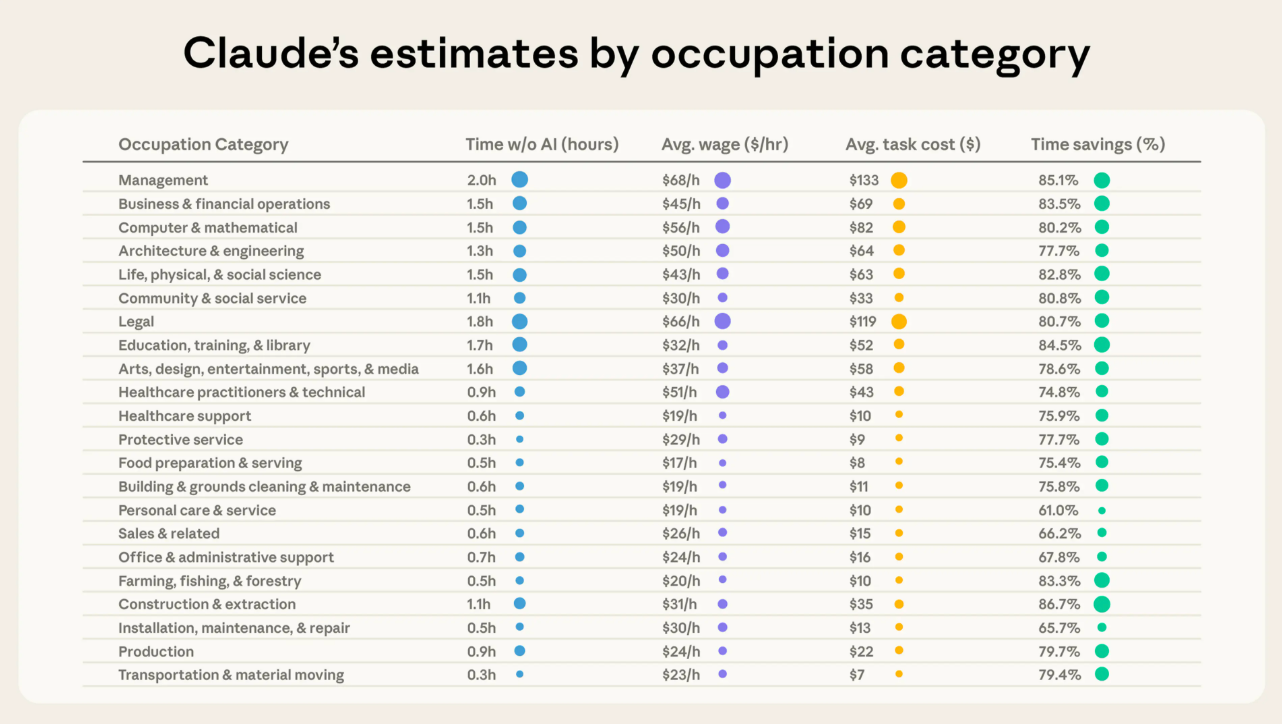
Its January report goes further, and it is enough to shake a few certainties, starting with my own: according to this report, the usage observed mainly involves taking on tasks that require an above-average level of education, so that its first effect would actually be to strip jobs of their most skilled tasks.
So, while I wrote last month that AI would first absorb the administrative layer of contract management, this observation has probably already been overtaken by events. Lawyers, for instance, are already experiencing this: an article published yesterday by Les Echos reports clients now arriving at meetings with clauses already drafted, or draft writs produced by AI, confirming that drafting a first version is no longer the professional's job alone.
AI can now replace the contract manager in drafting first versions, producing notes and minutes, searching through numerous documents (contracts, case law, technical appendices, emails, and so on), producing reports, and more. In short, as with many knowledge professions, the contract manager's zone of genius has shrunk considerably.
Ensuring reliability, orchestrating and convincing: what remains (for now) for contract managers
So what would be left for the contract manager? On this question too, we can read plenty of stock phrases (applicable to every profession) that boil down to one word: "the human factor". However, to avoid another cliché and try to add something to the discussion, I propose going a little further.
First, there is the matter of ensuring the reliability of deliverables. I propose to illustrate this with a very concrete, real-world example, one we face daily at Prime Conseil, concerning the use of AI and its limits.
Indeed, while it is undeniable that AI saves us real time when it comes to finding a clause, the opposite is often true when it comes to analysing a letter in detail. At first glance, one might think that AI saves time, at least for a first, quick read-through. Except that in practice (those who have experienced this will understand), between the time spent formulating the request, reading through everything AI has produced in full to make sure it has not invented or missed anything, and the time spent correcting it, we regularly find that we would have been faster doing it by hand.
The real gain therefore depends less on what AI can do than on the cost of checking what it has done. The Anthropic study mentioned above acknowledges this itself, with a degree of honesty worth noting: the 80% productivity gains mentioned above do not account for the time spent checking, the quality of the result, or judgement.
My second point concerns the precision that is intrinsically necessary to our profession. Taking another example, consider an EPC contract for a EUR 2 billion megaproject. On such a project, a hallucination is not a typo, it is a missed notification deadline, a lost right, or a claim that collapses, failures that can potentially cost millions (a far cry from a contract manager's salary).
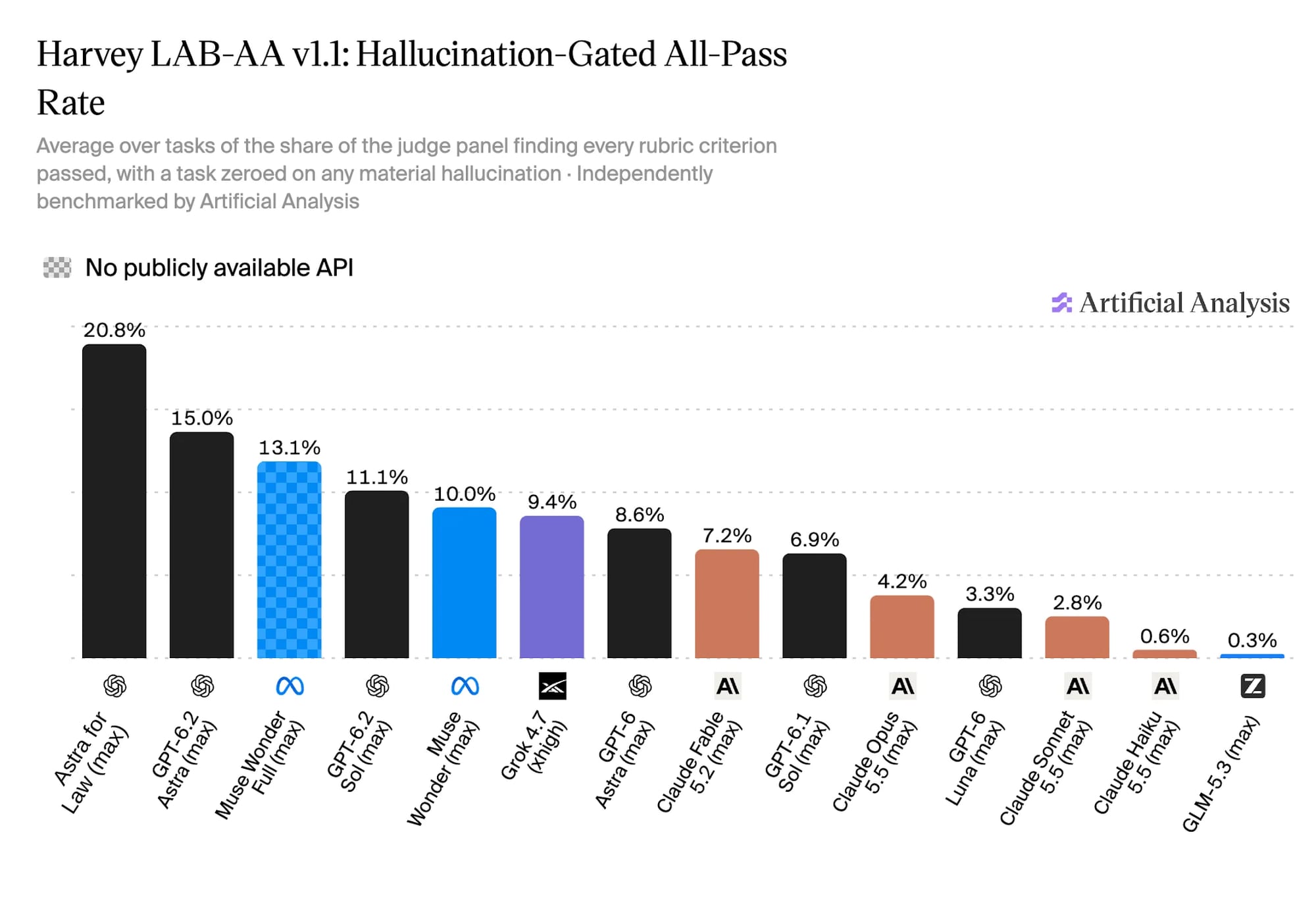
Given the stakes involved in these megaprojects and the small margin for error they tolerate, the article published by OpenAI the day before yesterday, announcing that its new model ranks first by managing to complete 20% of tasks without hallucinations, seems hard to reconcile with replacing contract managers on this type of project.
My third point is probably the one closest to my heart. Contract management is, by its very nature, a profession built on interfaces and relationships. The fact that AI can answer in a second a question that would take a human two hours changes little about what actually takes time on a project: bringing the right people together around a table, aligning positions that are not aligned, defusing a conflict before it escalates, rallying a team behind a shared position. Decoding negotiation dynamics, understanding stakeholders' interests, linking a behaviour to a situation, staying one step ahead: all of this remains deeply human, the complete opposite of a probabilistic calculation.
To illustrate this, here is an example from a few weeks ago at Prime Conseil, concerning a claim on which we are supporting a client. At first sight, the exchanges between stakeholders should have taken a few lines, one or two pages at most. Yet we found that these claims took the form of numerous letters running to dozens of pages excluding appendices, full of accusations, assertions and rhetorical flourishes, but ultimately very little substance, along with a few tell-tale signs (typeface, sequencing, syntax) indicating that both parties had drafted their letters with the help of AI.
The direct consequence of using AI in this situation is that, where it was once laborious (for most project teams) to put together a written file, AI has made project actors highly verbose, leading to a war of words that is often damaging to both substance and relationships. Yet in a claim, precision, subtlety and restraint are essential. AI does not always reduce the workload: sometimes it simply shifts it onto whoever has to sort through and decide.
Finally, as I finish this paragraph, I must admit that these arguments are, more or less, the ones every profession puts forward to reassure itself: the job will not disappear, it will reinvent itself. This may well be true, and it is also, quite precisely, what we all want to hear.
Ambiguous AI policies and corporate cultures
Beyond the question of what AI can or cannot do, and how contract managers need to adapt to it, there is an essential factor that is often underestimated in this debate: culture.
There is no shortage of examples of technologies that were ready long before the humans who were supposed to adopt them, from self-driving cars to drones, including electronic voting in some cases.
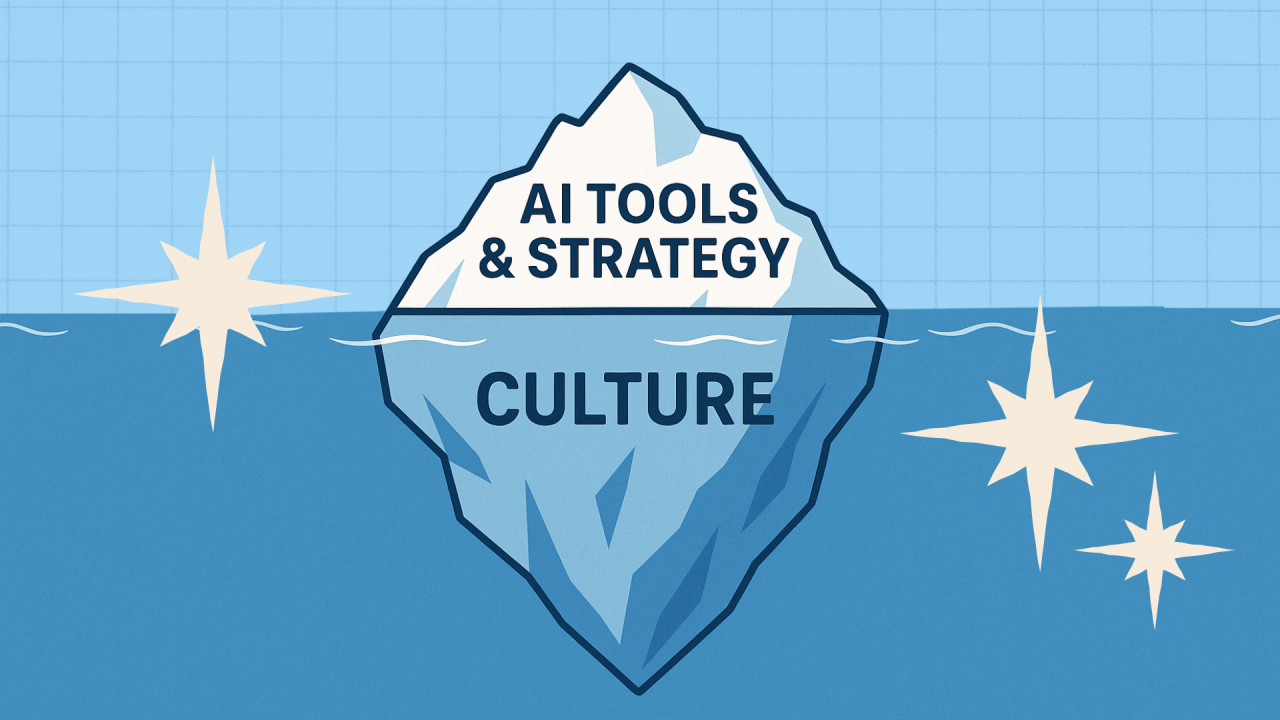
Contract management is no exception: companies have their own obstacles, their own reluctance and, let us be honest, their own contradictions. The very organisations that draft very strict policies on AI use see their teams using it every day, outside any framework. The very management teams who say they want to pay for results continue to compare their providers on hourly rates and headcount, as KPMG pointed out just a few days ago.
We cannot act as if this cultural dimension did not exist, neither within our own organisation nor among our clients. We therefore have to work with a market that wants a variable approach to AI use.
How much is a contract manager worth in the age of AI?
Having shown that AI can in fact carry out many of the tasks a contract manager performs daily, that there is still a playing field reserved for the contract manager, and that organisations are adopting AI at breakneck speed, yet still with a lack of perspective (and consistency), it is time to move on to the most uncomfortable question.
This question concerns a consultancy like Prime Conseil just as much as an organisation that must establish and justify a workload plan, or a contract manager who ultimately practises the discipline on a daily basis.
Before talking about pricing, we first need to know what value we are actually creating. This thinking has already begun at Prime Conseil, but also at the giants of consulting, since around a quarter of McKinsey's fees worldwide are now said to be linked to results achieved rather than time spent, and a head of KPMG's consulting practice admitted just a few days ago that selling consulting services alone had, in effect, ceased to exist.
Two researchers, Erik Brynjolfsson (Stanford) and Georgios Petropoulos (USC), published an analysis this summer that gave me much food for thought. Their starting point is simple: pricing for a service is currently set based on what the client can observe, the effort made or the result achieved. AI now blurs the first indicator: when part of the work is done by the machine, hours billed no longer say much about the actual effort involved, hence the temptation to shift towards payment by results.
The subtlety of the analysis lies in the fact that even a perfectly measured result does not reveal what is attributable to the service provider and what belongs to the client (rather like a contract manager taking all the credit for the outcome of a negotiation on a contract amendment).
The study's conclusion is interesting: the hybrid model, with a fixed portion and a results-based portion, is not a transitional step but the actual destination. The study also notes that billing by time still makes full sense for highly specialised work where humans remain central, which sounds rather like contract management as we understand it at Prime Conseil.
For a contract manager, these difficulties feel familiar: defining indicators that cannot be gamed, setting out assumptions and exclusions, organising a shared performance review, this is exactly what we apply to the contracts we manage. What is new is that we will have to apply it to our own value. And this is where the subject becomes dizzying, because a large part of a contract manager's value lies in what does not happen: the dispute avoided, the deadline met, the right preserved. AI does not create this attribution problem, it simply makes it impossible to ignore.
Are junior profiles at risk?
We have just seen above that billing by time spent is set to become more difficult, the very time that allowed a junior to offset their lower productivity while continuing to learn.
But if time is no longer paid for, who will fund the learning curve of juniors? A study carried out by KPMG and the University of Texas among 523 young professionals working with AI agents gives food for thought: only half of them perform better than AI alone, a quarter perform as well, and a quarter perform worse.
Worse still, if we look at the trend among software developers (more directly affected by AI), the divide between juniors, mid-level professionals, seniors and experts is immediately apparent:
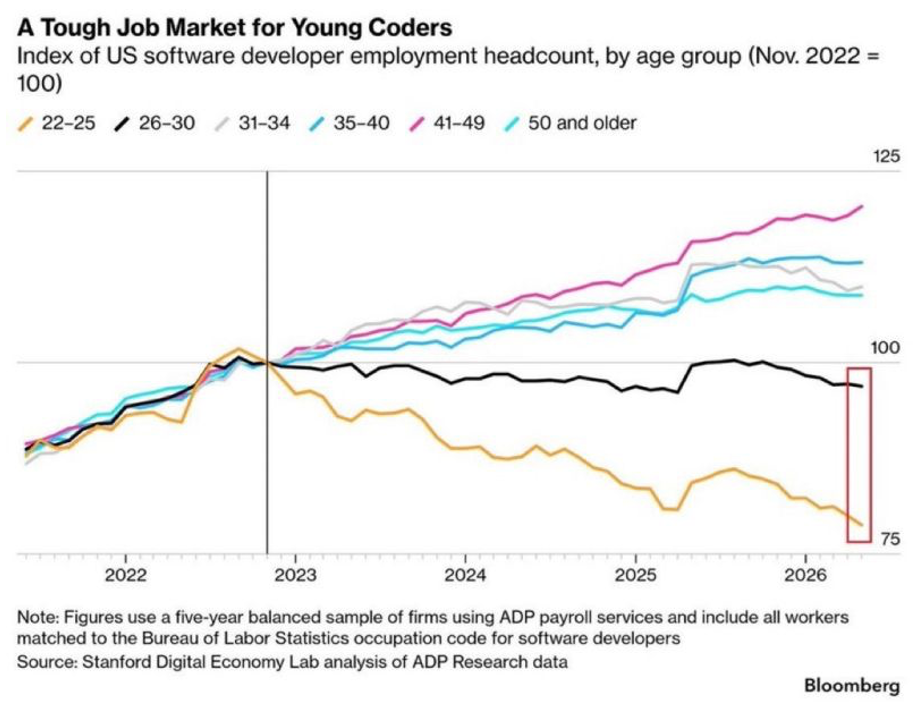
In short, there is no shortage of juniors on the market. What we risk lacking tomorrow, however, is seniors, if no one takes the time to train them today.
Conclusion
I shall be careful not to state anything definitive about pricing, the maturity of organisations or the training of juniors, and I am wary of anyone who claims to have the answers.
Yet everyone, in their own position, has a question to ask: the project director on what they still expect from their contract manager, the finance director on what they are really paying for (time or results), the procurement director on how to buy contract management services, and above all the contract manager on which activities they are still genuinely useful for.
I remain deeply convinced, however, by the pairing of AI and the contract manager, far more than by the idea of one replacing the other. The contract manager's place in this pairing is that of an orchestrator who brings a different perspective: the ability to see things through a different lens, to know how to say no, to make counter-proposals, and to challenge the status quo and the ready-made answer.
More broadly, I remain convinced that a good contract manager is a kind of five-legged sheep (not a very flattering image for the sheep, but an accurate one): someone who has mastered contracts, who understands the technical and financial stakes, and who is attuned to the dynamics of a project, its uncertainties and the richness of its interfaces. It is precisely these many strings to their bow, these dots to connect that I mentioned last month, that give them a capacity for abstraction and a different way of reasoning, making them the machine's natural complement.
At its core, the cliché with which I opened this opinion piece is exactly what an AI is good at producing: the most probable answer, the one everyone expects. The useful contract manager, the one we will need tomorrow, will be precisely the one who knows how to go further than convention dictates, to propose genuinely new strategies!