
The release a few days ago of the 4th edition of the Contract Management Standard® (CMS™) marks an important milestone in the structuring of contract management. Born of a collaboration between the two largest international organisations: the National Contract Management Association (NCMA) and World Commerce & Contracting (WorldCC), this international framework sets out to be simple, global and accessible.
Once that framework is set, one question naturally arises: what does this standard, American in origin, change in practice for contract managers in the field, and particularly on the old continent and in France? At Prime Conseil, we have analysed this new edition in the light of our own experience and drawn five key takeaways from it, actionable for any contract manager.
1. Clear definitions that prompt reflection
In the CMS, the "contract manager" is defined as “the designated, professional representative(s) or agent(s) for a contracting party that brings value through buying and selling via the planning, execution, and/or monitoring of the management of contracts.”
In other words (and taking a few liberties with the translation), a player geared towards value creation more than risk management, along a cost-quality-time axis. A very results-driven approach, typically Anglo-Saxon, which contrasts with the sometimes more abstract or academic definitions used in France. Beyond the semantic differences, those definitions also shape how the contract manager is perceived: as part of an organisation’s value creation cycle rather than as a cost centre.
The definition of "contract management" gets the same simplification treatment, as the discipline is very efficiently defined as: "discipline that brings value through buying and selling via the execution of job tasks in accordance with the Guiding principles, as defined in the Contract Management Standard". Again, a short, simple definition, geared towards value creation around the activities at the heart of an organisation: buying and selling.
This simple, basic (do you catch the reference?) and results-driven definition deserves to be welcomed and adopted, in the way contract management is organised, but also in HR practices, service offerings and corporate competency frameworks.
2. A generic and accessible standard
Unlike many publications, the CMS does not try to be yet another technical treatise or a doctrinal compendium reserved for experts. It aims at something more ambitious: to offer a framework applicable to any type of organisation (public, private, large or small), in any field of activity, and from the buy side as well as the sell side.
It has to be said that the goal is met, with an extreme simplicity that deserves credit, because to quote Steve Jobs: "Simple can be harder than complex", which explains the absence of any major framework in our discipline.
The CMS can therefore act as a starting point, a compass, to structure the contract function in organisations where contract management is still young or embryonic, but also as a common thread for continuous improvement in organisations where contract management is more mature.
3. Seven guiding principles for contract management
After two opening points that concern form more than substance, the third notable feature of the CMS lies in the "guiding principles" identified by the NCMA and WorldCC.
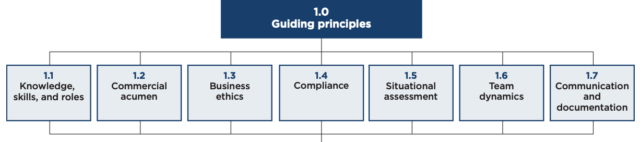
These principles, which apply to every phase of the contract lifecycle, draw a welcome distinction between the what (the tasks the contract manager must carry out) and the how (the principles that guide contract management). In our view, this distinction is essential to organise the discipline around a common base of values, behaviours and skills.
a. Skills & roles
The contract manager must draw on a body of knowledge, a broad range of practical skills (negotiation, risk management, contract administration) and varied roles to be adapted to the context (leader, mediator, spokesperson, and so on).
b. Business acumen
The contract manager must be a player in the organisation’s operating cycle and, as such, understand its objectives, understand how it creates value, measure risks and contribute to the results the organisation expects.
c. Business ethics
Confidentiality, integrity, loyalty: professional ethics must be one of the foundations of the contract manager’s credibility, a source of trust in the relationships built with all the contract’s stakeholders and, more broadly, the pole star (the expression "north star" is far more telling in English…) that must guide their actions.
d. Compliance
The contract manager is not a compliance officer, but is one of its main operational relays. They must ensure that contractual, regulatory and internal requirements are met and, consequently, master the regulatory environment and call on the right resources (in-house counsel, DPO, external lawyers, etc.) at the right moment.
e. Situational awareness
A guiding principle that is often overlooked, even though it is one of the criteria that separates a good contract manager from a very good one! They must be able to read a situation quickly and as a whole in order to anticipate, adapt and learn from the past (the famous lessons learned). Their ability to analyse situations, identify interdependencies and propose adjustments should make all the difference.
f. Team dynamics
Contract management is by nature an interface discipline, at the crossroads of many functions (project manager, engineering, legal, procurement, sales, etc.). The contract manager must therefore act as facilitator, coordinator and contributor to a positive team dynamic that generates results, all without any hierarchical authority (or leverage)!
g. Documentation and communication
This point may seem trivial, but the CMS has made the quality of exchanges and documentary rigour its seventh and final principle, as the guarantors of effective contract management & administration. These activities, at the heart of contract management, are the raw material that allows the contract manager to secure relationships and run contracts on an informed basis, reducing disputes and building on experience.
While many of us apply these principles day to day, recognising them as pillars of contract management should prompt us to rethink how we organise and deploy them daily, in order to make contract management a resolutely strategic function serving performance and trust.
4. A simplified view of the contract lifecycle
While the literature and the experts in contract management agree (or not) on a contract lifecycle built around five to eight key stages, the CMS does better, simpler and more indisputable: a lifecycle split into three stages only:
- Pre-award (before signature)
- Award (contract signature)
- Post-award (after signature)

Once again, this simplification is anything but reductive: it lifts us out of a technical debate that produces as many answers as there are business or organisational specifics, in favour of a view that is legible to every stakeholder (including those with no contract management background), while leaving the freedom to graft on more detailed sub-phases, as we do at Prime Conseil in our own model described here.
5. An activity framework to make your own
Finally, the last notable point is that the CMS lists fairly comprehensively the key activities relating to the contract at each phase of its lifecycle (following the three-phase split described above).
The result is a very useful task list, which will notably allow every reader of the CMS:
- to build a map of the actions to be carried out at each stage,
- to clarify responsibilities between the contract manager and the other stakeholders,
- to structure the whole contract management process.
Going a little further, one may regret the absence of an explicit distinction between what, in the eyes of the NCMA and WorldCC, belongs to contract management and what belongs to procurement or sales (depending on which side you sit), but once again, that is neither the point nor the purpose of a general framework.
Each organisation will therefore have to take ownership of this framework and adapt it to its own context: the sector in which it operates, its position as buyer or seller, but also its culture, its resources and the maturity of contract management within it.
An essential tool to get started
This Contract Management Standard®, 4th edition, is not a bible. It is a reference framework, deliberately simple and universal, which aims to create a common language and lay the foundations of a still heterogeneous profession.
At Prime Conseil, we recommend that companies wishing to structure their contract management approach read it and keep it in mind in every organisational discussion about contract management. It is a valuable base for structuring processes, defining interactions and continuously improving contract management practice.
Once that framework has been absorbed, substance and specifics must be added. Other resources can enrich the approach: the CMBOK (Contract Management Body of Knowledge) for more methodological depth, or, for a French framework, the interface sheets from the AFCM, which has done remarkable work defining the interfaces between contract managers and other stakeholders.