
For this new season, I'm launching a new format: an article, or rather a monthly op-ed. The concept is simple: each month, I'll pick up my pen to share a more personal (and more opinionated) view than our usual articles, on a subject that runs through our contract management practice. This is the first op-ed in a series that could run for a long time if the format proves popular, or be very short if no one finds it particularly interesting. Your feedback is therefore very welcome!
The articles found online or on social media about AI applied to contract-related professions almost all follow the same pattern: a spectacular productivity figure or promise, a few fairly generic use cases, an enthusiastic conclusion, and the usual clichés, from the « paradigm shift » to the traditional line: « AI won't replace you, but those who use it will replace those who don't ».
For this first op-ed, I'd rather offer you some real insight: a quarter-by-quarter review of what we actually did with AI at Prime Conseil over the past twelve months. I'll share our trials, our mistakes and, above all, our iterative progress.
One clarification before I start, for those of you who don't know: before founding Prime Conseil, I had founded two software companies, one focused on the pre-contract phase, the other on the post-contract phase, both of which already used AI. We were able to draw on this experience as a software publisher, which spared us some major biases and instilled an early conviction about AI, and digital more generally, within Prime Conseil. This background has vaccinated us against two extreme stances: outright rejection on one side, and pointless all-AI enthusiasm on the other.
Third quarter 2025: sketching out the first use cases
As I mentioned in the introduction, our thinking on AI actually started before 2025. Still, we need a starting point, and from September 2025 we agreed on one thing internally: integrating AI into our daily practices meant changing the way we worked, and therefore starting by sketching out genuine use cases (and ultimately finding the time to do so, which isn't always easy given our day-to-day work as consultants). We therefore applied advice I used to give clients back in my software publisher days: start step by step, in particular by building a data collection space during this period of reflection. Indeed, every organisation holds a great deal of data, but few collect it, centralise it, clean it and prepare it for AI.
In concrete terms, we built our own data lake, hosted on our own servers, a sovereignty choice consistent with the sensitivity of the data we wanted to use as raw material. We opened a dedicated storage space on our servers, organised into thematic buckets, into which we imported our data. We then tried to clean up and tag these documents using Label Studio, an open-source annotation tool, in order to ultimately convert this cleaned data into vectors, to make the AI's work easier and better. The objective was fairly simple, and we achieved it without too much difficulty: quickly build a RAG allowing a model to draw its answers from our own documents rather than solely from its training memory.
Once this RAG was built, we took the logic all the way by connecting a local LLM (Ollama, in this case) to this database. Up to this point, we did all of this in an artisanal way, with whatever means we had, with the sole aim of getting first results, even if it meant a somewhat shaky initial architecture. Within a few weeks, we obtained initial results, all running locally, which proved correct on simple tasks but clearly limited as soon as complexity increased, even on straightforward contract management tasks (for example, drawing logical links between a schedule in MS Project and a critical path annexed to a contract). This gave us a first lesson: a fully self-hosted solution seems poorly suited to the resources of an SME like Prime Conseil.
Fourth quarter 2025: putting our artisanal method and commercial models to the test of contract management reality
It was structuring our knowledge and our processes that took us to the next level with AI, by genuinely bringing it into our profession.
On the strength of this finding, we spent the quarter comparing our in-house solution with the "turnkey" offerings from the main providers on the market: OpenAI, Anthropic and Mistral. I won't dwell for long on Copilot which, despite using LLMs from the GPT family, was ruled out within a few days because its results on contract management remained clearly below the others.
This concrete test taught us a first lesson that applies to all practitioners: benchmarks, including legal-specific benchmarks such as BenchLM or Artificial Analysis, are never a substitute for testing against your own use cases. In any case, you also need to bear in mind that today's best model probably won't be the best one in six months' time, and that your practices and your company culture will never resemble exactly what the benchmarks test.
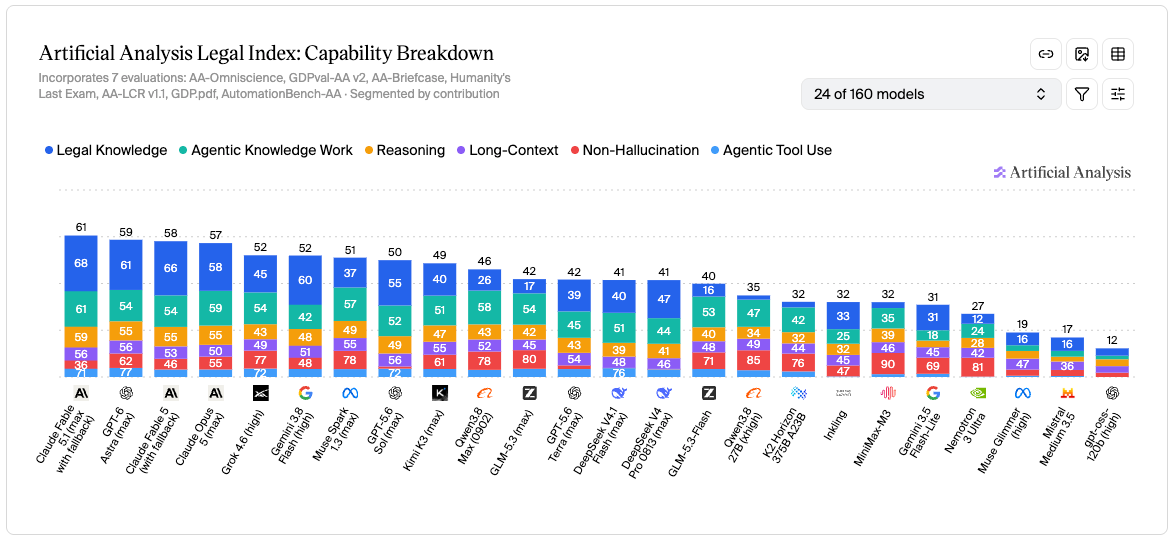
After these first few months spent, let's say, playing with our data, carefully sorted, organised, anonymised and then handed over as-is to the market's LLMs, the verdict was mixed, with some genuinely pleasant surprises. On creating memo sheets for simple contracts, the results were genuinely relevant, better than we had expected. Hallucination rates, compared with what we observed in 2022 on public models, and honestly compared with what we managed ourselves with our self-hosted open-source models, had dropped drastically. Nonetheless, disappointment remained: business intelligence was almost entirely absent from the results. AI can read, restate literally and order data, but it doesn't analyse in the contract management sense, particularly because our profession involves interpreting data that seems to have no correlation and connecting points in a way that isn't logical. On top of this lack of substance, there's a flaw we still notice today: the form, with semantic structures, ways of phrasing things and slide layouts that remain highly recognisable, with a frankly robotic feel, at times irritating.
The overall picture wasn't negative though, and a series of small-scale uses became established internally: drafting minutes, preparing internal presentation materials, organising our events. Essentially, using AI to produce imperfect deliverables that at least existed, where before they sometimes didn't exist at all for lack of time. On the client side, however, usage remained non-existent, for two main reasons: firstly, our clients have their own security policies and don't want to see AI used on their files, and secondly, at this stage, we ourselves weren't convinced of the business value AI brought.
While the quarter ended with a mixed record of uses that could mainly be described as "office-based", the end of the quarter was marked by a turning point that, paradoxically, had nothing to do with AI as such: the publication of the contract management standard (CMS)! Beyond the text itself, the CMS provides a professional framework, which we enriched, adapted (and then adopted), to create our own reference framework for what contract management is.
Above all, it highlighted a simple reality: we practise our profession every day, we hold views on the subject, yet we were expecting AI to understand us, to understand our profession, without having taken the time to explain it precisely, in language that AI is capable of understanding. The exercise forced us to put our processes down in black and white, and to break them down into several hundred tasks: what a contract manager is, how contract management is practised, how a skill is assessed and developed, but also tasks that seem trivial, such as how to draft a letter, how to analyse a liquidated damages clause, and so on.
It was structuring our knowledge and our processes that took us to the next level with AI, by genuinely bringing it into our profession. To borrow a distinction that takes me back to my law student days and intellectual property lectures: the idea is to move from mere juxtaposition to combination. An AI fed with a solid professional framework and our real day-to-day practices produces something quite different from an AI that is simply asked questions, however precise, without any framework given to it.
First quarter 2026: acceleration
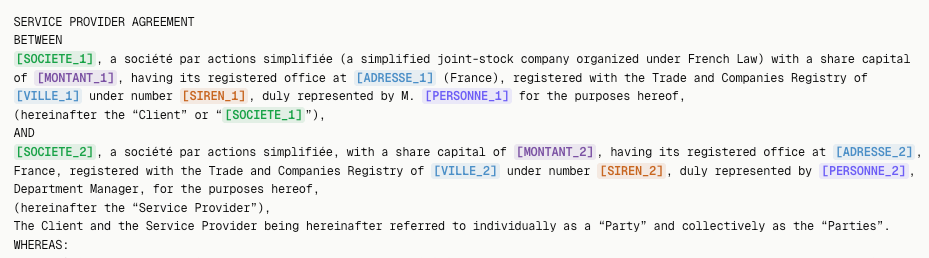
With the framework in place, everything moved very quickly, and this single quarter accounts for the bulk of our year. It began by removing a very concrete obstacle that every practitioner knows: how do you feed a contract into AI without exposing sensitive data? We answered this in January with Prime Security, a small in-house executable that anonymises documents before they are sent anywhere. Nothing spectacular, but this breakthrough was the condition for everything that followed.
Prime Academy, our first full-scale rollout
Again building on our framework (which is now central to everything we do), datasets built up in late 2025 and our experience as contract management trainers, we were able to build Prime Academy. AI didn't make us invent anything: what we put into it, we had long been delivering in person. What it allowed us to do was digitise it: content, training programmes and learning paths, brought together into a structured training platform, developed within timeframes and, above all, at a cost that would otherwise have been unimaginable. The educational content and training method remain entirely our own; AI served as architect and executor.
Still on the training side, this quarter also marked a turning point because AI made spectacular progress on video. In late 2025, we had filmed content with our partner Sidequest to train lawyers as part of the FIF PL scheme.
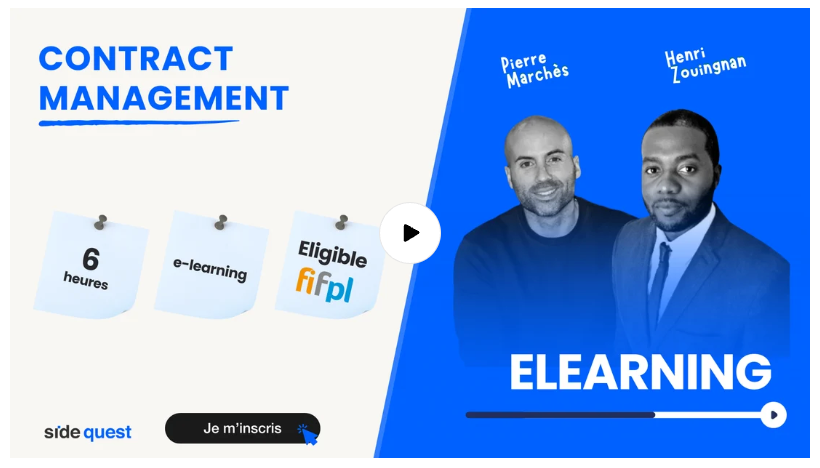
A high-quality exercise, but a time-consuming one in practice, relying on our partner's expertise in filming and editing, and one that can't be endlessly duplicated for budget and time reasons. Yet from the first quarter onwards, given the progress observed in avatars, we were able to enrich our video learning paths on our own, thanks to digital avatars that carry our face and voice. The result genuinely surprised us: see my avatar below.
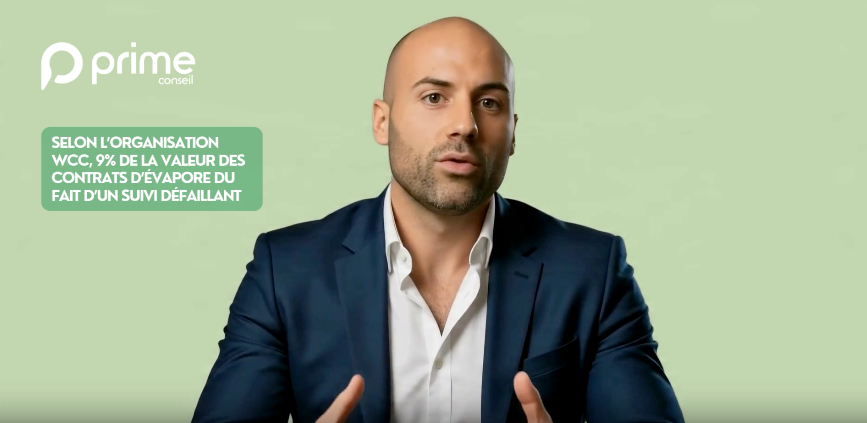
Of course, my family and friends, as well as those who know me, will see it's an avatar, but this has no impact on the learning path: these modules are followed remotely or in a hybrid format, and the sequences entrusted to the avatar cover the most theoretical parts, those requiring the least interaction. In our view, humans remain exactly where interaction matters.
Transforming our staffing methods
Staffing (or recruitment) is undoubtedly one of the most human parts of our work, and we have no intention of delegating it, still less to AI. This may seem counter-intuitive when you see certain ATS and other AI-boosted applicant tracking systems promising automatic analysis of applications, but we remain convinced that people are at the heart of our profession, that this is what makes the difference for our clients, so the idea lies elsewhere.
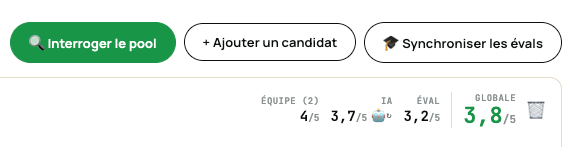
What we set up in February is more of a cross-check of perspectives: the team builds its staffing as it always has (calls, video calls, and so on), then has its choices challenged by an AI that cross-references the requirements of the assignment. In the end, our tool resembles a game of bluff poker between human and machine, whose added value lies in radically different reading lenses: the human eye has its biases, AI has its own, and combining the two corrects much of both. We also notice that human and AI assessments are, more often than not, fairly close:
Lastly, I can't finish this paragraph without a word for candidates: don't optimise your CVs for machines, or at the very least, if you do, do it cunningly, the way a contract manager would. There really is nothing worse than reading CVs written by ChatGPT or Claude, which all look alike, not just in form, but also in their turns of phrase and the emptiness of their content.
The Zevra bootcamp and the move to agentic AI
In late March, we were fortunate enough to take part in a bootcamp organised by Zevra. Three days to bring together everything we had built up: contracts, data and business knowledge, gathered in our data lake, which had by then become a genuinely usable dataset.
It was on this occasion that we measured the gap between two ways of using AI. The first (ours until then) was minimalist, almost artisanal, consisting of giving a model a contract, a context and a method, and asking it for an output file in return. This first method delivers correct but unremarkable results. The second is a matter of architecture: an agentic approach in which more than twenty specialised agents and sub-agents share out the work, check each other and complement one another. The results are then in a completely different league, in terms of the quality of the reasoning, the use of supporting documents and, of course, the output file. It was on this basis that we, working with Smartpreuve, relaunched Smartclaim, a tool for preparing incoming and outgoing claim letters.
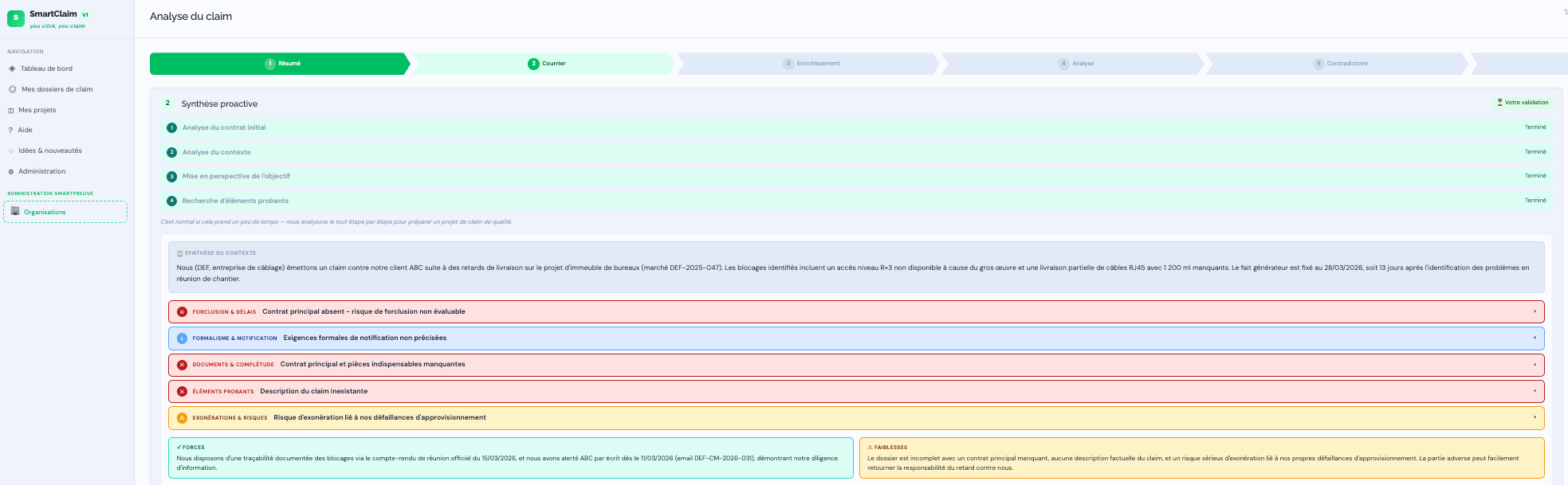
One (unwelcome) surprise deserves sharing, because nobody publishes this kind of figure: cost! Mobilising the full set of agents to produce a finished claim letter uses around 30 euros' worth of tokens. Our first reaction was that this seemed extremely high, in an era where AI is supposedly a commodity, before we followed a different line of reasoning: set against the time a contract manager spends drafting such a letter, getting a serious first draft for 30 euros is remarkably economical.
This bootcamp organised by Zevra also consolidated a practice that has become the guiding thread of our approach to AI: "human in the loop". A concept whereby human and machine collaborate to produce a result. This determination to keep humans at the centre isn't a rejection of the "all-AI" approach that may well arrive one day for certain aspects of contract management, but rather pragmatism, given our own level of demands: AI alone produces a result that doesn't satisfy us, whereas systematically combining the machine with a contract manager's judgement produces results that do impress us.
Second quarter 2026: equipping the profession, from skills to contracts
The second quarter was one of consolidation: turning the lessons from the bootcamp and the framework we had established into lasting tools. The first, now built into Prime Academy, is called the Skills Evaluator. This tool grew out of a synthesis of several sources: the CMS, which provides a framework for contract management, the AFCM's interface sheets, and our own practices, built up assignment after assignment.
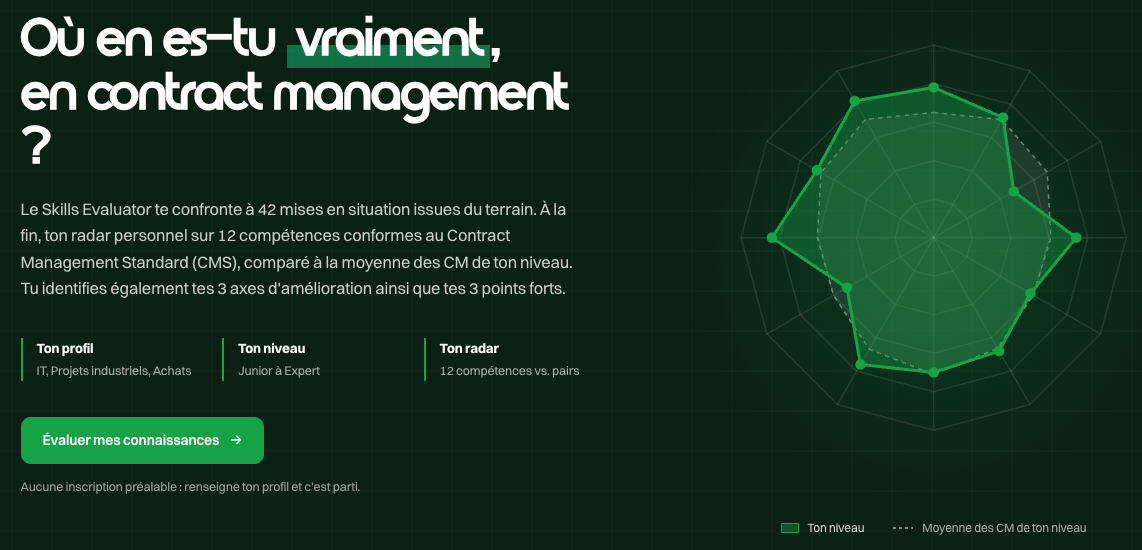
The tool streamlines two exercises that most organisations still handle in a largely intuitive way: assessing skills and managing each consultant's skills development. It has also found a natural extension in our staffing process: precisely assessing a candidate's strengths and weaknesses allows us to match them with the right projects and the right clients, feeding into the cross-check of perspectives described above. Here again, AI didn't invent anything: it allowed us to bring together frameworks and experience we already had, and turn them into a tool we can use every day.
The second tool closes a loop opened in autumn 2025: the famous memo sheets. Our first attempts, honestly, could only be used on small contracts. We therefore tried again, applying what we had learned, to create Contract Memo Maker. At this stage, the tool remains deliberately simple: you upload a contract, it anonymises it, vectorises it, sends it to the AI, then generates a memo sheet built through a contract management lens: rights, obligations, key mechanisms, and so on.
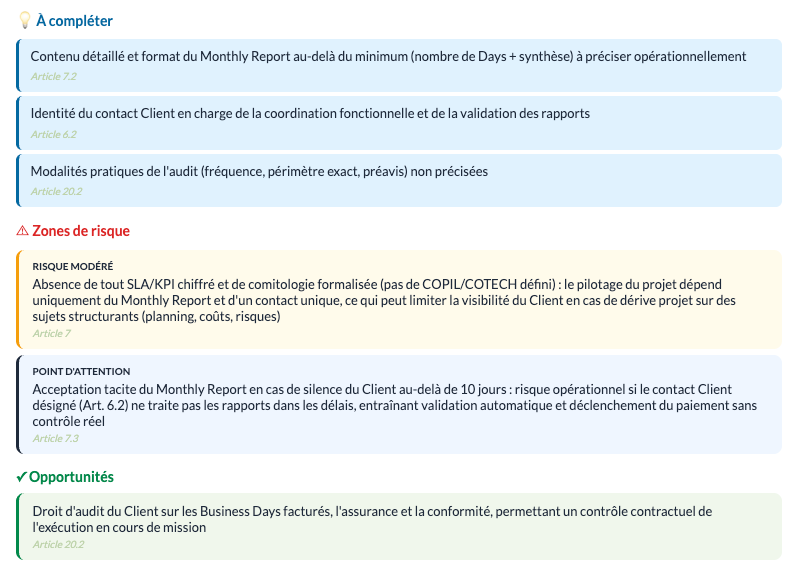
The intention isn't to replace the contract manager's work, but to support them on a specific point we observe at most major clients: on a large project, the main contract has its memo, but the portfolio of subcontract and supplier contracts almost never does, for lack of time. These generated memos are less refined than those produced by an experienced contract manager, but they go considerably further than what today's market CLM tools produce, and above all, they exist where, before, there was nothing.
Third quarter 2026: optimising our processes
Summer allowed us to broaden the playing field beyond the contract itself. Like any consultancy, Prime Conseil has an intranet that centralises our day-to-day management, so rather than piling up subscriptions or calling on a supplier for every need, we developed a series of extensions within this platform.
The first project focused on the billing chain, with a telling example: time-tracking. Each consultant logs their time, the tool consolidates it by assignment and by client, and billing is based directly on this data, whereas before, the process relied on scattered files and re-entered data. We then built tools to track our publications, from the editorial calendar right through to distribution, followed by a series of small everyday tools that, taken individually, would never justify development: an internal form here, a dashboard there.
This is in fact one of this quarter's lessons: every company has real needs, not always major ones, but ones that create day-to-day friction. These needs are real, but often too specific and too modest to justify buying a dedicated tool. AI makes it possible to find solutions, since what remained an idea or an Excel file has become an integrated tool within a few days. The logic remains the same as for everything else: internal tools, built on our own data, with a human keeping control, and oversight that comes all the more naturally since we know precisely what the tool needs to do, because we live it every day.
In summary, what we've learned from the past 12 months
Taking the example of claims management, which we developed further with Smartclaim, the results are mixed but instructive. After a few months of use, it's rare for AI to find an argument we hadn't already spotted (whereas the reverse is almost always true). AI's strength lies elsewhere: among the arguments identified, it excels at redeploying them in the right order, exhaustively, with the right references and the right sources. In other words, AI proves to be a remarkable assistant, but still a mediocre strategist.
More generally, we still see a genuine limitation at the very heart of our profession, given that the nature of contract management is precisely to be an interface role. In practice (as I mentioned above), that means cross-referencing a schedule, technical specifications, a contract and a site progress report to detect weak signals, and ultimately connecting points that nothing explicitly links. On this exercise, AI remains (very) weak, and we believe this is, at this stage, fairly structural. Our profession is difficult to model arithmetically; each configuration is unique, and this reading calls on subjectivity, critical judgement and an intuition built through experience. You can't easily train a machine on cases that never repeat themselves.
In this summary, I must also make a mea culpa about a prediction I admit I got wrong. I long believed that AI would allow those less comfortable with writing to close the gap, and thereby open up contract management further to profiles less at ease with the finer points of drafting. In practice, the opposite happened, because AI is (too) verbose: those who struggled to produce written work can now do so easily, but producing isn't the same as writing well. The visible consequence over the past few months is a proliferation of overlong letters and reports whose purpose is no longer clear. The gap between contract managers comfortable with writing and the rest hasn't narrowed, it has widened: the former use AI as an amplifier, they cut, prioritise and keep an intention in mind, while the latter produce a great deal, in bulk, with no clear objective. The door remains open to non-literary profiles, but not in the way I expected: what matters now isn't the ability to produce text, it's the judgement to decide what deserves to be written (and that's rather good news for the discipline).
Lastly, one final lesson worth sharing concerns the models themselves. In 12 months we've gone from Ollama to GPT, before moving on to Claude, and given the race under way between Anthropic, OpenAI and even DeepSeek or Qwen, it's a safe bet that we'll change again within a few months.