
A series from Prime Conseil, where projects come to life, contracts take on meaning.
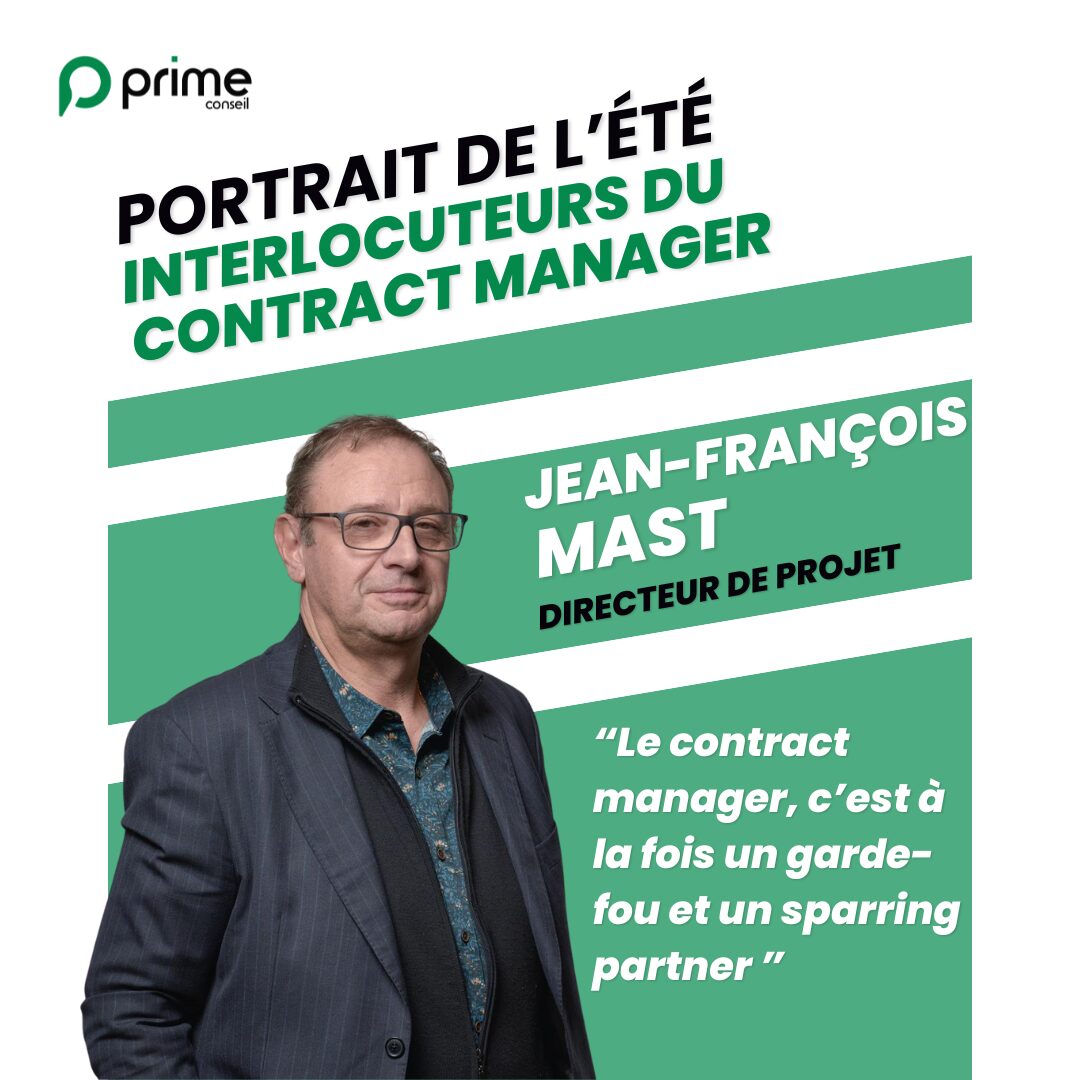
“The contract manager is both a safeguard and a sparring partner”
To open our summer series “Portrait of the summer”, devoted to the people who work hand in hand with contract managers, we were lucky enough to talk to Jean-François Mast, a seasoned project director with complete command of complex industrial project management in France and internationally, particularly in the energy and construction sectors.
With infectious enthusiasm, Jean-François shares his view of the project director's job, his day-to-day work, his relationship with contract managers and, above all, what in his view makes for genuinely effective and lasting collaboration on a project.
Prime Conseil (PC): before you take us into your daily routine, how would you define the role of project director to a Year 10 pupil on work experience?
Jean-François Mast (JFM): For me, a project director is above all an orchestra conductor. They do not play every instrument, but they answer for the harmony of the whole. In practice, that means I am responsible for the project as a whole: meeting the deadlines, delivering the quality the client expects, and steering the budget. To do that, the project director is supported by a number of people: package managers, engineers, design managers, buyers, the contract manager and others, in order to see the project through while respecting two fundamentals:
- the schedule, meaning that the project necessarily has a programme with a start and an end, and
- the quality expected by the client.
So I sit at the interface between two worlds: the client's, with its expectations, its requirements and sometimes its internal disagreements; and the project team's, with its own operational priorities. My role is to turn the needs expressed into concrete actions, to follow them through, and to make sure the answers are clear, relevant and within the bounds of the contract. To illustrate, I like to talk about a diabolo: on one side the client sends me its expectations, which I centralise; on the other I pass them on to the internal teams as precise requests. And I make sure everything then flows back up to the client in a structured way. My role is to keep information moving both ways, without any loss, throughout the project.
PC: do you remember your first encounter with a contract manager?
JFM: When I started out, we did not call them contract managers and, truth be told, they were not really contract managers as we know them today. We worked more with in-house counsel, often called in like firefighters when a dispute broke out, who would then hand over to external solicitors.
But it was internationally, on FIDIC contracts, that I met the role and watched it develop. There, the lawyer was embedded in the daily life of the project. They attended the meetings, analysed every incoming letter, challenged our decisions in the light of the contract and helped us define our strategy. That was when I understood that the contract manager should not be called in only when something goes wrong. They were a strategic co-pilot, who opened up a different approach to handling and using the contract, and that really took shape when the function became rather more widespread on projects a few years later.
PC: what does a good contract manager change in your daily routine as a project director?
JFM: A great deal. The contract manager is both a safeguard and a sparring partner.
A safeguard, because they stop me from locking myself into an overly technical or emotional reading of a situation. They remind me what the contract says, they open up options. They do not just say “yes” or “no”, they unfold the possible scenarios. That is precious.
And a sparring partner, because I need to talk things through and test my ideas. The project director's role can be quite a lonely one: you carry the responsibilities, but often without line authority over the teams. The contract manager is the person I can dig into things with, push back against, build strategies with, find solutions with. They are there to challenge me so that I can put the best options on the table. It is a genuine day-to-day relationship, and one the project benefits from.
PC: if this were a film, what part would the contract manager play?
JFM: They would be the investigator in a good thriller. Not the one who is there around the clock, but the one who knows where to look and gets people to talk differently. Sometimes, when a contract manager asks a question, answers appear as if by magic where, had it been me asking, I would have been told “all is well, boss”.
They are also a trusted relay. They help me connect with departments or teams that do not report to me directly. They have an investigative capacity I do not always have the time for. And of course you have to avoid the perverse effect: some might be tempted to delegate everything to the contract manager, when it is in fact a shared responsibility.
PC: are there mistakes you sometimes see contract managers make?
JFM : Yes, sometimes a positioning that is too confrontational. The contract manager is not there to throw the punches in the project manager's place. They are the one who prepares the boxing gloves, who helps pick the right moment to strike, but they do not take the boxer's place. It takes genuine complementarity.
PC: on that note, how do you build that complementarity day to day?
JFM: It starts with a degree of mutual humility. Neither of the two can have too strong an ego. Then you need to set up a routine of exchanges, regular catch-ups, even short ones, what I like to call “appointments”, which let you share out the tasks and move forward as a pair. It is like a roped party of two: it takes trust, loyalty and a good sense of anticipation.
PC: do you have a motto on projects that you would like to share with contract managers?
JFM: Yes: “fast and well”. A project is a race against the clock, but you have to deliver something reliable and complete, within the time allowed. You do not start a project without checking every warning light: programme, quality, safety, budget. Just as you do not get on the motorway without checking your tyres, your oil and your windscreen.
PC: and if your job were a team sport?
JFM: Volleyball, without hesitation, a sport I used to play. On court, everyone matters; you cannot make up for a “weak link”. The project director is a bit like the setter, the one with the overall view. The contract manager? They would be the second setter, distributing the play intelligently, anticipating and supporting.
In a good team, everyone raises their game together. It is not just about delivering a project, but about making it a collective success, reaching a tangible result, a facility that works.
The Prime Conseil team warmly thanks Jean-François for taking part in this exercise with so much enthusiasm, and for his frank perspective, always turned towards action. This account and this advice (following on from our contract managers' tips) show how far collaboration between project management and contract management is not only useful but essential to the success of a complex project.