
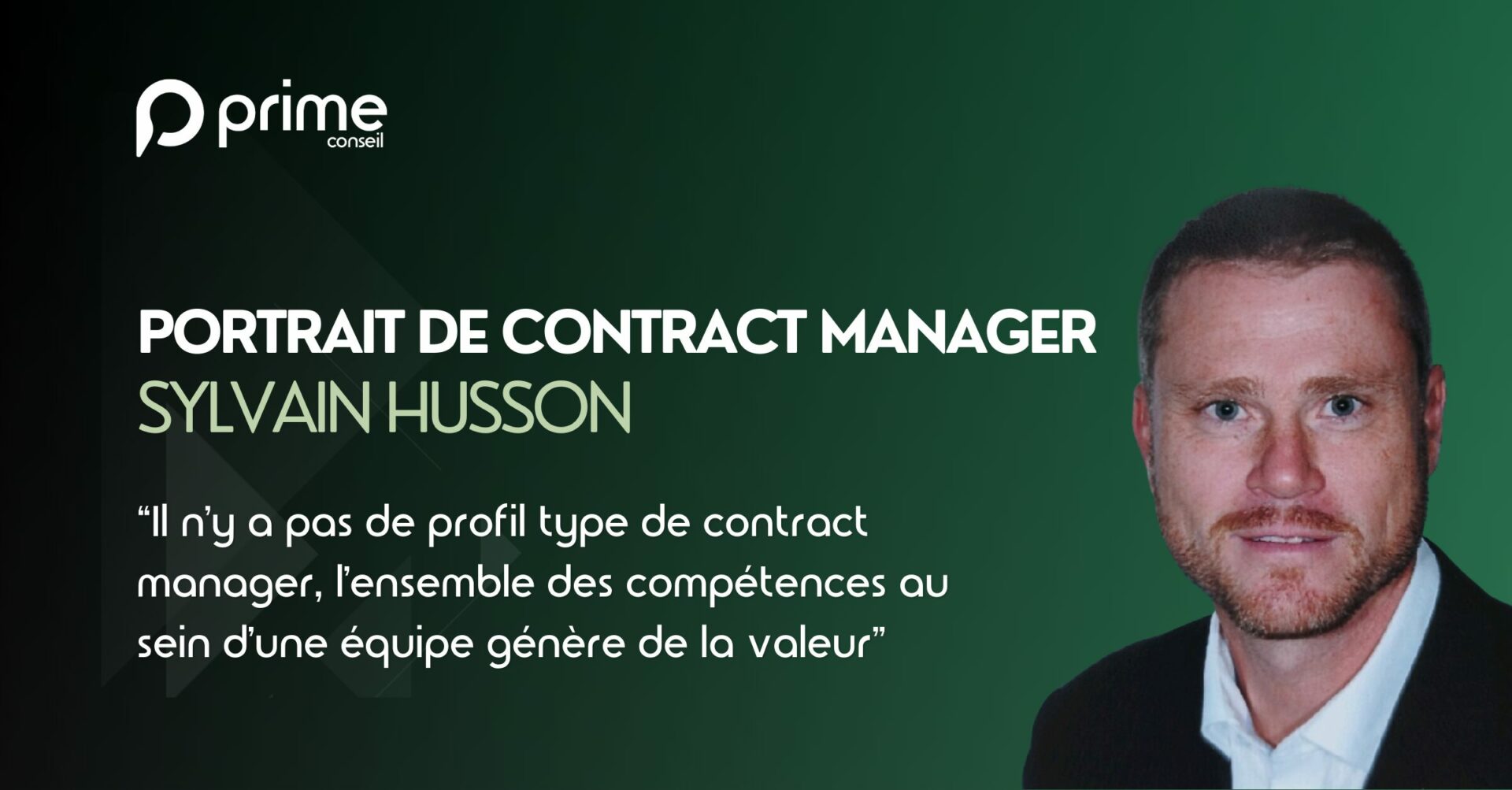
In my view there is no standard profile, but rather a set of skills that a contract management team needs to have.
Let us continue our series of contract manager portraits with a contract management expert! A few weeks ago we had the chance to talk with an experienced contract manager with a rich and varied background. Over the course of a career that has taken him through bids, engineering, projects and procurement, Sylvain Husson has lived several professional lives before turning to contract management.
This rich industrial career has made Sylvain a contract manager with cross-cutting knowledge and multiple skills, which quickly led us to discuss a topic as fascinating as it is divisive in our profession: the “standard profile” of the contract manager. It is a theme that, along with that of the qualities of the contract manager, comes up very frequently within companies, and we share this interview with you in this article.
Prime Conseil (PC): in our conversations with clients, the topic that comes up most often is the contract manager’s profile. Given your own background and your many experiences, do you have a firm view on the subject?
Sylvain Husson (SH): In my view there is no standard profile, but rather skills that a contract management team needs to have.
To illustrate with a concrete example, my team is made up solely of legal and operational profiles, and we complement each other perfectly! More than that, my manager recently mentioned a candidate to join our team with a background in structuring PPPs (public-private partnerships). Rather than prejudging that background, I immediately replied that it was an excellent idea, because it would complement the team’s skills very well!
But beyond these standard contract manager profiles (the “lawyer”, the “engineer” or the “buyer”) you have to look well beyond a background and technical skills. A contract manager must also have strong people skills and must not be afraid to go and see the teams, to make themselves known in order to develop and promote contract management.
PC: That brings us to the qualities a contract manager absolutely must have. If you had to list three essential qualities that make a contract manager, what would you say?
SH: Without any hesitation, I would name the following three qualities:
- Interpersonal ease, which makes it possible to build bridges between contract management and every other discipline it has to interact with,
- Skill in negotiation, whether negotiating with a third party (client, buyer, etc.) or even internally, the key for a contract manager being to get ideas across, to enrich the debate and to allow every party to a contract to come out a winner, or at least satisfied with the outcome of a negotiation,
- Strong analytical ability: obvious as it may sound, common sense and an analytical mind are essential to the practice of contract management, which sits at the crossroads of many disciplines. Without being an expert on every subject, the contract manager must use that common sense to tell what is rational, what is important and what is urgent from what is less so.
These three qualities, which can be worked on and improved, allow you to be creative, to take a problem-solution approach and to cultivate critical thinking, including about your own biases, so that you never get stuck, whether facing a contract or facing people.
PC: I note that we have talked about background, soft skills and experience. Does that mean the contract manager role is only for experienced professionals?
Experience is what makes the difference between reading a contract and understanding it
SH: Without being categorical, it does seem difficult to start a career in a contract manager role.
I have come across junior contract managers straight out of university, but that remains the exception. In my view you need a past in another discipline to add depth to contract management, because it is in the field, dealing with mistakes and confronting operations, that you begin to grasp the subtleties of contracts. It is that experience above all that gives depth and makes contract management interesting.
Ultimately, that experience is what makes the difference between reading a contract and understanding it, and so what takes you from contract administration to contract management. In some organisations, you could nevertheless imagine pairing junior and experienced contract managers, or internal career paths that speed up learning straight out of university.
PC: Following on from the standard-profile question comes that of reporting lines. In your view, where should contract management ideally sit?
SH: Contracts are becoming more and more complex, time and money are lost, and you realise that the contract has to be kept alive and that you need freedom of movement during performance. So I believe that, on the one hand, the contract manager should have family ties with a legal department, but not a reporting relationship, and on the other hand should be close to an operational department, because contract management is above all a discipline at the service of operations.
So the ideal is obviously a standalone contract management department, but one that is nonetheless supported! Fighting for the autonomy of contract management at all costs is not, to my mind, a guarantee of performance, because an unsupported contract management department does not exist, carries no weight, and risks turning into a claims desk or a support function for legal.
PC: That is exactly where I wanted to go! How do you make the most of being a versatile contract manager without falling into the “generalist” trap, which organisations tend not to value?
SH: That versatility, and more broadly the contract manager’s added value, is in my view hard to establish from day one! A contract manager’s added value is not assumed, it is demonstrated day after day. The best way to get there, for me, is to become known, to have an impact in meetings, to be proactive. As a result, little by little, the contract manager I call the “Swiss Army knife”, who manages to connect the dots between very different topics to create value, becomes indispensable and their value is recognised by everyone.
To add a note of optimism to my answer, in recent years I have seen a shift in how contract management is perceived within organisations, which increasingly understand the usefulness of the discipline. We are no longer former lawyers or engineers; we are becoming contract managers in our own right. Every contract manager has a part to play in spreading that image and promoting the importance of the role. Maturity will come in a few years. The more we become known and recognised, the faster it will happen!