
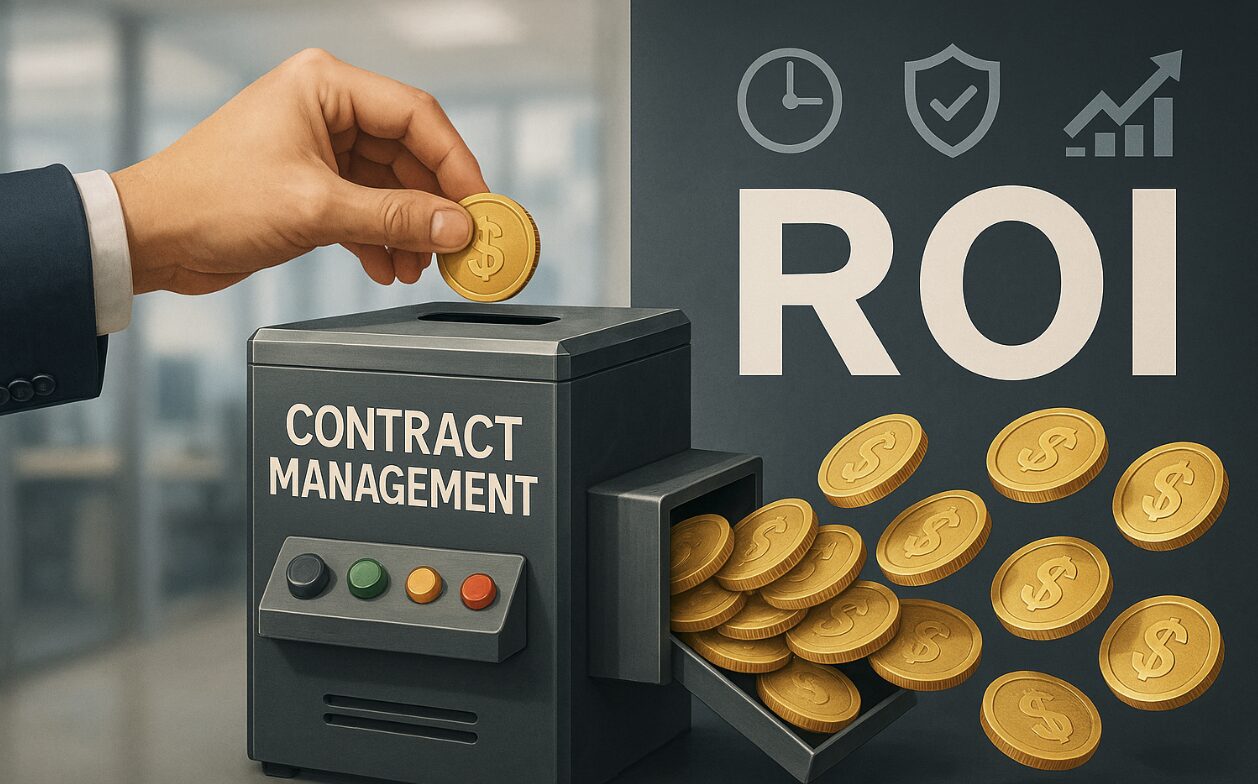
In an increasingly uncertain economic environment (we discussed this in our last article), companies are constantly looking for levers to secure and improve the profitability of their projects. Among those levers is a discipline that is still little known, yet a key driver of project profitability: contract management.
A landmark study by World Commerce and Contracting (formerly IACCM) shows that poor contract management can cause losses of up to 9% of annual revenue. Conversely, effective contract management can turn an average project into a financial success. How? That is what we will look at in this article.
I. What is contract management within a project?
We have already defined contract management in this article, but applying it to projects calls for some explanation of the role the discipline plays, and the value it brings, during project execution.
a. Managing the contract throughout its lifecycle
Contract management is not simply about signing a document and filing it away in a drawer. It is a continuous process that begins upstream of the project (negotiation, structuring of the contract), continues during execution (tracking obligations, managing changes) and ends at closure (review, archiving, lessons learned).
Throughout the contract lifecycle, close attention must be paid to the rights and obligations it contains, in order to optimise each phase, every one of them equally important.
b. The difference between administrative handling and strategic management
Contractual management during the project execution phase is too often reduced to an administrative function (hence the preference for the English term “contract management”, which conveys a more strategic and comprehensive function than the French “pilotage de contrat”). Project players sometimes believe they are doing contract management by compiling DC4 forms or subcontractor declaration files, or by chasing invoicing deadlines.
The reality is far richer (and more complex), since it covers a wide range of activities (drafting, negotiation, performance monitoring, identification of risks and opportunities, and so on). Contract management is therefore not only an activity distinct from project management: when carried out professionally, it is a genuine performance lever that helps, among other things, to protect margins, avoid disputes and align stakeholders around common objectives.
c. A cross-functional role serving performance
You will have noticed that we did not speak of a “support” function in this sub-heading, but of a cross-functional one. That idea of cross-functionality fits contract management far better, as it is an interface discipline working with many other functions: legal, procurement, finance, projects, quality, and so on.
This cross-functionality is a powerful lever for consistency and anticipation. It underlines the interface role the contract manager occupies, as well as the discipline’s contribution to fluidity, transparency and risk control.
II. Three dimensions that drive project profitability
You will certainly have noticed that “project profitability” is our creed at Prime Conseil (we have even made it our slogan). This ROI-driven view of contract management can be expressed and delivered from several angles, chiefly:
a. Avoiding and limiting financial losses
One of the most direct effects of good contract management is the reduction (or limitation) of losses. Whether it is missed deadlines, expired claim windows, penalties not negotiated with clients or not applied to suppliers, the list can be a very long one… and every contractual failing is expensive.
On major projects, for example, poor handling of variations, change orders or EoTs can represent tens or hundreds of millions of euros in losses.. on one and the same project! In construction, close to two thirds of claims are rejected because of formal defects, omissions or missed deadlines. One example among others showing that proactive contract management limits financial losses on a project.
b. Securing additional revenue
The French, and more broadly European, view of contract management places great weight on defending one’s interests and managing risk, sometimes neglecting the opportunistic side of contract management (which our Anglo-Saxon counterparts, for their part, have grasped very well!).
Contracts are usually full of opportunity levers: performance bonuses, price indexation, favourable renewal options, volume rebates, but also loose drafting on additional works, exemption clauses, and so on. A professional practice of contract management makes it possible to identify these contractual clauses and use them to your advantage.
It also helps avoid what is known as revenue leakage (the subject of the World Commerce & Contracting study mentioned at the outset, that is, the loss of revenue caused by poor execution or by a failure to track contractual obligations.
c. Reducing internal costs and the mental load on project managers
Finally, a last lever too often passed over in silence: a well-built, well-monitored contract also means fewer disputes, less rework and less stress for teams, project managers in particular! It cuts hidden costs (time spent hunting for a clause, managing a conflict, making up for an oversight) and makes internal exchanges run more smoothly during project execution.
III. A few best practices for turning contract management into a profitability lever
In the sections above we looked at the roles and responsibilities of the contract manager during the project phase (I), then at the impact of contract management on profitability. All that remains is to go into the detail and see how, in practice, to put in place contract management that serves project profitability.
This operational practice of contract management requires organisation, clear methods and a shared culture that treats the contract as an instrument of performance. Here are four concrete best practices that turn contractual management into a genuine profitability lever.
a. Put tools, methods and reference frameworks in place
One of the first obstacles to effective contractual management is the lack of centralisation. According to an article by ContractWorks, 71% of companies are unable to locate at least 10% of their contracts. The result is a string of consequences that damage projects: missed deadlines, lost information, opportunities left untapped, and even legally invalid commitments.
Putting harmonised reference frameworks and tools in place, from “simple” tools such as Excel files through to an electronic document management system or Contract Lifecycle Management (CLM) software, makes it possible to:
- make information reliably accessible to all stakeholders (legal, procurement, projects, finance)
- secure the traceability of versions, contract amendments and signatures
- prepare the ground for automated tracking of deadlines, alerts and obligations
To illustrate this, in a study entitled “Contract Management as a Tool for Successful Project Performance: A Pragmatic Study on Construction Projects in Zambia” carried out in 2024 on construction projects, the companies surveyed identify the centralisation of contractual information as an essential factor in improving project performance and limiting disputes.
b. Define contractual performance indicators (KPIs / OKRs)
Like any strategic process, contract management must be steered by clear indicators. Too often, companies measure supplier, client or project performance without including contractual KPIs, even though these are crucial for tracking proper execution of the contract.
Relevant contractual KPIs might include:
- Compliance with contractual deadlines (deliverables, payment, approvals),
- The acceptance/rejection rate of claims submitted (including the reasons for any rejection),
- Trends in non-conformities,
- The share of claims (delays, non-conformities, etc.) passed on to the supply chain,
- Punctuality in submitting deliverables,
- And so on.
As with the previous point, to illustrate this with research, we can cite a 2023 study entitled “Impact of Contract Management on Contractor’s Profit”, as well as a report by the UK Ministry of Justice, which stress that the absence of clear indicators can lead to reduced margins, poor allocation of resources and a risk of the value chain breaking down.
c. Strengthen post-signature management
This is one of the most widely shared observations, in the literature as well as in the field: most organisations concentrate their contractual effort on the negotiation and signature phase, but neglect the crucial step of post-signature monitoring. That is a great pity, because the execution phase is precisely where a project’s P&L is decided.
As a rule, the pre-contract phase is (broadly speaking) fairly well mastered up to signature, thanks on the one hand to the involvement of many players (lawyers, buyers, finance staff, sales teams, pre-sales units, and so on) and on the other to robust tools and processes (GO/NO-GO grids, commitment committees, and the like) that give a relatively complete and relevant view of a contract’s risks and opportunities at the point of signature.
The catch is that, once the contract is signed, the resources, tools and methods available for contract monitoring become far more rudimentary. The execution (post-award) stage is often patchy, with little tracking of commitments, KPIs barely used and contractual teams only lightly mobilised. As we saw earlier, this leads to delays, cost overruns and even abandoned projects.
Allocating resources (and therefore budget) to this post-signature management phase is the surest way to avoid what we earlier called “revenue leakage”, whether by applying or avoiding the penalties or bonuses provided for, or more generally by anticipating and dealing with risks as the project runs. We know that allocating resources is often a sensitive matter within organisations, but good practice is to get started, even gradually, and to measure the ROI of this management effort, which should very quickly show executive management that contract management is a profitable discipline!
d. Improve the internal contractual culture
A well-negotiated, well-drafted contract is only worth something if it is understood and used by the people who implement it. Too often, operational staff have only a partial knowledge of the commitments made, which weakens the execution phase. Applying recommendation (c) above is not enough on its own for the magic of contract management to work: for the contract manager to carry out their mission, the project counterparts working with them (project managers, planners, buyers, and so on) must be made aware of the fundamentals of contract management so that they can:
- read and interpret the main clauses of a contract,
- identify key obligations and major risks in order to call on the contract manager at the right moment,
- document contractual actions (changes, disputes, notifications),
- adopt a proactive stance towards the contract’s stakeholders.
There are many contract management training courses available for this, but beyond those providers, your contract manager should know how to start raising awareness within the teams, in particular through contract awareness.
Conclusion
Contract management is neither a luxury nor a secondary function reserved for the large groups of the CAC 40: it is a genuine strategic lever for performance and profitability. At a time when margins are tightening, when projects are becoming ever more complex and when partners are multiplying, mastering the execution of contractual commitments is a vital skill for any organisation.
As we have seen throughout this article, well-structured contract management makes it possible:
- to avoid avoidable financial losses (disputes, penalties, automatic renewals)
- to secure the contractual value anticipated at the time of signature
- to reduce the costs caused by internal inefficiencies
- and to improve the quality of contractual relationships, by establishing a clear, shared framework
Every study and every field report points the same way: whether for public projects in Africa, French multinationals in construction or American technology companies, organisations that master their contractual management see a net gain in their operational and financial results.
In France, however, the discipline is still too little spread within companies and public bodies. Too often confined to legal or procurement teams, it is not embedded as a cross-functional management tool, nor taught as a core skill on courses in project management, finance or operational performance.
It is time for a cultural shift. Contract management should be rolled out on a large scale across French organisations, through:
- training designed for non-lawyers
- the creation of shared reference frameworks and processes
- the gradual equipping of operational functions
- and above all the involvement of executive management, aware that every well-managed contract is a strong link in the value chain.
Contract management is, by nature, an ROI-driven discipline: every euro invested in a structured contractual approach can generate several euros in savings, in secured revenue, or in disputes avoided.
Adopting contract management is not simply about managing your documents better. It is about managing your projects better, collaborating better and succeeding better. It is, quite simply, about making every contractual commitment a strategic asset serving profitability.