

On most projects, a received idea holds that a claim is won on substance. The idea is appealing: the claim would be a matter for technicians and experts, resting on the facts, the reality of the event, the strength of the causal link, or the quality of the costing.
Yet form matters just as much, and not only under FIDIC. Most contracts governing projects, whatever the model used, make claims subject to notice, deadline and formal requirements that teams often discover too late. What is distinctive about FIDIC contracts, however, is that they have pushed this logic all the way, turning it into a complete mechanism, codified and framed quite strictly by deadlines. The FIDIC forms therefore illustrate perfectly a rule that reaches well beyond them: substance gives a claim its value, form determines whether it exists at all. A perfectly well-founded entitlement, notified on the 29th day or buried in a progress report, is likely to enter turbulent territory: that of the time bar. While the latest FIDIC editions do provide a few recovery mechanisms (we come back to this later in the article), compliance with formal requirements remains a prerequisite that contract managers must keep in mind at all times.
In this article we propose to lift the bonnet on Clause 20 through a particular lens (one we are especially fond of at Prime Conseil): reading the clause as an internal crash test rather than as a legal exercise. Behind each mechanism in this clause lies an organisational question, starting with this one: how long does it take, within my organisation, for an event occurring on site to be identified and then formalised in a notice?
A mechanism designed to handle claims at the pace of the project
The 2017 overhaul of the FIDIC contracts reorganised claim management in depth. The claim is now distinguished from the dispute: Clause 20 deals with claims, Clause 21 with disputes, and you move from one to the other only once a claim has been rejected, expressly or by silence. This separation is not cosmetic; it reflects an intention: to deal with requests during the project, as execution unfolds, rather than letting them pile up for the end. We described in an earlier article what a claim left to drag on really costs; Clause 20 of the 2017 forms is built to make that drift difficult.
The mechanism is in fact fairly simple, since it comes in three stages: 1. a "notice of claim" first, to be issued within 28 days of becoming aware of the event, 2. a fully detailed claim next, expected within 84 days, and finally 3. an agreement or a determination, handled under the Clause 3.7 procedure.
What makes the regime singular is that every actor in the claim (claiming party, receiving party or Engineer) must meet deadlines, and that silence produces automatic effects: an unchallenged notice becomes valid, a determination that is not issued counts as a rejection, a determination that is not challenged becomes final. The chart below sets out the full chronology, with the starting point of each deadline:
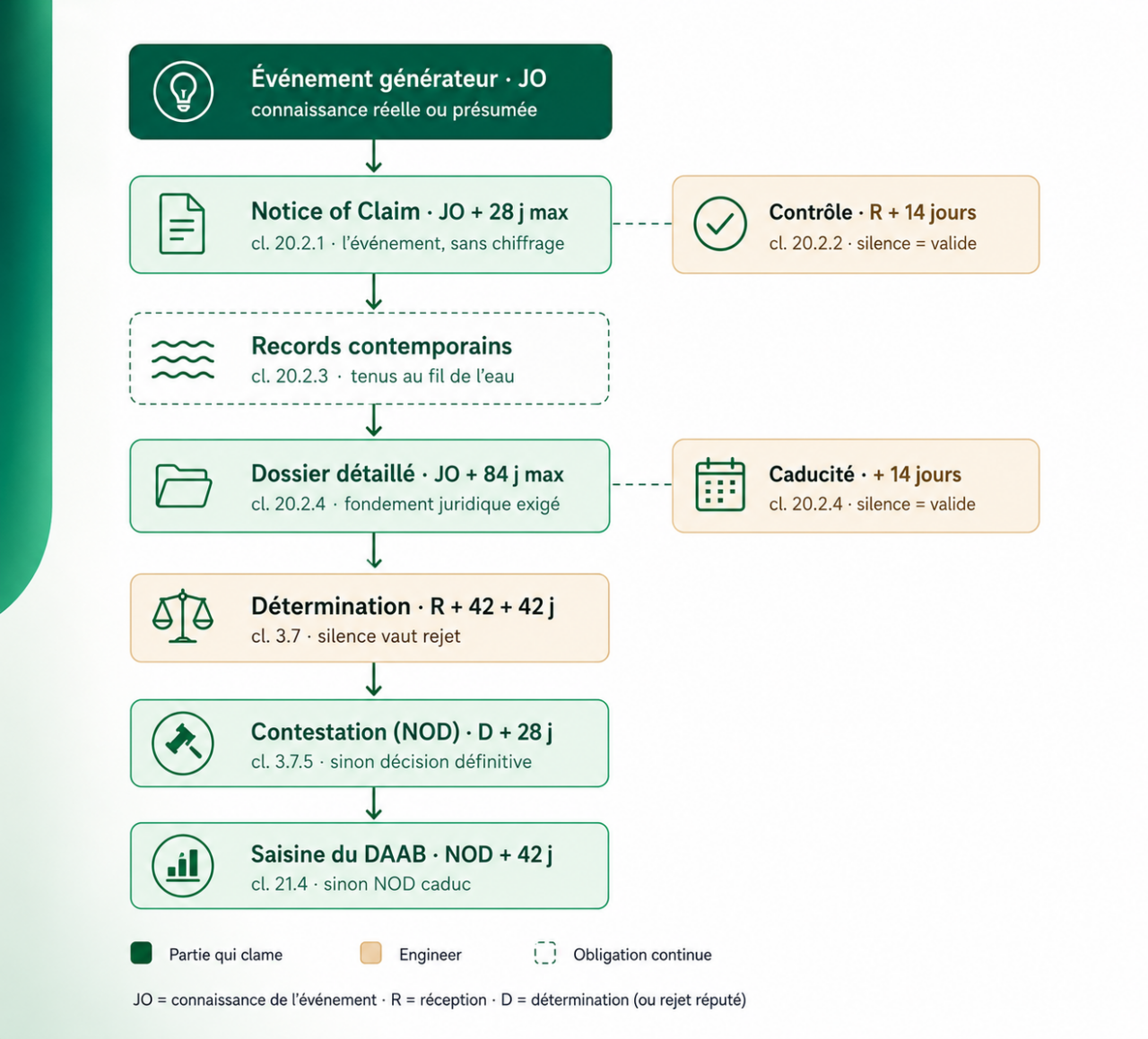
Two points of clarification before going into the detail of the mechanism: the first is that this full procedure applies mainly to "complex" claims and not to the micro-disagreements that the contract manager should seek to handle differently (and faster); the second is that pre-2017 FIDIC contracts will still be running for years, with different deadlines and a different balance. The first check, on any contract, is therefore to establish which edition and which particular conditions each contract actually lives under.
A rebalancing that clarifies more than it corrects
Under the 1999 editions, the two parties did not play by the same rules, at least in appearance. The Contractor came under Sub-Clause 20.1, with its 28 days and its express time bar, while the Employer came under Sub-Clause 2.5, which asked it to give notice as soon as practicable, with no stated deadline and no written sanction. Many client-side project owners concluded that notice discipline was the other party's problem.
That somewhat sweeping reading has sometimes been contradicted by arbitrators, for example in NH International v NIPDC, in which a client-side project owner discovered, in arbitration, that its counterclaims were inadmissible, the court holding that, absent notice, the deadlines applied equally to the Employer's claims. The 2017 FIDIC editions wrote this logic into the text, with Sub-Clause 20.2.7 expressly reserving to the Clause 20 channel any Employer claim, compensation or deduction.
The rebalancing carried out by the FIDIC drafters therefore clarifies more than it corrects, with a now single regime, an identical 28-day deadline, and a time bar applicable to each party, so that Employer claims arising from delays, defective work and overpayments live by the same rules as Contractor claims.
The time bar, a question of precision
Under FIDIC contracts, the question of the time bar is often reduced to the 28-day deadline. Yet when that deadline starts is just as important. On this point, the text requires notice "as soon as practicable, and no later than 28 days" after the party became aware, or should have become aware, of the event (Sub-Clause 20.2.1).
The deadline is therefore a ceiling, not a target: an organisation geared to respond, in a normal case, on the 28th day is already putting itself in an uncomfortable position. That leaves the question of "deemed awareness" of an event, where it is not always easy to give a binary answer to the question: when should I reasonably have become aware of the event? Here, the fact that the information appears in site meeting minutes or another monthly report should allow the contract manager to make a case-by-case assessment.
The content of the notice also deserves attention. The contract manager must remind project teams that the notice to be sent within 28 days is not a fully detailed claim, and this distinction is probably the one that catches out the most organisations. What is notified is an event, not an impact: describing the circumstance and preserving the entitlement is enough, with no costing, no argument and no supporting documents. Also, subject to particular conditions that may alter the required content, the FIDIC general conditions separate notice from justification by giving each its own deadline: 28 days for the notice and 84 days for the fully detailed claim (Sub-Clause 20.2.4), the latter being capable of extension by agreement with the Engineer.
The classic trap into which many organisations fall is to reverse this logic: trying to produce a complete, substantiated, costed notice straight away, and burning on perfectionism a deadline that called only for a formalised alert.
A second trap exists: the starting point of the 84 days allowed to prepare and provide the fully detailed claim remains the date of awareness of the event, not the date the notice was sent or received. In other words, notifying on the 28th day leaves only 56 further days to build the file, notifying on the 10th leaves 74, and so on. The speed of notification is therefore not only a matter of survival of the entitlement, it is a matter of comfort in preparation.
Finally, there is a particular case (not so rare in practice): events whose effects extend over time. In that situation, the contract provides for an interim claim within 84 days, monthly updates, and then a final claim within 28 days after the effects end (Sub-Clause 20.2.6). The rule changes, but the logic stays the same: an event that lasts is not claimed at the end of the project, but throughout its occurrence.
Enforcing the time bar under a FIDIC contract
Having looked at some of the traps around deadlines, let us now turn to the sanction that FIDIC lays down without hedging: absent notice within the deadline, the other party is discharged from any liability connected with the event (Sub-Clause 20.2.1).
That looks clear and terse, but the time bar provided for by the FIDIC contract is not automatic. The Engineer has 14 days to give notice, with reasons, that it considers the notice late, failing which the notice is deemed valid (Sub-Clause 20.2.2). Even then, the claiming party may challenge the Engineer's finding or justify its delay in its fully detailed claim. The text goes further, providing that the circumstances of a late submission, the prejudice actually suffered by the other party, and that party's prior knowledge of the event must be taken into account in the determination (Sub-Clause 20.2.5).
These qualifications to the idea of an automatic "time bar" imposed by FIDIC deserve emphasis, all the more so as the real severity of a time bar also depends on the applicable law and the tribunal seised, some being more inclined than others to temper the harshest clauses, which is one more reason for the contract manager to coordinate claim management so as to avoid the uncertainty of the time bar.
Next comes the question of the time bar where the fully detailed claim is not submitted within the 84-day deadline. On this point, it should be noted that it is not so much the absence of the fully detailed claim that brings down the notice, but the absence of a statement of the contractual basis (see (b) of Sub-Clause 20.2.4). The reason for this is sound, and it dictates the order of priorities. The factual account, the supporting documents and the quantum make up the substance of the evidence the claiming party must produce, whereas the basis protects the other party, which needs to know what it is defending against. In the race against the 84 days, setting out the basis must absolutely come before the costing.
In conclusion, the time bar under a FIDIC contract deserves to be approached with granularity, and in particular through two levels of reading. The first level is the most critical; it concerns mainly two failures: (i) submitting a notice outside the 28-day deadline, and (ii) the absence of any statement of basis after 84 days. The second level covers the rest, with a Sub-Clause 20.2.7 that establishes a proportionate sanction: a procedural failure does not extinguish the entitlement, it reduces it to the measure of what it prevented or hampered in the handling of the claim.
Confusions that can prove costly
As we see throughout this article, claim management under a FIDIC contract calls for real rigour. That means, in particular, avoiding a number of frequent confusions:
The form of notices
The first concerns the very form of the notice. A notice is a written communication identified as such and issued through the channels set out in Sub-Clause 1.3. It should be noted that the text expressly rules out progress reports or programmes standing in its place (Sub-Clauses 4.20 and 8.3). The FIDIC drafters spelled this out precisely because the claim buried in routine correspondence had become a tactical game.
Notices and early warning
The second confusion sets against each other two things that site teams readily merge: the advance warning (or early warning) under Sub-Clause 8.4 and the notice under Sub-Clause 20.2. The first falls under the duty to cooperate: it flags an upcoming risk and carries no express sanction in the assessment of entitlements. The second preserves an entitlement and starts the deadlines running. Issuing one while believing you are doing the other means thinking yourself protected while the time bar runs on, so the contract manager will take care to clarify the distinction between these two documents.
Particular conditions vs. general conditions
The third stems from false familiarity with "FIDIC", since the particular conditions frequently reshape the claims regime, and the Clause 20 mechanism is so interlocking that any contractual amendment is liable to throw the whole thing out, commentators having in any event identified a few drafting imperfections in the standard text itself. Every contract manager must therefore adopt one reflex on every contract: read the drafting of Clause 20 in that contract carefully before applying standard reflexes, a theme we developed in our opinion piece on FIDIC contracts.
Subcontracting and flow-down of FIDIC conditions
The last one plays out a level below, in the subcontracting chain. Subcontracts often replicate the notice requirements of the main contract with shorter deadlines, 14 days against 28 for example. The gap between the two windows stays with the main contractor: a time-barred subcontractor no longer passes its entitlement up the chain, while the event continues to produce its effects upstream. Mapping these mismatches at contracting stage costs a few hours; discovering them at claim time usually costs a project a great deal.
The Engineer, an essential cog in the mechanism
The Clause 20 we discuss in this article is substantially the same in the three major books of the 2017 FIDIC editions: same deadlines, same sanctions, same deeming mechanisms. There is, however, one major change between the Red Book and the Yellow Book on the one hand, and the Silver Book on the other.
In the Red and Yellow Books, claims are handled by the Engineer, whose position the contract describes in a single line, stating that the Engineer "shall act neutrally between the Parties and shall not be deemed to act for the Employer". In the Silver Book, by contrast, there is no Engineer: the Employer's Representative handles claims, without the neutrality requirement being replicated. In other words, the opposing party itself holds the pen on the determination, which changes the way the relationship must be approached and gives full weight to the DAAB, now standing in all three Books. The claims regime is therefore, in its own right, one of the criteria for choosing between the FIDIC forms.
Meeting the deadlines is above all an organisational matter
Let us come back to the deadlines imposed by Clause 20, and in particular to the 28 days to issue a notice. While that period often looks comfortable for issuing a "simple" notice, at the scale of an organisation it can quickly prove short: between the occurrence of the event, its detection by the team living it, its qualification as a triggering event, its escalation and finally the drafting and internal approval of the notice, it is not unusual for half the period to be used up before anyone has even considered writing. In practice, the contract manager often sees the same scenario repeat itself: an instruction changes the sequence of the works, the site team absorbs it thinking it will make up the time, the commercial team discovers it three weeks later while preparing the monthly application, and the first formal expression of the claim arrives after the deadline.
Meeting this deadline is above all a cultural and organisational challenge. Claim-triggering events arise at any moment during performance of the contract: site access, ground conditions, variations, changes in legislation, suspension, exceptional events. As a knock-on effect, any stakeholder in the contract may face a triggering event: site teams, procurement, legal, project management, commissioning, HSE, and so on. The ability to claim within the deadlines must therefore be worked on across the whole organisation, which maps out fairly precisely the contract manager's role: less the solitary drafter of notices than the facilitator of the reflex that makes them possible. Through facilitation and awareness-raising, the contract manager gets this contractual culture to spread, and ends up with site teams that know how to recognise a triggering event, a short circuit between detection and drafting, and ultimately a claims register kept as a living schedule.
What if the claim were not won while it is being handled?
The claims regime is probably one of the most procedural mechanisms in the whole body of FIDIC contracts. That is precisely what makes it revealing: better than any other clause, it measures the gap between what an organisation has signed and what it knows how to operate (in other words, an organisation's contract management maturity level).
For the contract manager, the practical consequence is clear. Clause 20 reads as a set of rules of the game, and rules of the game are tested before you play. Putting it through a crash test upstream, by running a fictitious site event through to the signed notice, reveals in a few hours what a real claim would reveal at your expense: who detects, who qualifies, who approves, and how many days each link consumes out of the 28 the contract allows for notice. Detecting in time, establishing the basis within the deadline, watching for each party's silences: none of this can be improvised on the first claim. This capability belongs to no one individually; it is a property of the organisation, and the fruit of effective contract management.