

Taking on public procurement can be a real lever of transformation for a small or medium-sized enterprise (SME). However, the process of monitoring and identifying opportunities, and above all of drafting and submitting tender responses, can prove complex and discouraging. In this article, we offer five simple, actionable tips to help your SME win public procurement contracts.
1. Demystify the process
Before you take on public procurement, it is essential to understand the rules of the game and to demystify what it involves (you will see, it is not that complicated).
It starts with simple questions:
– Are all public procurement contracts published? How do you find public procurement contracts?
– Can an SME bid for any public procurement contract?
– How do you respond to a public procurement contract?
Each of these questions has fairly simple answers. For the first, there are publication thresholds above which a public buyer is required to publish (see the table below).
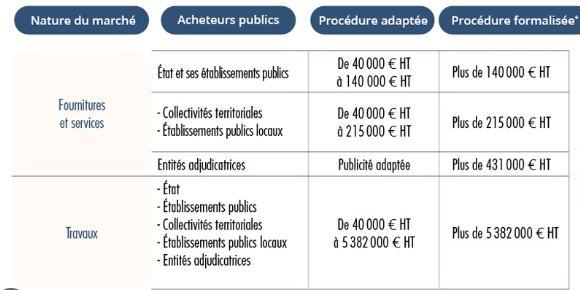
Once published, these tenders appear on a “buyer profile” (a kind of directory listing public procurement contracts). The only snag: there are a great many directories! Do not panic, plenty of software exists (Propizi, for example) to help you identify opportunities.
On the question “can an SME bid for a public procurement contract?”, the answer is of course YES! The Government and the public authorities are encouraging more and more SMEs to hold public procurement contracts, so being an SME is a competitive advantage to put forward in your bid (provided, all the same, that you can demonstrate your technical and financial capacity to deliver the contract).
Finally there is the question of how: how do you respond to a tender? To keep it simple and concise, you need to put together a submission with a bid and an application. Most often, the exhaustive list of documents to be provided is set out in the tender rules (règlement de consultation, or RC). Feeling lost? Do not panic, the Prime Conseil teams are on hand to help.
In short, public procurement is a field that has to be tamed, but once mastered it is an oasis of opportunity.
2. Target and segment according to your value proposition
On one side, public procurement represents around €200bn a year and hundreds of thousands of tenders.
On the other, public buyers (who go by the gentle name of contracting authority) can, depending on the contract, receive a great many bids.
Putting these factors together (an abundance of both supply AND demand), you will appreciate that it can be risky and poor on return to bid for too many tenders (at least to begin with).
So identify, in the light of your value proposition and your strengths and weaknesses (time to dust off your SWOT), the market segments you want to position yourself in.
Once again, our teams continuously analyse the DECP (données essentielles de la commande publique, the essential public procurement data). This helps us understand how public buyers behave, so you can make the best positioning decisions.

3. Build relationships with public buyers and partners
Building relationships with public buyers can help you win contracts (entirely lawfully).
To do so, attend events, meet-ups and other networking conferences, or sessions presenting the procurement programmes or plans of ministries, local authorities and the like, and make sure you follow up with the contacts you meet.
More spontaneously, you can also ask to meet public procurement managers to discuss your business and how you can help them achieve their objectives. A dialogue is possible as long as it takes place before a contract notice is published.
Buyers are not the only stakeholders with whom building relationships is essential. Creating and maintaining relationships with an ecosystem of partners and subcontractors is just as essential if you are to bid for significant tenders where you will pool resources, expertise and financial strength.

4. Think “problem-solution”
Far too many SMEs make the mistake of “flexing their muscles” when responding to a tender.
Yet, as is so often the case, the company that wins is not the one with the best solution, the best service offering or the best product, but the one that best answers a need!
So spend the time needed to read the tender documents (dossier de consultation, or DCE), which are generally packed with useful information (notably in the RC, the CCTP, and sometimes the BPU/DQE) that will help you understand what is driving the public buyer to publish a tender.
Also, still with the aim of providing the answer best suited to a need, always keep an eye on the award criteria (technical/price) so you know which parts of your bid to emphasise.

5. Get support!
We could not end this article without telling you about our expertise and our services!
To take your first steps in tendering, why not call on experienced consultants who will help you ask the right questions and so save time and money in responding.

Conclusion
By following these five tips, an SME can significantly increase its chances of winning public procurement contracts.
Patience and perseverance are certainly key virtues, but good news can arrive much sooner than expected.
Whatever happens, use these bidding experiences to improve your positioning and your offering, building on the data gathered during these procedures.