

In many organisations, the procurement function is now solidly structured, equipped and professionalised. Contract management, for its part, is still often seen as a client-facing discipline, called upon once the contract is signed, when the first difficulties arise. That view is reductive, however, particularly when you look at how supplier contracts are actually performed and, by extension, at the performance of your supply chain. On closer inspection, it quickly becomes clear that “supplier contract management” is neither an extension of the procurement process into legal territory nor an organisational luxury: it is a central lever of performance, risk control and value creation.
This article sets out to decode the interactions between buyers and contract managers, and to offer a few good practices for building a contract management dimension into a procurement process. As is often the case in contract management (even if the trend is towards standardising processes), it is difficult to define a single model, but practice and the literature nonetheless offer keys, methodological markers and good practices for bringing these two functions together, both in terms of process and in human terms.
1. The procurement process, an organisational backbone
The procurement process can be defined as all the steps an organisation goes through to acquire the goods or services it needs to operate. This definition, widely shared in the professional literature, is a reminder that procurement is not a one-off act but a chain of structuring decisions, from the expression of need through to payment and close-out, taking in sourcing, tendering, negotiation, contracting and performance monitoring.
In a broader sense, the procurement process fits within the logic of Procure-to-Pay (which SAP defines far better than we do in this article), which aims to ensure continuity between the purchasing decision, delivery of the service and the financial flow. It is therefore not only about selecting a supplier at the best price, but about guaranteeing that what has been bought will actually be delivered in line with the organisation’s expectations, under the economic and operational conditions agreed.
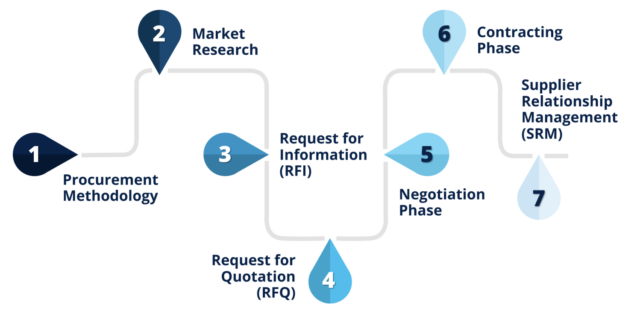
This is precisely where the contractual dimension comes into its own. The supplier contract is not a mere legal instrument or document: it formalises choices, trade-offs, assumptions and an allocation of risk. In other words, if the procurement process creates value, it also generates commitments, sometimes with heavy consequences. Without structured contractual steering, that potential value can quickly turn into losses, disputes or operational drift.
2. Why embed contract management in the procurement process?
Embedding contract management in the procurement process is not a passing fashion. It answers a very concrete economic and organisational reality. Many entities (not least contracting authorities and industrial players with a B2G business model) are, by nature, organisations that rely largely on the performance of their suppliers. And that performance depends directly on the quality of delivery and of the contractual relationship.
In these organisations, supplier contract management is neither a luxury nor a “nice to have”. It sits at the heart of the business model. Every supplier contract commits resources, timescales, responsibilities and sometimes the very functioning or reputation of the organisation (the availability of a surface vessel is critical for a Ministry of Defence, just as that of a nuclear power plant is to guarantee energy supply and sovereignty). Treating contract management as a client-facing discipline therefore means ignoring a large part of many organisations’ business models.
In that sense, embedding contract management in the procurement process allows some organisations to create a logical continuity between upstream and downstream, and others to optimise the way they operate as a whole. Decisions taken during sourcing or negotiation find their operational expression during performance. Conversely, the difficulties met during performance should feed future procurement strategies. This virtuous loop only exists if procurement and contract management work in a coordinated way, with a shared view of the contract lifecycle.
3. Procurement and contract management: a question of process… and of people!
The relationship between procurement and contract management is often discussed in organisational terms: reporting lines, remit, governance. These questions matter, but they are not enough to explain why some organisations manage to make this relationship work, while others struggle to get beyond silo thinking.
The relationship between buyers and contract managers is above all a human one. It brings together profiles with different backgrounds, reflexes and, at times, priorities. To take a few shortcuts, the buyer is traditionally geared towards pre-signature activity such as negotiation, price competitiveness and placing the order. The contract manager focuses more on the performance phase, ensuring consistency between the contract and the field, the quality of the relationship during performance, the security of commitments and the management of risks and opportunities over time.
The point is not to let one logic prevail over the other, but to strike a balance. That balance rests on clear processes, but also on mutual recognition of expertise. When contract management is seen as a counterweight or a brake, the relationship becomes strained. Conversely, when it is brought in as a partner to the procurement function, it helps to inform decisions and make them more robust.
Organisationally, certain good practices recur in mature organisations. Formalising roles and responsibilities across the contract lifecycle is an essential foundation. Likewise, separating the procurement function from the contract management function, ideally reporting into different departments, avoids asymmetries and encourages a balanced dialogue. Finally, aligning the set-up with the organisation’s culture and business model is essential: a process disconnected from operational reality remains a dead letter.
4. Setting up contract management: audit, formalise, support
Creating or strengthening supplier contract management is almost always a transformation project. Like any change, it meets resistance: fear of losing territory, misunderstandings about roles, worries that processes will become needlessly complex. This resistance is rarely rational, it usually reflects a lack of clarity about the purpose of the set-up.
That is why any serious approach begins with an audit of the existing situation. The point is not to start from a blank page, but to understand how procurement and contracts are actually managed, beyond the procedures as they are supposed to exist on paper. On that basis, it becomes possible to design and formalise a target operating model, suited to the organisation’s maturity and specific challenges.
Change management is the third step, and often the most underestimated. Training, raising awareness, explaining, reassuring: these actions are essential if supplier contract management is to be seen not as an extra constraint but as a tool serving collective performance.
5. Who does what? The killer question
The question of “who does what” between buyers and contract managers comes up every time. It is legitimate, but it calls for a nuanced answer. There is no universal recipe: the split of roles depends on the organisation’s culture, the maturity of the teams and the nature of the purchases involved.
The work carried out by the AFCM nonetheless sheds a structuring light on this. The interface sheets it has produced identify twenty-one points of contact between procurement and contract management across the contract lifecycle. The top ten of these interfaces shows a marked concentration on the post-signature phase (7 out of 10), that is, on performance. Here is a summary of the AFCM’s top ten interfaces:
- Contract analysis and briefings, clarification of requirements, milestones and deliverables
- Support on applying flow-down or back-to-back provisions
- Help with reviewing and approving tender documents
- Identification and treatment of Contractual Risks and Opportunities (ROCs)
- Contract review and negotiation support
- Support and advice on contractual exchanges and correspondence
- Support in handling contractual gaps and deviations
- Help in handling claims
- Support in the contractual handling of certain crisis situations
- Raising awareness and training procurement teams in contract management.
This finding reflects a widely shared reality: historically, contract management has stepped in where the difficulties become visible. That does not mean its role should be confined there. Other approaches, notably English-speaking ones, offer a more integrated view, clearly separating pre- and post-signature while organising numerous feedback loops between procurement and contract management. On this point, we can cite our neighbours across the Channel who, through projectdelivery.gov.uk, set out a highly integrated view of how government acquisition contracts are awarded and managed. Here again, a fairly clear distinction is drawn between pre-signature and post-signature, handled respectively by procurement on the one hand and contract management on the other. That said, the feedback loops and interactions (see the diagram below) are numerous and show that the work is seen as highly integrated rather than siloed
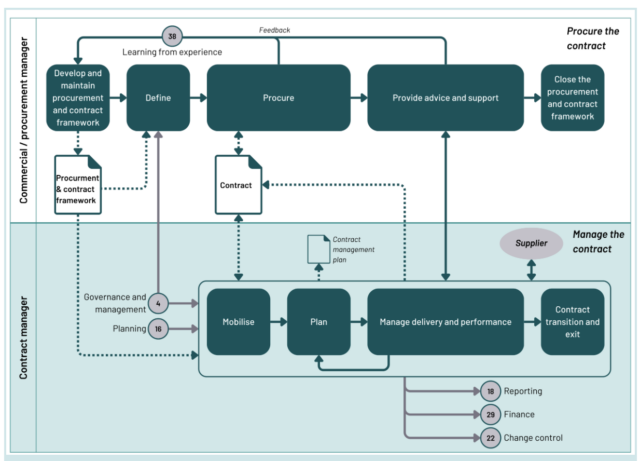
In every case, the aim is not to compartmentalise but to smooth the interactions by setting out a “who does what” in a simple, clear and intelligible way, while leaving room to revisit that split according to a range of factors such as changes in headcount, the maturity of the organisation, and so on.
6. Gradually moving contract management upstream in the procurement process
Confining contract management to the performance phase would be a caricature. Involving it upstream in the procurement process has an obvious strategic benefit. During sourcing or tendering, the contract manager can help to anticipate risks and opportunities better, to build more robust contract templates and to read critically the commitments proposed by suppliers.
That said, it is understandable that many organisations choose to start with performance. Post-signature performance monitoring is often neglected by procurement, for lack of time. Yet it is precisely in this phase that value is lost. Starting with performance is therefore a quick win: it quickly demonstrates the usefulness and added value of supplier contract management, before gradually extending its scope upstream.
Conclusion
Every organisation builds its own articulation between the procurement process and contract management. There is no single model, and no fixed boundary between the two functions. One certainty does stand out, however: supplier contract management is neither optional nor an organisational whim.
In an environment marked by complex value chains, pressure on margins and greater exposure to risk, the ability to steer supplier contracts in a structured way is a major performance lever. When it is fully embedded in the procurement process, contract management does more than secure: it informs decisions, strengthens the consistency of commitments and helps turn contracts into genuine strategic steering tools.