

In the construction, energy and major infrastructure sectors, the contract manager sooner or later comes across a FIDIC contract. That is how they may cross paths with the Red Book, the oldest and most widely used of the FIDIC forms, the one that serves as the reference on a large share of works projects where the employer controls the design. Knowing it in detail, knowing when it applies, and knowing what separates it from the Yellow Book is part of the contract manager’s basic toolkit on construction and infrastructure projects.
This article offers a concise but complete reading of the Red Book: its definition and its place in the FIDIC suite, the way it is organised, the central role of the Engineer, the payment, variation and claim mechanisms, dispute resolution, and then a quick comparison with the Yellow Book.
The Red Book in brief
Although it is called the “Red Book”, this contract’s full name is “Conditions of Contract for Construction”, a rather ambiguous title. The logic fits in one sentence: the employer provides the design, and the contractor executes the works in accordance with that design. The form allows for some elements to be designed by the contractor, but it stops being suitable as soon as the bulk of the design falls to them. In that case, you turn to the Yellow Book or the Silver Book, which are built for design-and-build.
A quick historical detour explains this positioning. The very first FIDIC form, published in 1957, quickly became known as the Red Book because of.. the colour of its cover (you could not make it up!). Modern editions have dropped the civil engineering reference from the title, and that removal is not incidental. It marks the shift from a logic that classified contracts by the nature of the works to one that classifies them by how design and risk are allocated between the parties. The Red Book therefore applies today to any construction operation where the employer is responsible for the design. The reference edition (as at today) is the 2017 edition, revised in 2022, which succeeded the 1999 version. To give an idea of how the form has thickened over time and how deal structures have grown more complex, the Red Book went from around sixty pages to more than a hundred between 2009 and 2017!
For an overview of the FIDIC family and its origins, you can read our article “What is a FIDIC contract”, which is intended to set the scene more broadly. Below, at the end of the article, you will also find a fairly simple infographic to situate the Red Book (or livre rouge in French) within the FIDIC suite of contracts.
How is the Red Book structured?
It is often said that a FIDIC contract can look exotic at first glance. Like the other contracts in the FIDIC suite, the Red Book combines general conditions, common to all projects that use it, and particular conditions, which tailor the form to the case at hand. Together they form the conditions of contract. The Red Book also provides drafting guidance, as well as various security templates, parent company guarantee, advance payment guarantee, retention money guarantee, which the parties activate as required. It ends with standard forms, letter of tender, appendix to tender, contract agreement and dispute adjudication agreement.
This architecture has a practical consequence that practitioners know well. The standard form does not, on its own, carry the balance of the contract. In most cases it is the particular conditions, the technical requirements and the appendices that decide the real risk allocation. Amending the form without mastering its internal consistency introduces ambiguity, and a good share of disputes originate there. That is how, in practice, you often end up with a contract that is a “FIDIC base” but which has in fact been heavily adjusted.
A few key points of the Red Book
The role of the “Engineer”
At the centre of the Red Book sits the Engineer (or l’Ingénieur in the French version), engaged and paid by the employer. Its main role is to administer the contract day to day: it issues instructions, certifies payments and declares completion of the works. It is the contractor’s permanent point of contact and its decisions set the rhythm of the site.
Its position has a particular feature that deserves attention, and that often puzzles the uninitiated. That peculiarity stems from the fact that when the Engineer has to decide a question or settle a claim, it consults each of the parties to try to reach agreement, and failing agreement, it issues a fair determination taking account of all the relevant circumstances. So although appointed by the employer, the Engineer is entrusted with a duty of impartiality when making determinations, and the 2017 edition reinforced that requirement of neutrality. For the contract manager, this (sometimes precarious) zone of balance is a playing field: it is managed by documenting positions, anchoring them in the contract and preparing determinations rather than being subjected to them.
Payment, variations and changes
Under the Red Book, remuneration is by default on a measurement or BoQ (bill of quantities) basis. The quantities actually executed are measured and valued by applying the unit rates in the schedule. In practice, the contract also allows for lump sum payment where the nature of the project lends itself to it. The contract manager is therefore expected to steer the choice of the most suitable method in the upstream phases of the contract lifecycle, but also to follow contract execution very closely on a measurement basis, since quantities are verified as work progresses, through joint measurement, and not solely on the basis of a price fixed once and for all.
Finally, since construction projects rarely run in a straight line, the Red Book frames changes. The employer can change the works through variations, for which the contract sets the valuation and pricing rules. Careful management of these changes, tracked and valued in accordance with the prescribed procedure, prevents them from turning into sources of disagreement.
Claims, deadlines and notices
The contract also organises the handling of claims, in both directions, and of extensions of time. This is where a decisive part of contract management & administration plays out. The Red Book stresses strict compliance with the time limits attached to notices, claims and responses, and failure to meet those time limits can result in the loss of an entitlement, regardless of its merits. Many projects do not lose their claims on the substance, but on form or procedure, for want of having given the required notice within the contractual window. Rigorous management of deadlines and of contemporaneous written records weighs just as much here (if not more) than the quality of a claim built after the fact, which is why claim monitoring is best handled from day one, and not when the dispute erupts. On analysing the consequences of a delay, our article on Time Impact Analysis sets out a proven method, and the very notion of a claim is covered more broadly elsewhere.
Unsurprisingly, this Red Book contract form also provides for delay penalties (liquidated damages), which the employer can apply when the contractor fails to complete within the agreed time. These penalties, whose amount and cap generally appear in the particular conditions, are one of the financial levers of the contract and deserve to be anticipated rather than discovered.
Taking over, warranties and defects
The contractor’s commitment does not stop at completion. The Red Book provides for tests and commissioning intended to verify that the works conform to the requirements, followed by a defects warranty period, the “defects liability period” (often called the DLP), during which the contractor remains obliged to make good any defects that appear. This phase extends the contractual relationship beyond delivery and calls for the same documentation care as the rest of the works.
Dispute resolution
The Red Book puts in place a rather healthy escalation for resolving disputes. The Engineer’s determination (the role discussed above) is the first step. Where it is not accepted by one of the parties, the dispute is taken to a Dispute Avoidance/Adjudication Board, the famous “DAAB”, whose remit includes preventing disputes upstream, and not just resolving them (experienced contract managers will remember the dispute adjudication board that applied before the 2017 edition). DAAB decisions are in principle binding but temporary, until resolution by agreement or by arbitration. As a last resort, the dispute is settled by international arbitration. On multi-party and often multi-jurisdictional projects, this chain is no formality, it shapes the whole management of litigation risk.
Red Book or Yellow Book? Design as the dividing line
The most structuring difference between the two FIDIC forms lies in the design, and almost everything else flows from it. Under the Red Book, the employer provides the design and retains tighter control over the specifications, the materials and the sequencing constraints. It therefore keeps the exposure to errors or shortcomings in that design, and disputes then frequently concern variations, drawing revisions, design inconsistencies and buildability issues.
Under the Yellow Book, the contractor designs as much as it builds (these are often referred to as EPC contracts). The employer gives up part of its control in exchange for a cleaner transfer of responsibility, and the discussion shifts to performance, to how well the design meets the requirements and to the quality of the employer’s requirements. Our article dedicated to the Yellow Book explores this design-and-build logic in more depth.
Behind this choice lies a trade-off that any project management or executive team would do well to state clearly. More control generally comes with more internalised risk. Conversely, more transfer means a higher price combined with less influence over design choices after signature. In practice, we see some employers choose the Red Book because it is familiar to them, only to find that they have retained risks they thought they had transferred, particularly where the design was not sufficiently advanced at the tender stage.
Finally, one point deserves emphasis, because it applies to both forms. The colour of the cover does not carry the risk allocation on its own; it is the particular conditions, the employer’s requirements and the technical appendices that most often decide the outcome. A FIDIC contract has to be analysed and managed, it cannot be reduced to the colour of its cover.
Which FIDIC contract for which project?
Beyond the Red Book vs. Yellow Book divide, the thinking belongs to a broader project configuration logic. The Green Book targets simple, low-value operations. The Red Book matches works designed by the employer. The Yellow Book covers design-and-build entrusted to the contractor. The Silver Book addresses EPC or turnkey contracts, on a lump sum basis, where the contractor bears most of the risk. The Gold Book, finally, adds operation and maintenance to design and construction, which makes it suitable for public-private partnerships. The flowchart below summarises the decision path from one book to another.
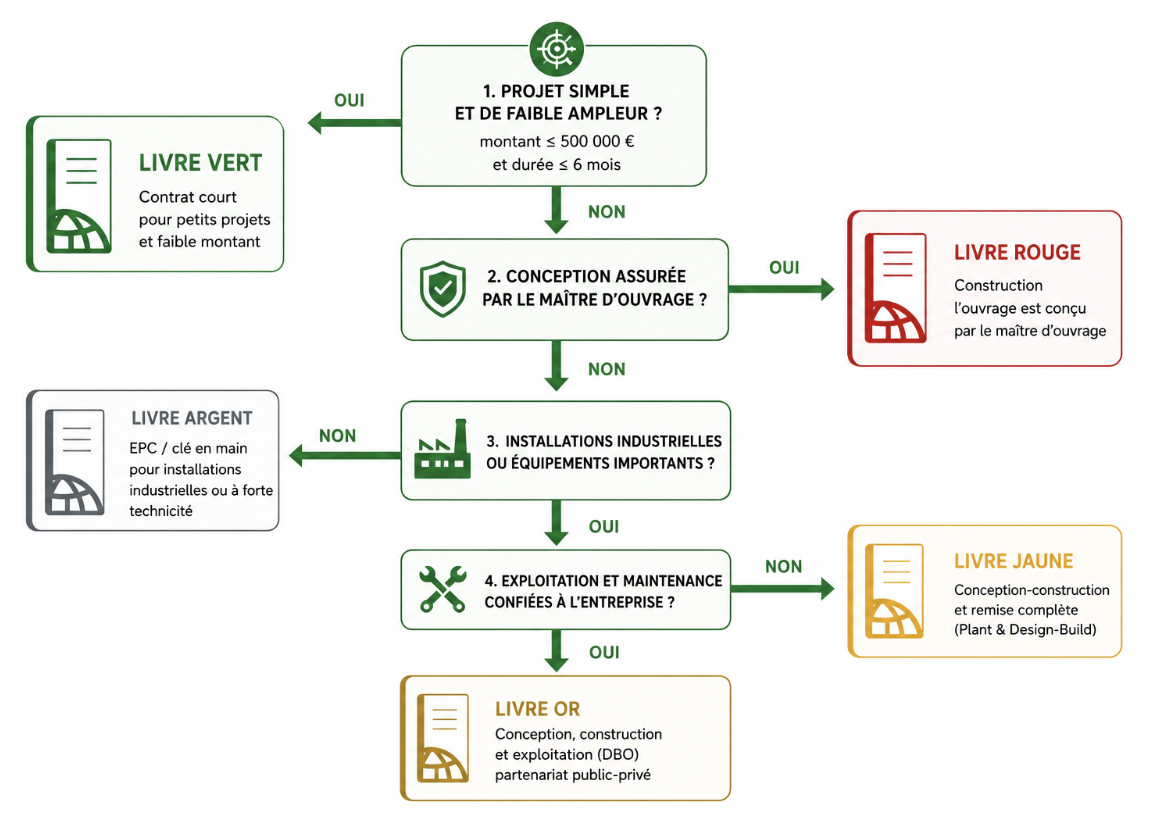
But coming back to the Red Book, in summary it generally applies when the employer has a sufficiently mature design and wants the contractor to build on that basis, with tight control over the specifications.
Red Book: a few points to watch
A few aspects call for sustained attention when running a Red Book contract, and FIDIC contracts more generally. First, the adjudication mechanism is best understood early, both in its time limits and in the scope of the board’s decisions, which are at once binding and provisional. Managing claims and variations requires knowing the admissible grounds and the valuation procedures, and documenting them relentlessly. Compliance with contractual time limits remains decisive, since a late notice can defeat an otherwise well-founded entitlement. The freedom offered by the particular conditions is an asset, but it can introduce risk when the form is amended without the necessary overall understanding. Risk allocation, finally, deserves close examination before signature, particularly on site conditions, delays and cost increases, because a clear allocation prevents a good share of disputes and prepares their management. To this must be added the management cost inherent in these contracts, which have become dense, and which calls for contract surveillance, documentation and claim monitoring, and justifies bringing in a dedicated contract manager.
Conclusion
The Red Book offers a proven contractual framework, recognised worldwide, for works designed by the employer. Using it well rests on two things: understanding the risk allocation it organises, starting with responsibility for the design, and managing the contract actively, from tracking notices through to the defects liability period. The choice of a FIDIC contract form, including the Red Book, is not settled by preference, but according to the reality of the project, the maturity of the design and each party’s capacity to bear the risk allocated to it. Well chosen and well administered, the Red Book remains one of the most robust instruments for delivering a large-scale construction project.