
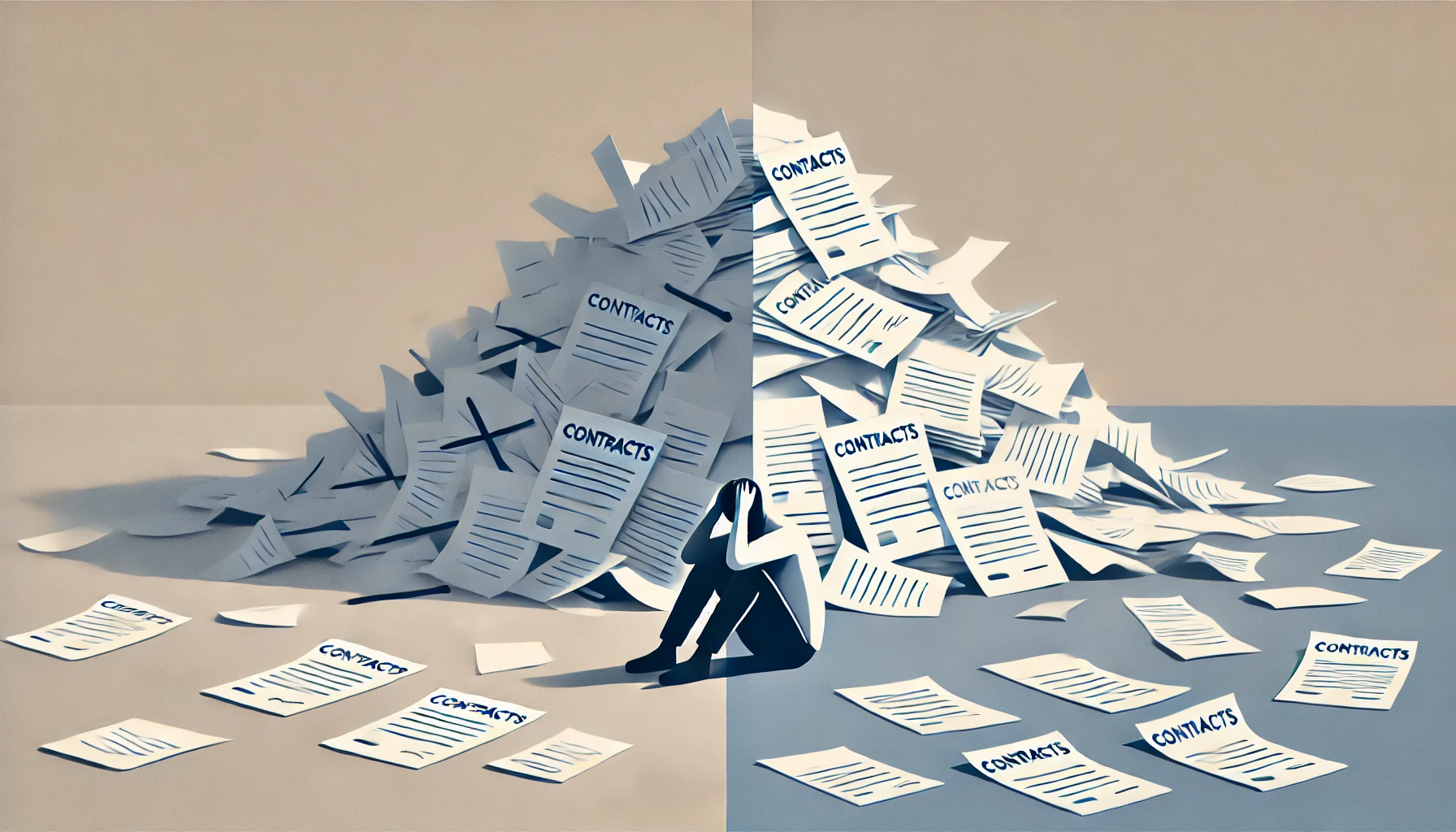
The contract template is riding high: everyone wants their own, to use as a working basis and save time in the pre-signature phases of the contract lifecycle. But are contract templates the answer to every ill? Does putting them in place really save time?
From the title and the questions that close the paragraph above, you will have guessed that our view on this is decidedly mixed! As contract management consultants, we have a ringside seat: we see this drive to industrialise everything (to “templatise”) at a good number of our clients, and we have picked up a few good practices along the way… as well as some bad habits. In this article, we go back over those best practices and the pitfalls to avoid when setting up contract templates.
I. The pitfalls to avoid when setting up contract templates
A. Contract = legal department
The first stumbling block, and not the least of them, is to hand the whole project to the legal department. At first sight that may seem logical: after all, who better than a legal team to understand the subtleties of legal clauses? Yet it is a strategic mistake. The legal department, expert though it is, only steps into the contract lifecycle at a few specific moments. So why entrust the creation of a contract template to those who will not be its main users?
The teams that will handle the contract day to day – whether in procurement, sales, projects or contract management – must play a central part in designing the templates. They are the ones who face the realities on the ground: negotiations with suppliers, discussions with clients and management of partners. But beyond any ideal profile, the best solution is to adopt a collaborative approach, involving all stakeholders so as to create a template that genuinely reflects operational needs.
B. The “one size fits all” effect
Have you ever bought a garment or an accessory in a single size (“one size fits all”)? Do you know the saying “good at everything, good at nothing”? In short, you get the idea: one contract template cannot suit every situation. Trying to create a single template capable of covering several contexts means designing a document that is both complex and ill-suited.
That “universal” template ends up needlessly heavy, because it includes far too many clauses that are superfluous in some situations, while remaining incomplete for others.
The result: long, complex negotiations punctuated by misunderstandings. Much of the content is beside the point in the case at hand, and what should be a simple working tool turns into a brake on collaboration. Worse still, it can create tension between the teams that draft, those that negotiate and those that have to implement the contract. A bespoke approach, tailored to each type of contractual relationship, is therefore essential.
C. Clauses within clauses, within clauses, and so on
A contract is neither a chest of drawers nor a storage unit. Unless you want to create a sort of administrative escape game (a contractual “squid game” where only one person makes it out alive), it is time to put these devices away for good!
Clauses within clauses, sub-clauses within those, and other internal notes are neither read nor understood. Use clear, simple, concise language. A contract gains nothing from being cluttered with obscure mechanisms that only add to the confusion. Remember: a simple contract is an effective contract.
II. Best practice in contract drafting
A. The contract: a team sport
It cannot be said often enough: contract management – and by extension the contract – is everyone’s business! A jointly built contract stands a far better chance of being clear, concise and effective. So, to build a contract, you should try to assemble the best possible team.
To continue the sporting analogy, while the work is collective it is essential to appoint a “captain” (or project lead) to guide the various players. When setting up a contract template, that role is critical to making sure the template heads in the right direction and takes on board the perspectives of everyone concerned, whether operational, commercial, legal or project management teams. Working together avoids both gaps and duplication, while producing a robust and relevant document.
B. The end justifies the means
Before rushing into drafting a contract template, you first need to think about the end goal. What are your organisation’s objectives (profitability, order intake, risk protection, and so on)? Should the contract be very short, to contain the time spent negotiating because deadlines are close (bid submission, and the like)? Or should it be comprehensive enough to anticipate later phases of the project? Should it follow a particular structure to make implementation easier? In short, these are all questions to be asked BEFORE diving headlong into drafting.
Every project has specific needs, whether reducing the page count, simplifying processes or guaranteeing fast negotiations. Those objectives must guide the creation of the template, allowing drafters to work within the frame and avoid adding pointless clauses. A clear approach from the outset fosters not only alignment between teams but also the creativity of the drafting teams which, instead of compiling standard clauses, will then seek to innovate, to create value through the contract by devising wording better suited to the use case.
C. Favour the checklist-plus-clause-library pairing over the contract template
The most agile method for drafting a contract does not necessarily rest on a pre-established template. All too often, templates end up weighing the drafting process down, forcing you to reverse-engineer the document to adapt it to specific needs.
Instead, a checklist or an upfront questionnaire makes it possible to identify the relevant clauses to include. This modular approach saves time and ensures that every clause chosen is useful and necessary. Some contract lifecycle management (CLM) tools support this approach by automatically assembling the relevant clauses from the answers to a form. That makes the process not only faster but also more accurate.
Conclusion
At first sight, contract templates can look appealing and a good lever for industrialising the upstream phase of the contract lifecycle, but they are not a universal solution. As contract management consultants, we can only recommend adopting a bespoke approach (or a made-to-measure one, for those in the know) tailored to the specific needs of each project.
Simplicity, clarity and collaboration between teams are the keys to creating effective, agile contracts while avoiding the pitfalls of a standardised approach. Technology can usefully lend a hand here to legal, contract management, operations and other teams, and can digitalise and automate certain tasks such as building intelligent clause libraries with Dilitrust, or setting up forms, for instance with OneFlow.