
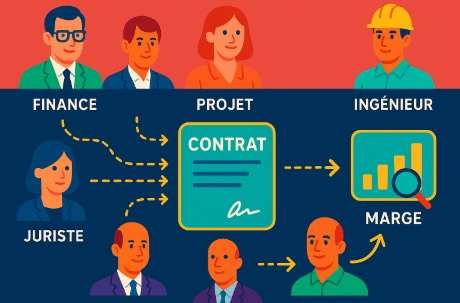
The title of this article is a (loose) translation of the title of a report published in September by the renowned association WCC. Beyond the title, which is not the most operational (what exactly is a “smart” contract?), this report addresses a subject that has always fascinated me and which shapes the way we practise contract management at Prime Conseil: the relationship between contracts, data and economic performance!
The report opens with an interesting statistic: 20 years ago, contracts were managed by finance departments in 30% of companies. That figure has now dropped to 10%, reflecting the rise of the legal function amid an increasingly complex business climate! While my first reaction was to welcome the rise of legal, and the underlying recognition by companies of the value of contracts, the corollary of this statistic is that the economic and financial performance of contracts has gradually been sidelined in favour of compliance and risk management.
Contracts have thus progressively established themselves in the day-to-day life of our organisations, but through a very (too?) legal lens, sometimes to the detriment of other equally essential economic and financial parameters (as illustrated by another statistic from the report: 69% of the 200 organisations surveyed acknowledge a disconnect between contracts and financial performance). This is precisely the point of the report, and of this article: to attempt to realign the various stakeholders in a contract around a shared objective, namely making the contract a dynamic tool serving the company's (economic) performance.
With the scene set, it's time to move from observation to action. How can we reconnect contracts and financial performance? How can we align lawyers, buyers, finance professionals, salespeople and other contract stakeholders around a common goal? In our view, and partly in line with this study, there are three levers to pull:
1. Making the most of contract data
Contracts, when you set aside the wording itself, are an incredible source of data: start dates, milestones, end dates, payment terms, invoicing terms, notification periods, response times, warranty durations, and so on.
These are all data points that companies use far too little. Some will object, pointing out that they scrupulously track deadlines and renewal dates via a CLM or contract repository.
Well, yes, practices have evolved over the past decade. However, they have remained confined to contract administration (see our article on the difference between contract management and contract administration). Using data to improve economic performance cannot simply mean receiving an automatic notification to send a termination letter, or generating a top-10 list of contracts in a CLM.
In contract management, data could be used to go much further, by identifying patterns and weak signals. To illustrate this with some examples, imagine:
In the construction sector: it would be possible to cross-reference the nature and identity of partners (engineering, civil works, assembly, cabling, etc.) with the float/slack in the original schedule, the initial margin sold versus the margin at project completion, and the project type (greenfield, brownfield, etc.) to identify recurring patterns of delays or losses, or the project events most likely to cause delays and/or cost overruns;

Another example, in the IT sector: it would be possible to cross-reference price differences between players in a given segment, the (particularly financial) terms of reversibility, with the actual reversibility durations and reported incidents or downtime, in order to individualise, improve and anticipate (for each major segment of an information system) the duration, amounts and contractual reversibility conditions imposed on suppliers.
Reading these examples, I can imagine some readers thinking they already do this, or have done it before. The point here is to systematise this approach, to collect as much data as possible, and to gradually delve into the detail that (ultimately) makes all the (financial) difference. To further illustrate this notion of detail with a subject we know particularly well: is your organisation able to determine which type, amount and/or duration of project should be assigned a dedicated contract manager, versus one managing a portfolio? What difference in performance can be observed with the presence of a contract manager? These are all questions to which data can (while not providing binary answers, since every situation is unique) bring valuable insight.
Here, I'm sorry to say, there's no ready-made template or single method. What matters is asking the right questions in light of your industry, business model and corporate culture. To keep with the thread of the WCC report, it has been shown that companies implementing this data-driven approach to contract management improve their margins by 5.4%.
2. Embedding financial performance into processes and methods
A “smart contract”, to use the report's title, isn't just about data or digital tools. Indeed, while the report focuses heavily on CLM and digital tools (the report is sponsored by Icertis), the reality is that, from a purely material standpoint, a contract is… just a string of characters.
To intelligently collect and use data from these contracts, you need processes and methods. Software can certainly come into play afterwards, but starting by thinking about CLM is often a serious mistake.
Whether it's about reducing friction in the contract lifecycle by identifying duplication, slowdowns and dysfunctions, setting up internal processes for bid review, contract review, centralising information (risks and opportunities, but also negotiation dynamics), or project and contract governance, there is plenty of work to be done to reach excellence.
These actions can include creating templates, standard analysis grids, and negotiation playbooks. Examples abound, but the pitfalls are twofold: on the one hand, trying to standardise everything, at the risk of stifling creativity; and on the other, creating overly cumbersome processes that won't be applied in practice. The right balance needs to be struck, and above all, an iterative approach is needed so that proportionate and effective actions are taken.
Among the best practices and tools we have implemented with our clients, we can mention:
- Greater involvement of finance throughout the contract lifecycle (not only at pre-signature validation milestones)
- Raising awareness among other project stakeholders of key financial fundamentals and issues (bank guarantees, provisions, budgets, valuation of additional works, etc.)
- Incorporating parameters linked to the financial performance of contracts and projects into the remuneration packages of other stakeholders in the contract lifecycle
- Adding clauses and contractual mechanisms for automatic revision based on the occurrence of specific events
- Etc.
Once these actions have been implemented, another WCC study (which we have also analysed) shows that maturity in contract management methods and processes can prevent up to 8% of value leakage from your contracts.
Here again, the study (quite deliberately) talks about the contribution of automation and AI to improving these processes. The reality, at least as we experience it with our clients, is that the current maturity of AI in CLM systems does not yet allow complex projects to be handled effectively.
3. Don't neglect the human factor and interfaces
Finally, let's talk about the essential element: people! So far, we've discussed data that brings contracts closer to finance, as well as processes and tools that streamline negotiation phases and contract execution, thereby helping to improve economic performance.
The third lever for (re)connecting contracts to financial performance lies in people. In the relationships between the various contract stakeholders, in the involvement of finance professionals and management controllers throughout the contract lifecycle, but also in non-financial stakeholders' understanding of financial issues.
According to the WCC study, 69% of respondents believe that legal and financial concerns are not aligned during contract negotiations:

Beyond this striking figure, the study also offers some concrete examples, illustrating the misalignment between finance and procurement, and proposing solutions:
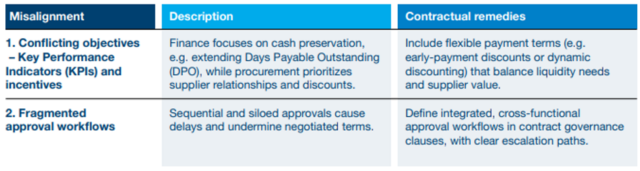
Beyond these simple, everyday examples, there is an endless number of other illustrations that could be added within every company. Here again, the idea is first to identify what could be improved, whether through workshops, audits or even (where data sources exist) data crunching, and then to find pragmatic, contractual solutions, notably through the involvement of a contract manager who will know (this is, after all, their role) how to understand everyone's interests and bring them together in drafting that is more agile than that of a lawyer.
The contract manager's role doesn't stop there, since maintaining links between project stakeholders, ensuring the smooth internal flow of information, and the timely, active involvement of all internal contributors are all part of the contract manager's “side quests”, whose role as an interface has never been more relevant.
These activities demand many qualities from the contract manager, who, in addition to their contractual expertise and technical understanding, must act as a binding force to preserve the connective thread linking the many stakeholders together. Looking at the bright side, organisations that recognise the strength of this connective thread as one of the contributors to a company's EBITDA will, by extension, recognise the added value created by contract management.
Conclusion
This study doesn't bring anything fundamentally new, but it does shine a light on a trend we've observed for many years: the lack of contractual alignment between legal and financial interests destroys value.
To address this, we believe there are three parts to the answer: data, processes and people, and one key player to bring legal and finance closer together for the benefit of economic performance: the contract manager!