
What place should leadership hold in the contract manager's role?
The contract manager's leadership is still too often seen as a secondary quality, useful in complex projects but distinct from the core of the job. This reading is reassuring, because it ties contract management to identifiable technical skills, but it reduces the role to what it produces, rather than looking at what it makes possible.
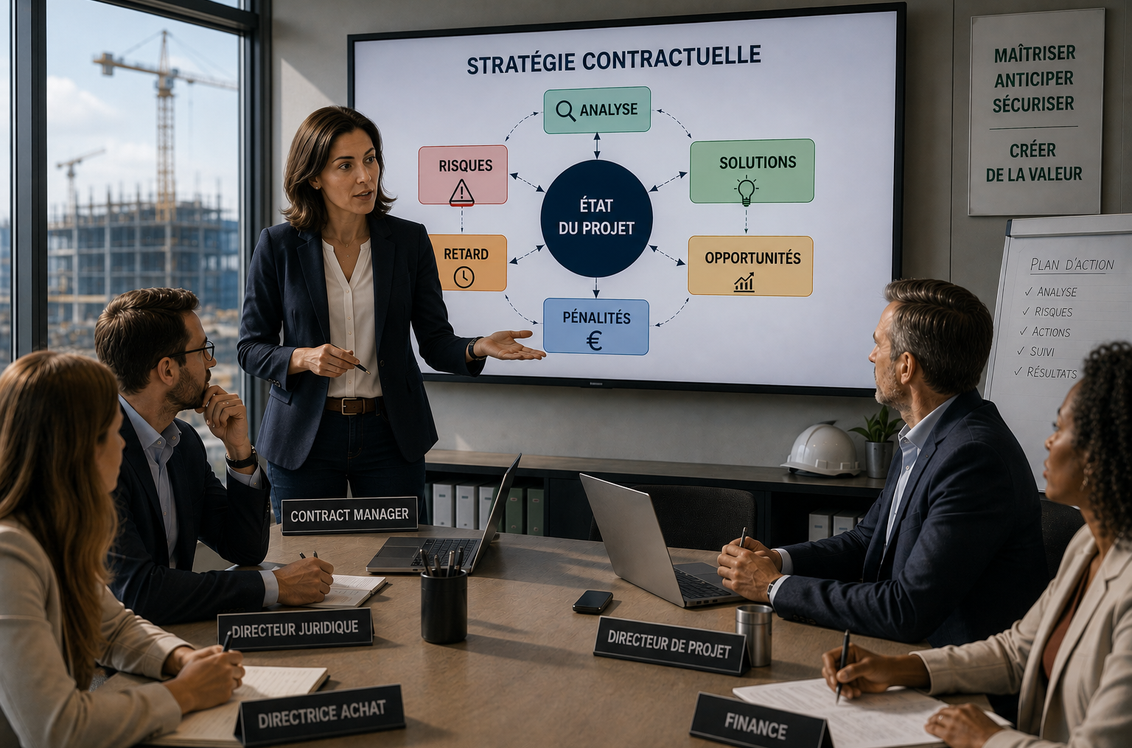
In the reality of a project, the contract manager is not only expected to analyse, qualify a risk or draft a letter. They are expected to inform decisions, take a stance, propose solutions and help teams regain control when the situation becomes tense.
This is where leadership stops being an additional quality. It becomes a requirement of the role.
Leadership as a stance
Even so, we need to agree on what we mean by leadership.
Many contract managers consider that they are not natural leaders, or that it simply isn't their profile. This reaction stems from a confusion between leadership and charisma, between influence and extroversion.
The contract manager's leadership has nothing to do with the ability to fire up a meeting room. It is a set of operational, concrete reflexes, learnt and trained, exercised in specific situations, with specific stakeholders, on specific issues. It is a way of occupying space within the project. Not by taking the place of others, but by bringing value that no one else can bring in the same way.
For a contract manager, developing leadership starts with becoming aware of what they actually contribute. They bring a contractual reading of situations, an ability to establish facts where impressions otherwise prevail, and an analytical rigour that turns critical situations into defensible positions, and even opportunities. Then comes the decision to make active use of this, rather than waiting to be asked.
A wait-and-see stance is perhaps the most common trap for a technically strong contract manager. Knowing without acting, analysing without communicating, identifying a risk without naming it, this lets the value they could create sit unused.
Trust as a foundation
But this active stance is not enough unless it rests on a relationship of trust.
This is undoubtedly one of the most important aspects of leadership. A contract manager cannot exert any influence if they do not inspire trust. And in a project environment, trust cannot be decreed. It is built through consistent, repeated behaviour.
This starts with open dialogue and authenticity. A contract manager who states their positions clearly, who says what they think without wrapping it in excessive caveats, creates the conditions for a reliable working relationship.
This also requires personal accountability. Standing by a position even when it is uncomfortable. Not hiding behind the idea that their role stops at analysis, when their contribution should actually help the project decide more clearly as pressure mounts. Holding a line, explaining it, defending it with determination. This is the kind of commitment that gives weight to the contract manager's word at critical moments.
Finally, there is a dimension that is often underestimated: clarifying one's own role. A contract manager who takes the time to explain to project stakeholders (internal teams, the client, partners) what they bring, why they are involved and how to work effectively with them, creates a climate of buy-in. They no longer simply endure their place in the project. They clarify it, they own it, and others know where they stand.
The moment of truth
This trust comes fully into its own when the project enters a period of tension.
It is in difficult situations that the contract manager's leadership is revealed, or not. When a project comes under strain, when the budget overruns, the schedule slips or the client relationship deteriorates, the contract manager cannot limit themselves to tracking and documenting the drift. Their role is to restore clarity to the situation, to distinguish between what is simply observation, what falls under the contract, and what can still be actioned to regain control.
They must then identify the available contractual levers, assess the additional costs that could be included in a claim, reconstruct facts that were insufficiently recorded, and help the project preserve its room for manoeuvre without needlessly damaging the relationship. The problem-solving contract manager carries out this analysis without being asked. They do it because they have understood that their role is not to observe difficulties, but to help the project get through them, with project profitability as a constant compass.
This should not be the sole concern of the project director or the financial controller. It is also, and fully, the concern of the contract manager.
The human dimension
But regaining control of a situation is never solely a matter of contract management.
A project under strain generates well-known mechanisms. Teams retreat into their own areas. Responsibilities get passed around without anyone taking them on. Tensions that had until then been contained rise to the surface and, if left unaddressed, end up paralysing decision-making.
The contract manager who can read these dynamics and respond to them constructively is the one who turns a deadlock into an opportunity to reset. This involves being able to identify levers for cooperation within a team under pressure, giving and receiving feedback directly, without ambiguity or harshness, and resolving conflicts before they harden into irreconcilable positions or, worse, disputes.
These are not incidental qualities. They are operational skills, on a par with drafting a contract amendment or analysing triggering events. A contract manager who develops them becomes, in practice, a valuable support for the project teams around them.
A stance to develop
This leaves one essential question: how is this stance developed?
What emerges from all this comes down to a simple conviction. The contract manager's leadership is not innate. Like any professional skill, it is developed through conscious effort and regular practice.
The first step is to become aware of one's own leadership strengths. This may include analytical rigour, the ability to hold a position under pressure, or in-depth knowledge of the contract lifecycle. The second is to decide to put these to active use, rather than reserving them for situations where someone explicitly asks for them.
The most effective contract managers found in the field are not necessarily the most charismatic. They are the ones who have understood that their value lies not only in what they know, but in how they put it to work for the projects and teams they support.
Conclusion
The contract manager's role carries a strong ambition: to contribute to project performance at every stage of its lifecycle. Not just by managing the contract, but by influencing decisions, securing positions, driving cooperation, and keeping profitability on track even when circumstances become complicated. This is precisely what the contract manager's leadership makes possible. And it is, today, what complex projects expect, even if they cannot always put it into words so clearly.